The Ministry of Economy, Trade and Industry will begin full-scale demonstration experiments of floating offshore wind power generation targeting areas with harsh weather and sea conditions starting in fiscal year 2027, through the New Energy and Industrial Technology Development Organization (NEDO). The background is the judgment that establishing floating technology capable of utilizing Japan’s vast Exclusive Economic Zone (EEZ) in Japan, where flat land is scarce, is essential for achieving carbon neutrality by 2050.
- Full-scale start in fiscal year 2027: Challenging harsh marine conditions
- Budget Scale and Demonstration Phase
- Entry into Exclusive Economic Zones (EEZs) and Legal Amendments
- Shortest Distance to Carbon Neutrality by 2050
- Beyond the past of “unprofitable.” Lessons from the Fukushima demonstration
- Establishing ‘Japanese-Spec’ Technology to Beat European Players
- Auction Price Fluctuations and Investment Predictability
- Port yards and ships. The ripple effects of a massive infrastructure industry
- Roadmap to the 15GW Target
- Regional Coexistence and Consensus-Building Model for Fisheries Rights
Full-scale start in fiscal year 2027: Challenging harsh marine conditions
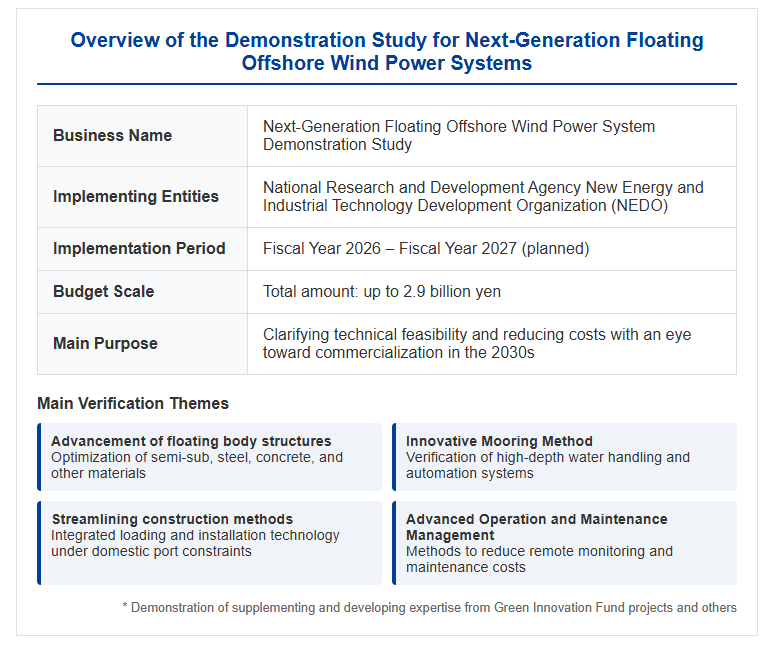
The New Energy and Industrial Technology Development Organization (NEDO), a national research and development agency, announced a public call for applications for the “Next-Generation Floating Offshore Wind Power System Demonstration Study” in March 2026, accelerating the establishment of technology for commercialization in the 2030s. This project will be implemented from fiscal year 2026 to fiscal year 2027, focusing mainly on demonstrations with actual sea area operations in mind. In particular, Japan is required to overcome unique challenges such as typhoons, severe waves, and complex seabed terrain. A major feature is the shift from laboratory-level studies to demonstrations in more demanding environments. The conceptual diagram of the demonstration is as follows.
Budget Scale and Demonstration Phase
This project is being carried out as part of the Green Innovation Fund initiative, with a total budget of up to 2.9 billion yen for fiscal year 2027. In fiscal year 2024, five projects have already been selected, including semi-sub and tension mooring (TLP) types, and in the new phase starting in fiscal year 2027, additional element technologies to complement these will be verified. Specifically, the scope is expected to include weight reduction of floating structures, conversion to materials suitable for mass production, development of automated mooring systems, and remote monitoring technologies that dramatically reduce maintenance costs. Practical solutions directly linked to social implementation, such as establishing construction methods that consider the constraints of domestic port facilities in Japan, are expected to go beyond simply improving power generation efficiency.
Entry into Exclusive Economic Zones (EEZs) and Legal Amendments
On April 1, 2026, the revised Renewable Energy Sea Area Utilization Act came into effect, expanding offshore wind development zones to include exclusive economic zones (EEZs). As a result, the vast sea area from the previously territorial sea (about 22 km) up to a maximum of 200 nautical miles (about 370 km) will be subject to development. In the demonstration experiment, installation in such deep offshore waters is also anticipated, and new criteria for securing business viability according to natural conditions are expected to be established. Preliminary marine environmental surveys by the Ministry of the Environment have also been introduced, aiming to reduce project uncertainty by visualizing environmental constraints at the initial stage.
[Background of Management and Strategy] Why is it urgent to reduce the cost of ‘floating bodies’?
Shortest Distance to Carbon Neutrality by 2050
Japan’s offshore wind power potential is overwhelmingly greater with floating types compared to fixed wind power. The government’s “Offshore Wind Industry Vision” aims to generate more than 15GW of projects by 2040, and mass production of floating turbines is essential to achieve this. Currently, shallow sea areas have already been selected as promising zones for the fixed-down type, and about 65% of the remaining areas in the preparation zone are deep-water projects based on floating body types. The establishment of floating technology marks Japan’s entry into the “last frontier” in expanding renewable energy adoption.
Beyond the past of “unprofitable.” Lessons from the Fukushima demonstration
In the past, the ‘Fukushima Floating Offshore Wind Farm Demonstration Research Project’ ended in a harsh result: despite investing about 60 billion yen, all units were dismantled in fiscal 2021 due to unprofitability. In this demonstration, learning from these lessons, emphasis is placed not only on safety and reliability but also on setting concrete numerical targets aimed at reducing the Levelized Cost of Power Generation (LCOE). Beyond mere technology development, the company is establishing a business model as a large-scale wind farm and is also considering fostering export industries through overseas projects.
Establishing ‘Japanese-Spec’ Technology to Beat European Players
Rather than simply introducing European precedents, the key to industrial competitiveness lies in developing ‘Japanese specifications’ technologies optimized for Japan’s harsh weather and maritime conditions. Currently, the biggest obstacle for floating types is that the power generation cost is higher than that of fixed types, and the question is how to compress this. NEDO’s public recruitment is expected to involve not only individual companies but also consortium forms that bring together domestic and international expertise, aiming to secure a competitive edge in the global market. Integrating the expertise of experts familiar with ships and floating structures to achieve innovative engineering for mass production is essential.
[Impact on Market and Stock Price] Building Supply Chains and Industrial Competitiveness
Auction Price Fluctuations and Investment Predictability
At an expert meeting held in July 2026, the maximum bid price for offshore wind power was raised to the maximum 700,000 yen per kW. This is up to four times the previous level, aiming to strengthen support for businesses struggling with profitability as a zero-premium project. If the floating cost structure becomes clear through demonstration experiments, institutional investors will become more predictable as targets for project financing. Toward full-scale adoption in the 2030s, market price formation and technological innovation are expected to proceed in parallel.
Port yards and ships. The ripple effects of a massive infrastructure industry
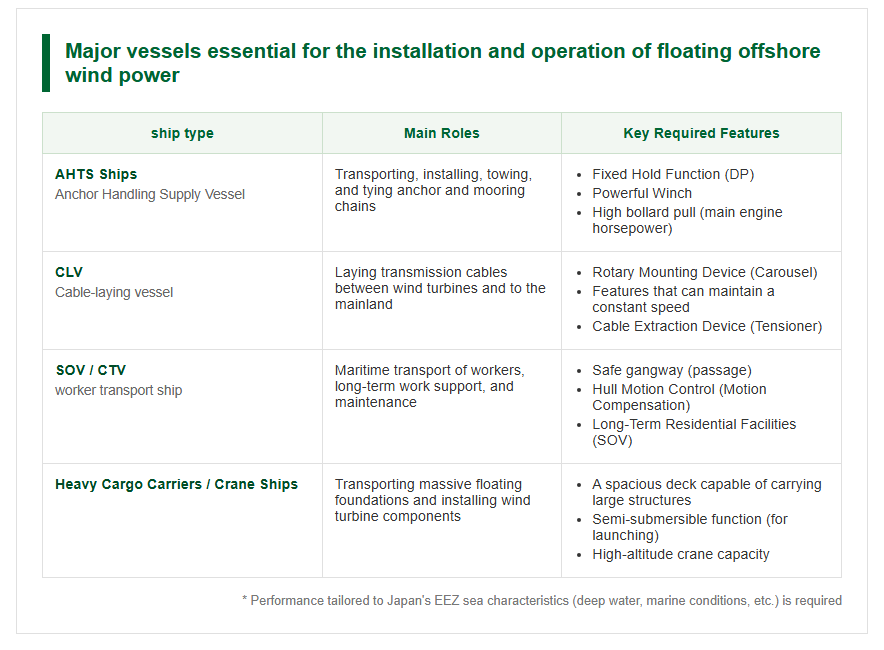
Implementing the floating structure requires securing a vast harbor yard for assembling massive floating structures and specialized workboats. Currently, development is underway to modularize multiple components and assemble them in a short period at the port. Additionally, demand is expected for vessels tailored to the characteristics of the EEZ, such as AHTS ships for anchoring, CLVs for laying cables, and SOVs for transporting workers. Expanding order opportunities for domestic companies involved in shipbuilding and construction could contribute to improved performance of related stocks. For examples of vessel construction, please refer to the diagram below.
[Mid- to Long-Term Outlook] Key Points for Commercialization in the 2030s
Roadmap to the 15GW Target
The future focus will be on the transition to the “mass production stage” toward commercialization in the 2030s. The data obtained from the demonstration experiment will be used to reduce project uncertainty and facilitate consensus building by combining it with marine environmental surveys conducted by the Ministry of the Environment. Among the 17 areas under the Renewable Energy Sea Area Utilization Act, the focus will be on when sea areas such as the Tokyo Islands will be elevated to promising or promoted zones and move to large-scale auctions. It is expected to serve as a supply source (reservoir) toward achieving the 15GW target by 2040.
Regional Coexistence and Consensus-Building Model for Fisheries Rights
It is also important to build a consensus-building model with local fisheries stakeholders and sea area users from the demonstration stage. There are cases where floating windmills serve as fish reefs and have been confirmed to attract fish such as maaji mackerel, striving for the coexistence of industrial promotion and regional coexistence. Using prior examples, such as the independently developed hybrid spar model off the coast of Goto City, Nagasaki Prefecture, as a model, the success or failure of commercial deployment will be determined by encouraging the utilization of local ports and the participation of local companies. Attention is focused on realizing industrial clustering that contributes not only to energy policy but also to support recovery from the Great East Japan Earthquake and regional revitalization.
[#経済産業省 #浮体式洋上風力 #再生可能エネルギー #カーボンニュートラル #EEZ #NEDO #サプライチェーン #グリーンイノベーション]


コメント