By implementing incident management platforms and AI automation technologies, NTT DATA Group has cut alert response times during system failures from 20–30 minutes down to seconds or a few minutes—an up to 92% reduction. Driven by chronic IT labor shortages and increasingly complex system environments, the shift toward AI-driven operations leveraging automation tools and generative AI is accelerating rapidly.
- Slashing System Outage Response Times from 20–30 Minutes to Seconds
- Monitoring Alert Filtering and Automated Escalation Workflows
- Chronic IT Labor Shortages and Rising System Complexity
- Autonomous Operations via Hinemos ver.7.2 and Generative AI Integration
- Enhancing Reliability to Support 24/7 Critical Infrastructure
- The Future of IT Operations Management: AIOps and Autonomous Systems
Slashing System Outage Response Times from 20–30 Minutes to Seconds
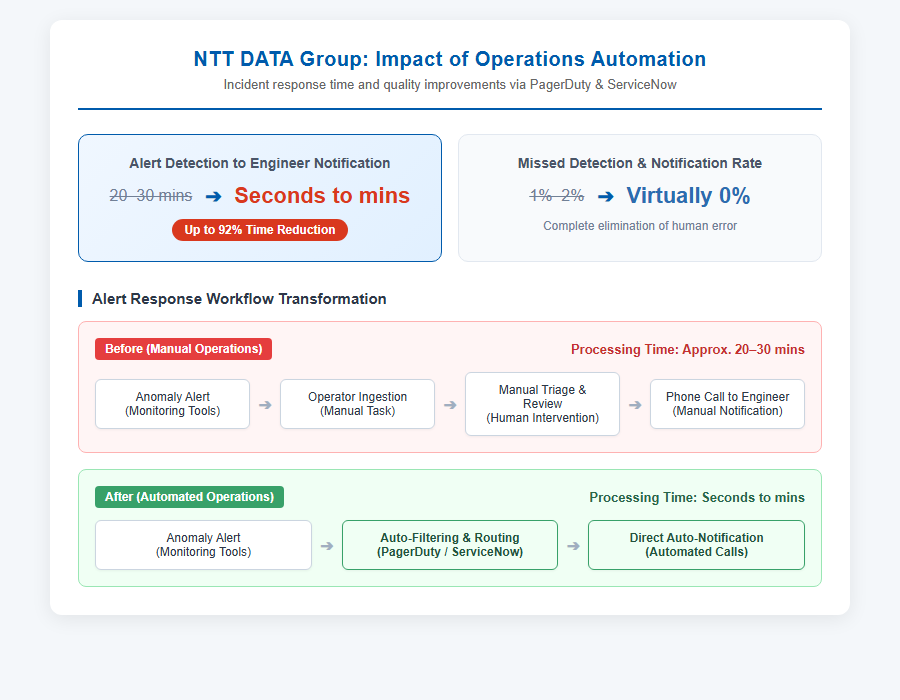
NTT DATA Group has been driving initiatives to accelerate initial response times and eliminate human error across its 24/7 mission-critical system operations. Under traditional operations, when monitoring tools detected an anomaly, operators had to manually review manuals, perform primary triage, and phone the engineers on call. Because this workflow required manual judgment and verification, it typically took about 20 to 30 minutes from alert generation to contacting the responsible engineer.
To address these challenges, the company implemented automation tools such as the PagerDuty incident management platform, fully automating the workflow from alert detection to contacting engineers. As a result, initial response times were reduced to seconds or minutes, achieving a drastic time savings of up to approximately 92%. At the same time, human errors—such as manual data entry mistakes and transcription errors during phone calls—were eliminated, reducing the historical 1% to 2% rate of missed detections and notifications to virtually zero. Beyond reducing cognitive and operational fatigue for operators, this transformation has significantly shortened the mean time to repair (MTTR) during system outages. The following image illustrates the company’s operational monitoring infrastructure.
Monitoring Alert Filtering and Automated Escalation Workflows
In modern system operations, managing a massive daily volume of notification messages from diverse servers and network devices often leads to “alert fatigue,” where critical alerts requiring immediate action get buried. To combat this, NTT DATA Group utilizes the message filtering capabilities of ServiceNow and Hinemos, an integrated operations management platform, to standardize and automate the end-to-end process from alert ingestion to triage and primary response.
Specifically, rule-based engines and AIOps technologies are applied to incoming monitoring alerts to automatically suppress and aggregate duplicate or low-priority notifications. Only incidents requiring urgent intervention trigger automated ticket creation and notification of assigned engineers based on predefined escalation policies. Because routine primary responses are executed automatically by the system, recovery procedures can begin even during night hours or weekends without requiring manual operator intervention. By automating this entire monitoring and notification workflow, primary operator tasks and administrative overhead have been eliminated, delivering massive efficiency gains—including a reduction of 144 person-months of workload annually in a specific operational project.
Drivers Behind Operational Digitalization and AI-Driven Operations
Chronic IT Labor Shortages and Rising System Complexity
As digital transformation accelerates across enterprises, hybrid environments combining core legacy systems with public clouds, private clouds, and on-premises infrastructure are rapidly expanding. While this growing architectural complexity drastically increases the number of monitored components, IT operations face a chronic shortage of specialized talent. Consequently, traditional operating models reliant on the tacit knowledge of experienced engineers have reached their limit.
According to market research by ITR, Japan’s IT operations automation market grew from 4.98 billion yen in FY2021 and is projected to expand at a compound annual growth rate (CAGR) of 17.4%, reaching 11.1 billion yen by FY2026. Growth in SaaS-based operations management services—which align exceptionally well with cloud environments—is particularly robust and expected to overtake the packaged software market in FY2025. Balancing operational efficiency with service quality is no longer just a cost-cutting measure; it has become a vital strategic priority governing business continuity and corporate competitiveness, making the transition from rule-based automation to advanced AI-driven operations essential.
Autonomous Operations via Hinemos ver.7.2 and Generative AI Integration
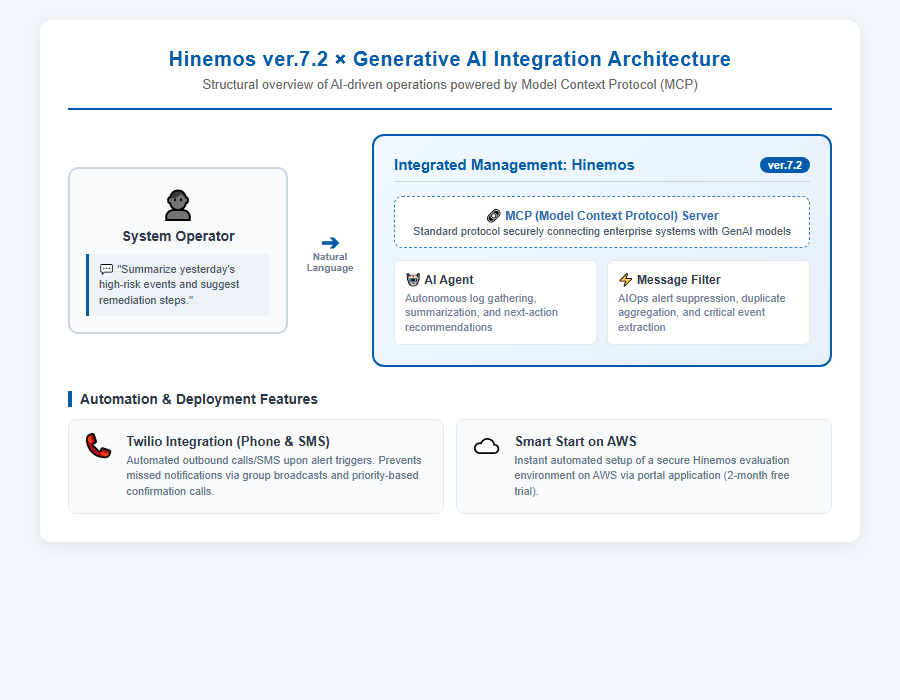
In April 2026, NTT DATA INTELLILINK Corporation launched Hinemos ver.7.2, the latest version of its integrated operations management software. Built around the concept of AI-driven operations, this release introduces AI Agent features compatible with Model Context Protocol (MCP) servers, a standard protocol connecting enterprise systems with generative AI models.
With this feature, operators no longer need to execute complex CLI commands or navigate intricate management consoles. Simply issuing natural language prompts such as “Summarize yesterday’s high-risk events and suggest remediation steps” allows the AI agent to autonomously collect and analyze logs before recommending next steps. Additionally, integrated automated phone and SMS notification capabilities powered by the Twilio cloud communications API enable flexible, automated alerts—including group broadcasts and priority-based sequential confirmation calls to prevent missed notifications. Furthermore, solutions such as “Smart Start on AWS”—which allows rapid deployment of evaluation environments in AWS—provide an accessible framework for organizations to easily adopt and validate advanced AIOps. The following diagram illustrates the integration model between Hinemos and generative AI.
Practical Significance in Enterprise Environments and Future Outlook
Enhancing Reliability to Support 24/7 Critical Infrastructure
Achieving a 92% reduction in alert response times holds profound significance for IT systems supporting vital social infrastructure, including financial institutions, payment gateways, and public sector services. For instance, CAFIS—Japan’s largest comprehensive cashless payment platform operated by NTT DATA—processes over 900 million payment transactions monthly on a 24/7 basis. Any system downtime on CAFIS could severely disrupt national economic activity.
By accelerating initial incident response times to mere seconds through operational automation, service outage risks and blast radiuses are minimized, significantly elevating system availability and customer trust. Moreover, automation tools serve as a foundational pillar for DevOps practices—where development and operations teams collaborate seamlessly—as well as Customer Reliability Engineering (CRE) initiatives focused on customer-centric reliability. Developers are increasingly embracing on-call duties and operational management, fostering a cultural transformation toward digital-native operations.
The Future of IT Operations Management: AIOps and Autonomous Systems
Looking ahead, system management will evolve rapidly from rule-based automation toward predictive maintenance—where AI detects early anomaly signals to proactively mitigate failures—and fully autonomous AIOps. NTT DATA Group is currently conducting proof-of-concept experiments for its “System Operations AI Assistant” vision, which combines historical incident logs, system configurations, operational manuals, and proprietary maintenance knowledge to empower AI in offering optimal remediation steps.
Furthermore, as highlighted in initiatives such as Legal Engineering for Software-Defined Society (LE4SDS)—advocated by Japan’s Information-technology Promotion Agency (IPA)—real-time monitoring and dynamic governance aligned with continuous software updates are becoming increasingly critical. The convergence of generative AI and integrated operations management platforms is key to standardizing operations previously dependent on expert intuition, thereby boosting overall IT service stability and agility. As full automation and advanced operational workflows take hold, engineers will be freed from routine incident handling, allowing them to redirect their expertise toward high-value business transformation and new service innovation.
Reference Pages
-
[NTT DATA Case Study: “Dramatically Reducing Incident Response Time” PagerDuty] https://www.pagerduty.co.jp/customers/nttdata/
-
[Digitizing System Operations with ServiceNow Case Study NTT DATA] https://css.nttdata.com/event/ngf/vol3/
-
[NTT DATA INTELLILINK “Hinemos ver.7.2” Press Release] https://www.intellilink.co.jp/topics/news_release/2026/040800.aspx
[#NTTDATA #OperationsAutomation #AIOps #GenerativeAI #IncidentManagement #Hinemos #ITOperations #ITInfrastructure]
コメント