On July 21, 2026, Microsoft in the United States and Mistral AI in France announced a significant expansion of their strategic partnership. Through multi-billion dollar investments, the aim is to build a unique computing infrastructure in Europe, avoiding dependence on specific companies while securing technological sovereignty.
- Securing multi-billion dollar computing resources and introducing next-generation GPUs
- Product integration of Mistral frontier models
- Breaking Away from U.S. Dependence and Data Self-Determination
- Secure deployment options for regulated industries
- Risk diversification to avoid excessive dependence on OpenAI
- Future Developments and Highlights
Securing multi-billion dollar computing resources and introducing next-generation GPUs
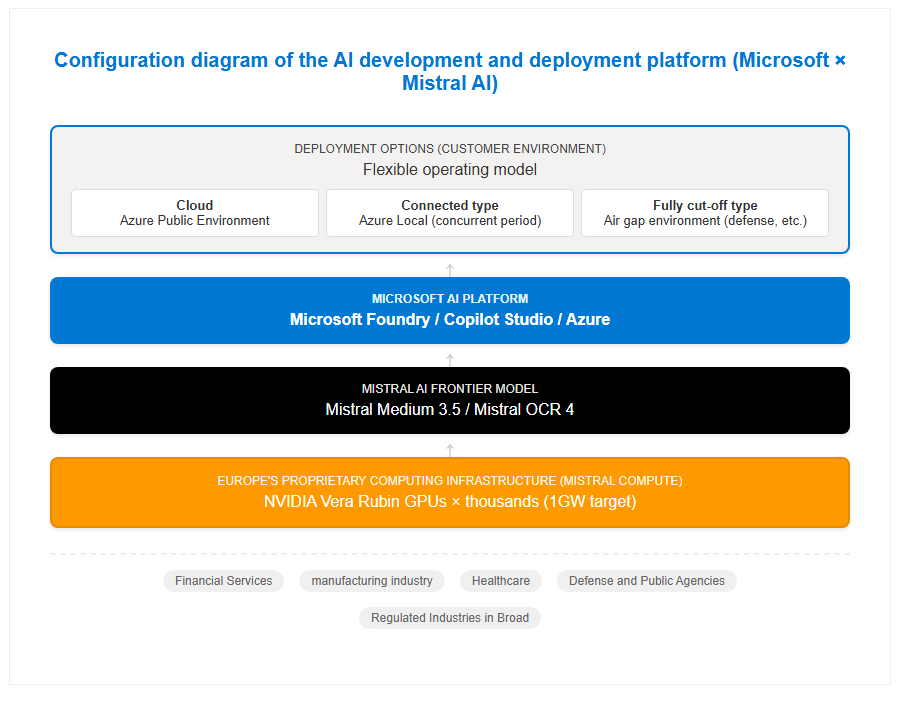
On July 21, 2026, Microsoft and French AI startup Mistral AI signed a new multi-billion dollar agreement aimed at expanding AI computing infrastructure in Europe. At the core of this partnership is that Microsoft will leverage the vast GPU infrastructure Mistral AI is building at its European base to enhance its capabilities in delivering its own cloud and AI services. Mistral AI has set an ambitious goal to deploy NVIDIA’s next-generation GPU, “Vera Rubin,” on a scale of several thousand units, aiming to secure 1 gigawatt (GW) of computing power by 2030. This infrastructure expansion will become a shared platform supporting AI development within Europe, providing comprehensive support from learning and inference to large-scale deployment. For Microsoft, there is a strategic advantage not only to build new data centers in-house but also to expand its foothold across Europe by collaborating with leading regional companies to quickly and flexibly respond to the rapidly growing AI demand.
Product integration of Mistral frontier models
The partnership has also deepened in terms of technology provision, with Mistral AI’s latest models, “Medium 3.5” and “OCR 4,” integrated into Microsoft’s enterprise platform. Specifically, “Microsoft Foundry” and “Microsoft Copilot” provide environments where developers can build and customize AI applications. These frontier models are available in the ‘Studio’ section. In particular, “Medium 3.5” excels at multilingual inference tasks while maintaining high efficiency, and when used in managed Azure environments, it enables predictable and cost-effective scaling. Additionally, “OCR 4” supports the construction of structured document processing pipelines and agentic workflows that autonomously perform tasks. This will enable Microsoft customers worldwide to easily operate their own advanced AI applications on familiar tools. The following diagram illustrates the overall picture of AI development and deployment.
“Sovereign AI” and the Establishment of Technological Sovereignty in Europe
Breaking Away from U.S. Dependence and Data Self-Determination
The background to this expansion of the partnership is the social and political context of the rapidly increasing demand for “sovereign AI” in Europe. Entering 2026, the U.S. administration has taken measures to temporarily restrict foreign access to certain major AI models, heightening concerns within Europe about complete dependence on U.S.-controlled cloud infrastructure. Arthur Mensch, CEO of Mistral AI, argues that Europe can secure international negotiating power by having a trusted and unique player in the key layers of the AI stack. Based on the “European Digital Commitment” announced in 2025, Microsoft has pledged to create an environment where European customers can access world-class AI without losing control over their data or digital future. This enables European public institutions and companies to implement AI in ways that align with their national regulations and values.
Secure deployment options for regulated industries
Particularly important is addressing regulated industries such as finance, healthcare, manufacturing, and defense, which require highly confidential and data location management. With this agreement, Azure customers can now run Mistral AI models in an “air-gapped” environment completely disconnected from external connections through “Azure Local.” This is the result of Mistral’s flexibility based on its open-weight philosophy combined with Microsoft’s robust security and compliance foundation. For example, in manufacturing environments where production lines are analyzed while protecting intellectual property, or when medical institutions process clinical data while strictly maintaining privacy, operating in this isolated environment is an extremely effective option. Mistral AI has already secured a defense contract with the French military, and this strengthened partnership is expected to accelerate its ability to meet these specific mission-critical needs on a global scale.
Shifts in the AI Industry Landscape and Microsoft’s Diversification Strategy
Risk diversification to avoid excessive dependence on OpenAI
One of Microsoft’s strategic intentions in deepening its relationship with Mistral AI is to reduce its reliance on OpenAI alone and spread risk. Since 2019, Microsoft has invested heavily in OpenAI to build its strongest partnership, but OpenAI has also begun seeking ways to break the “lock-in” that is not tied to any specific cloud platform, expanding partnerships with SoftBank, Oracle, and Amazon (AWS). Additionally, within Microsoft, to avoid tensions over technology sharing with OpenAI and antitrust authorities, Microsoft is accelerating the development of its own AI model “MAI” and investing in external partners like Mistral AI. In fact, since 2025, Microsoft has begun listing OpenAI as a competitor in its earnings documents, suggesting that it has entered a “competition” phase where cooperation and competition proceed simultaneously. Strengthening the “third option” of Mistral AI has become an essential move for Microsoft to maintain its bargaining power and leadership in the AI market.
Future Developments and Highlights
The future focus will be on how Mistral AI will realize its 2030 goal of building infrastructure at the 1GW level and achieving a roadmap to exceed 1 billion euros (about 1.1 billion dollars) in sales. Mistral AI will complete a €1.7 billion (about $2 billion) Series C funding round from ASML and NVIDIA in September 2025, with its valuation exceeding €11.7 billion. The joint go-to-market plan with Microsoft includes funding for proof-of-concept (PoC) and offering Azure credits, with key to how much this accelerates adoption by major European and global companies. Additionally, Mistral AI has entered the fields of physical and simulation AI through acquisitions, and its true value as the “European AI Wing” is being tested as a force that transforms industrial engineering beyond software. We can’t take our eyes off how Microsoft uses its own models, OpenAI models, and Mistral models to provide customers with the optimal portfolio, and the evolution of its product strategy.
Reference Page
-
【Microsoft and Mistral expand strategic partnership to give enterprises and regulated industries frontier AI they can control】 https://news.microsoft.com/source/2026/07/21/microsoft-and-mistral-expand-strategic-partnership-to-give-enterprises-and-regulated-industries-frontier-ai-they-can-control/
-
【Mistral AI raises 1.7B€ to accelerate technological progress with AI】https://mistral.ai/news/series-c-funding/
-
【Mistral Large News】https://mistral.ai/news/mistral-large/
[#生成AI #Microsoft #MistralAI #欧州経済 #技術主権 #クラウドインフラ #ビジネス戦略 #デジタルガバナンス]

コメント