On August 20, 2026, autonomous driving startup TIER IV and major semiconductor manufacturer Renesas Electronics announced a partnership to build a platform for Software-Defined Vehicles (SDVs). The collaboration aims to establish an open computing infrastructure that integrates software, AI, and in-vehicle processors for autonomous vehicles, thereby accelerating their safe and efficient practical deployment.
- Background of the Collaboration and Key Points of the Announcement
- Participation in National Programs and Open Chip Design
- Automotive SoC and Autoware Optimization and Verification Demo
- Ensuring Adaptability Through the Adoption of the TOSA Standard Intermediate Representation
- Pursuing Transparency and Reliability Through Formal Verification
- Challenges in the Manufacturing Process and Ecosystem Building
- Social Implementation of Level 4 Autonomous Driving and Key Points to Watch
Background of the Collaboration and Key Points of the Announcement
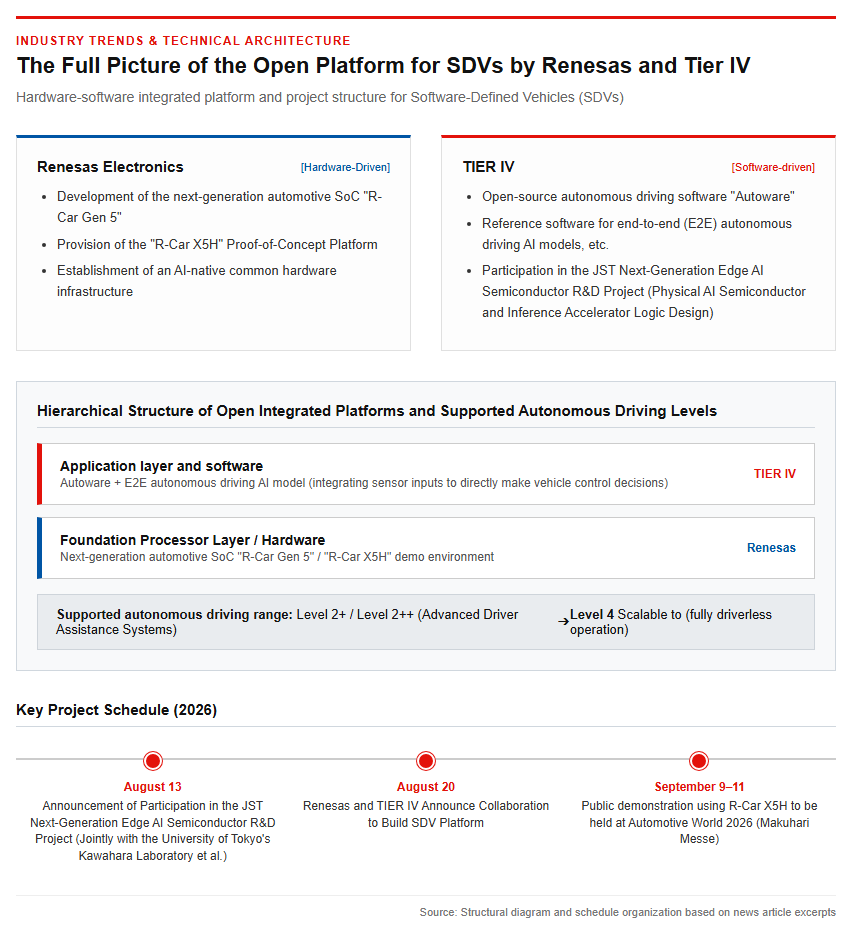
On August 20, 2026, TIER IV, a leader in autonomous driving software development, and semiconductor giant Renesas Electronics announced a partnership to build a platform for Software-Defined Vehicles (SDVs). While traditional automotive development was hardware-driven, a global shift is currently underway toward SDVs, where software and AI dictate vehicle performance. This partnership aims to establish a common open and AI-native hardware and software foundation capable of advanced AI processing to popularize mass-producible autonomous vehicles. At the core of the collaboration is the integration of Autoware, an open-source autonomous driving software developed by TIER IV, with Renesas’ next-generation automotive system-on-chip, the R-Car Gen 5. By widely deploying this integrated platform to automakers and suppliers, the companies aim to optimize autonomous driving technology industry-wide and drastically shorten development timelines.
Participation in National Programs and Open Chip Design
In addition to its partnership with Renesas, TIER IV is also advancing semiconductor development through national projects. On August 13, 2026, the company announced its participation in a next-generation edge AI semiconductor research and development project led by the Japan Science and Technology Agency (JST). Under this program, TIER IV is collaborating with a research team led by Professor Yoshihiro Kawahara of the University of Tokyo to develop physical AI semiconductors that tightly integrate physical control and AI processing. TIER IV’s role is the logic design of inference accelerators specialized for autonomous driving. Relying entirely on the cloud for autonomous driving decisions is impractical due to the risks of communication latency and connection drops, making it necessary to complete processing on the edge device itself. Through this project, TIER IV plans to open-source its technical assets, including not only the chip’s logic design but also dedicated compilers and development toolchains.
The Structure of an Open and AI-Native Technology Platform
Automotive SoC and Autoware Optimization and Verification Demo
As a concrete initiative of the partnership, optimization is underway to pair Renesas’ next-generation SoC, the R-Car Gen 5, with reference software such as the end-to-end (E2E) autonomous driving AI model developed by TIER IV. The E2E model is an advanced AI technology that comprehensively processes inputs from various sensors—such as camera images and point cloud data—to directly make vehicle control decisions. By implementing and optimizing this technology on the R-Car Gen 5, the companies aim to deliver a highly scalable autonomous driving solution capable of supporting everything from driver assistance systems like Level 2+ and Level 2++ to Level 4 systems that enable fully driverless operation. Immediately following the partnership announcement, the two companies plan to host a public demonstration at Automotive World 2026, held at Makuhari Messe from September 9 to 11, 2026, showcasing Autoware and reference AI models running live on Renesas’ R-Car X5H. As shown in the figure below, you can observe the integration of the actual hardware and software.
Ensuring Adaptability Through the Adoption of the TOSA Standard Intermediate Representation
Technological innovation in autonomous driving AI is extremely rapid, creating a risk that hardware designed for specific model architectures will become obsolete and unable to support new algorithms. To address this challenge, the platforms from TIER IV and Renesas have adopted TOSA (Tensor Operator Set Architecture), a standardized intermediate representation. Developers first convert autonomous driving AI models built using various frameworks, such as PyTorch and TensorFlow, into the common TOSA representation. The compiler then performs various optimizations and code generation via this TOSA representation, outputting executable instructions for the target AI chip. As a result, even if changes occur in the structure or computational methods of the AI model, the system can flexibly adapt simply by updating software components like the compiler and runtime, without requiring a physical hardware redesign.
Pursuing Transparency and Reliability Through Formal Verification
In Level 4 autonomous driving, where extremely stringent safety requirements are demanded, ensuring processing transparency and reliability is a top priority. When efficiently executing AI models on in-vehicle chips, complex conversion tasks—such as model format conversion, computational process optimization, and numerical quantization and rounding—are indispensable. However, minute numerical discrepancies arising from these conversion processes can have a fatal impact on the vehicle’s ultimate driving decisions. To eliminate this risk, this platform uses TOSA-defined operator specifications as a baseline and introduces a mathematical verification method known as formal verification during the compilation stage. By mathematically proving numerical consistency before and after specific critical conversion processes, and verifying that they remain within preset allowable error margins, the platform provides a reliable software execution environment.
Challenges Toward Practical Application and Future Vision of Social Implementation
Challenges in the Manufacturing Process and Ecosystem Building
Even if the logic design of a groundbreaking open-source AI chip is unveiled, numerous barriers inherent to physical semiconductor development remain before it can be deployed to the market as practical hardware. To make the designed logic function as a real silicon chip, a series of manufacturing processes must be cleared, including logic synthesis, layout design, timing closure, physical verification, foundry prototyping (tape-out), packaging, and physical board validation. These development stages require massive capital, advanced expertise, and lengthy development cycles. Furthermore, meeting automotive-grade quality requires ensuring physical reliability to withstand extreme temperature fluctuations and vibrations, along with strict compliance with functional safety standards. Beyond simply publishing open-source blueprints, the ultimate challenge for practical adoption is building a commercial ecosystem—through robust partnerships with semiconductor manufacturers and automotive system suppliers—that enables mass production and long-term support.
Social Implementation of Level 4 Autonomous Driving and Key Points to Watch
In the social implementation of autonomous driving technology, TIER IV has built a solid track record in Japan. In October 2024, the company became the first in Japan to obtain Level 4 autonomous driving operation approval—requiring no driver—on public roads in Shiojiri City, Nagano Prefecture. Being permitted to operate at a maximum speed of 35 km/h in a complex public road environment mixed with pedestrians and regular vehicles is a major milestone toward the widespread adoption of autonomous mobility services. Under its Digital Garden City Nation Initiative, the Japanese government has set a target to introduce autonomous driving services in approximately 50 locations by 2025 and over 100 locations by 2027, placing an exceptionally significant role on TIER IV. The newly announced platform, which optimizes Renesas’ high-performance automotive SoC, open-source software, and advanced E2E AI models, is expected to further enhance the energy efficiency of in-vehicle computing and accelerate the full-scale mass production and social implementation of Level 4 autonomous driving.
Reference page
-
[TIER IV Collaborates with Renesas to Build an Open and AI-Native Computing Platform for SDVs] https://tier4.co.jp/updates/tieriv-builds-open-ai-native-computing-platform-with-renesas
-
【TIER IV Obtains Level 4 Autonomous Driving Permit for Public Roads: Toward Societal Implementation of Autonomous Mobility Services】https://tier4.co.jp/updates/press-release/20241031-01
-
【The Autoware Foundation GitHub Repository】https://github.com/autowarefoundation/autoware
-
[Tensor Operator Set Architecture (TOSA) Framework] https://www.mlplatform.org/tosa/
[#AutonomousDriving #AISemiconductor #SDV #Autoware #Renesas #TierIV #Level4]
📝 Feel free to let me know if you would like any adjustments to the article’s structure, word count fine-tuning, or the addition of explanations for specific technical terms.

コメント