Salesforce has announced a major expansion of “Headless 360,” enabling AI agents to dynamically and autonomously invoke business functions. This is driven by a rapid paradigm shift as companies seek to evolve AI from a mere personal chat assistant into an autonomous workforce, propelling their transformation into agentic enterprises.
- Overview and Event Highlights of the Headless 360 Extension
- Why Going Headless Without a GUI Is Important Now
- The Role of the Open Standard “MCP” and the New Server Group
- Data 360 MCP Server and Slackbot Integration for Extending Data Integration
- Reusable Skills for Developers and Diverse Developer Tools
- Challenges and Future Outlook of AI Agent Operations in Enterprises
Overview and Event Highlights of the Headless 360 Extension
On August 19, 2026, Salesforce announced a major expansion of Headless 360, aimed at further evolving its platform for the era of agents. “Headless” refers to a design approach that separates functionality from a specific user interface, making it accessible across various screens and applications. This latest expansion adds new Model Context Protocol (MCP) servers, Data 360 capabilities, Slack integration, and over 100 reusable agent skills. These features are being made available across core cloud products such as Marketing, Sales, Service, and Commerce. With this overhaul, a wide variety of AI agents granted appropriate permissions can now securely discover and execute actions on trusted business functions built on Salesforce, without relying on a user interface. The ability for external AIs to invoke enterprise-built business processes and data access via a common standard brings a major transformation to system integration.
Why Going Headless Without a GUI Is Important Now
For over 27 years, Salesforce has provided systems for various business operations such as sales, marketing, and customer support, designed to be operated by humans through web browsers. However, in today’s era where AI agents are rapidly becoming a new enterprise interface, traditional graphical user interfaces (GUIs) optimized for humans are increasingly becoming barriers to automated system integration. For AI agents to autonomously deliver value, instead of clicking menus and navigating screens, a structure is required that allows them to reliably and efficiently access functions and data directly via APIs or dedicated standard protocols. This headless transformation is an indispensable initiative as a foundation for companies to evolve AI from a mere personal chat assistant into an autonomous workforce that executes business operations, thereby realizing the Agentic Enterprise. The following diagram illustrates the role that Headless 360 plays.
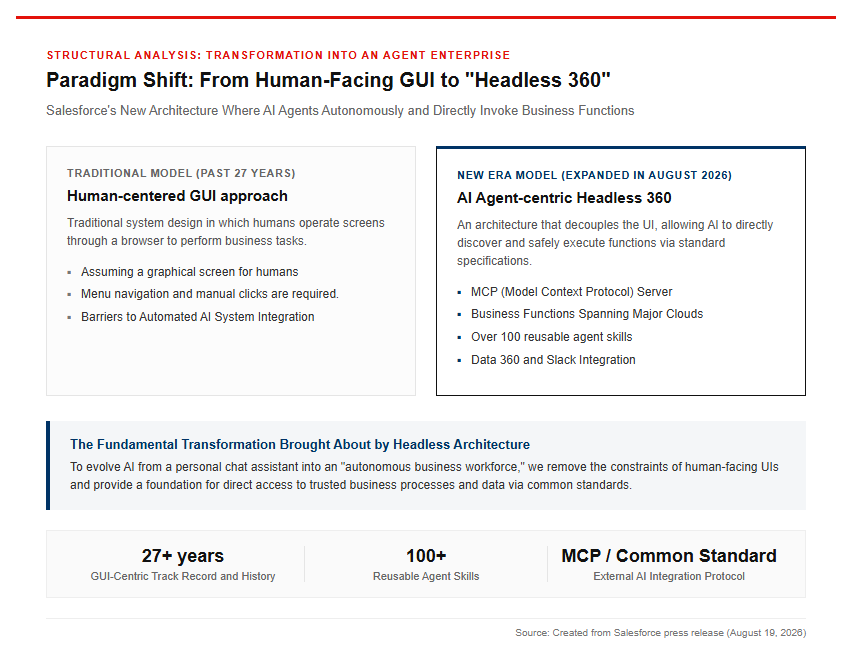
The Evolution of System Integration and Data Integration Brought by Open Standard MCP
The Role of the Open Standard “MCP” and the New Server Group
The most important technical milestone in this expansion is the full adoption of the Model Context Protocol (MCP), an open standard proposed by Anthropic. MCP is an industry-standard connection method for AI agents to access external data sources, tools, and business systems. With the newly released Headless 360 MCP Server, autonomous AI agents running not only on Salesforce’s official Agentforce, but also on Claude, ChatGPT, Cursor, and other external development tools, can now dynamically discover and invoke Salesforce features and metadata in real time. The brilliance of this mechanism lies not just in exposing data endpoints, but in allowing AI agents to directly understand security settings, data validation rules, sharing rules, and governance policies that have been cultivated within Salesforce over many years, fully inheriting that context to execute processes securely.
Data 360 MCP Server and Slackbot Integration for Extending Data Integration
The Data 360 MCP Server, which is already generally available, makes approximately 200 Data 360 APIs available in compliance with open standards. This allows AI agents granted appropriate data access permissions to autonomously execute tasks ranging from building semantic models, data transformation, and checking identity graphs, to creating audience segments and launching campaigns, all through natural language instructions. Furthermore, integration with Slack—the platform where employees perform their daily work—is being strongly promoted. By using the already generally available Slackbot MCP client, employees can update Salesforce deal information, retrieve contracts, and initiate automated workflows directly from the Slack chat interface without having to switch between multiple applications. This seamlessly integrates AI and customer context into daily work processes.
Developer Support and Governance Supporting Autonomous Development and Operations
Reusable Skills for Developers and Diverse Developer Tools
Salesforce also announced a comprehensive suite of tools designed to enable developers to rapidly build new experiences powered by AI agents and autonomous applications. Specifically, over 100 pre-packaged, reusable agent skills—including data validation and business logic—are now available. Additionally, a multi-framework that makes it easy to build React applications while inheriting Salesforce’s native, robust authentication, security, and governance has entered general availability. Furthermore, a headless experience layer for flexibly developing conversational interfaces for mobile, web, and embedded devices has been released as an open beta. These technological environments allow developers to securely reuse business logic built once across any touchpoint, without the need to recreate custom integration or security logic from scratch.
Challenges and Future Outlook of AI Agent Operations in Enterprises
As companies advance the implementation of AI agents, two structural challenges have come to the fore: operational complexity caused by the proliferation of multiple AI systems, and the opacity of operating costs due to the surge in token consumption. To overcome these practical hurdles, Salesforce launched new features of MuleSoft Agent Fabric and MuleSoft Omni Gateway, a control plane for AI agents, in the Japanese market on August 17, 2026. By leveraging these new solutions, it becomes possible to centrally catalog AI agents and MCP servers operating in diverse environments both inside and outside the company, and to track and control traffic and consumption costs in real time. Moving forward, building “agentic enterprises”—where humans and AI agents collaborate securely under advanced governance to autonomously generate direct business outcomes—will become a critically important focus for sustainable corporate growth.
Reference Page
- [Salesforce Turns Enterprise Applications into Enterprise Capabilities – Official Announcement] https://www.salesforce.com/news/stories/expanding-headless-360-enterprise-capabilities/
- [MuleSoft Agent Fabric Details] https://www.mulesoft.com/jp/ai/agent-fabric/
- Details on MuleSoft Omni Gateway
【#Salesforce #Headless360 #AIAgents #MCP #AgenticEnterprise #SystemDevelopment #MuleSoft #Technology】
コメント