Following a sharp surge in French government bond yields, selling has spread across European stock markets—particularly among financial shares—fueling renewed concerns over a debt crisis. Behind this are France’s severe fiscal deficit, political turmoil, and the high hurdles for market intervention by the ECB (European Central Bank).
- Surge Shock in French 10-Year Bond Yields and the Cascade Decline in Major Stock Indices
- OAT-Bund Spread Widening and Sudden Drop in Major French Bank Stocks
- Growing Fiscal Deficits and Political Turmoil Surrounding the 2027 Budget Proposal
- ECB’s Decision to Forgo Intervention and the High Hurdles for Applying the TPI (Transmission Protection Instrument)
- Interest Rate Spillovers to Southern European Government Bonds and Swiss Franc Appreciation in the Foreign Exchange Market
- Political Uncertainty and Key Market Focus Points Heading into the 2027 Presidential Election
Surge Shock in French 10-Year Bond Yields and the Cascade Decline in Major Stock Indices
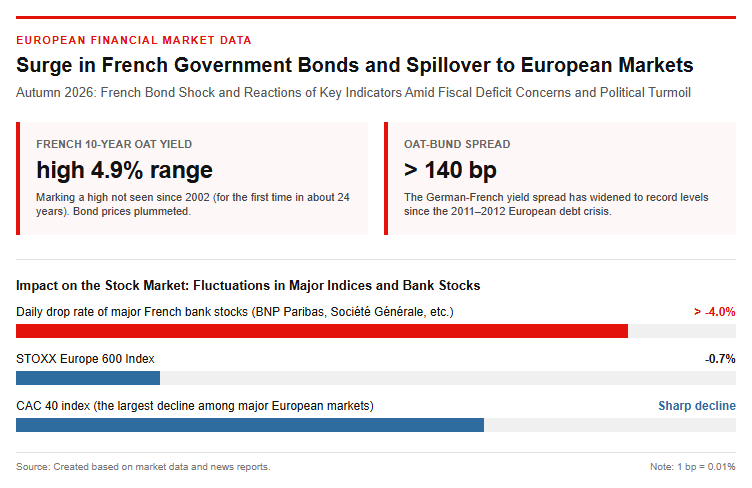
In the autumn of 2026, European financial markets are being shaken by a surge in French government bond yields. The yield on France’s 10-year benchmark government bond (OAT) temporarily soared to the upper 4.9% range, marking its highest level in about 24 years since 2002. Accompanying this, bond prices plummeted, spreading turbulence among market participants. This wave of surging yields immediately spilled over into the stock market as well. The STOXX Europe 600, a major European stock index, fell 0.7%, while France’s CAC 40 index recorded the largest decline among major European markets. French companies dominated the list of top stock losers, and a risk-off sentiment is rapidly intensifying across the broader market. In addition to upward pressure on global long-term interest rates, persistent high crude oil prices driven by escalating tensions in the Middle East have reignited concerns over prolonged inflation, creating a market environment where government bonds from major nations are being sold across the board. However, among them, the drop in French government bonds stands out by far, indicating that the market has begun to clearly recognize “France-specific risks” that go beyond a mere deterioration in the interest rate environment.
OAT-Bund Spread Widening and Sudden Drop in Major French Bank Stocks
The clearest reflection of market anxiety is the widening of the yield spread between French government bonds (OATs) and German federal bonds (Bunds), known as the OAT-Bund spread. This spread has exceeded 140 basis points (1.4%), widening to record levels not seen since the European debt crisis of 2011–2012. Originally boasting the same level of safety as Germany as a core eurozone nation, French government bonds now face investors demanding a substantial additional risk premium for holding them. This shock in the sovereign bond market directly hit the stock prices of major French financial institutions, which hold massive amounts of domestic government bonds. Share prices of major banks such as BNP Paribas and Société Générale plunged by more than 4% in a single day. This was driven by fears of valuation losses on held assets due to falling bond prices, as well as concerns that rising future funding costs would squeeze bank management. Furthermore, the stop-loss unwinding of “yield curve steepener” positions that hedge funds had accumulated during the summer added fuel to the fire, creating a vicious cycle of selling begetting more selling. Please refer to the figure below.
The Structure of France’s Fiscal Deterioration and Political Turmoil
Growing Fiscal Deficits and Political Turmoil Surrounding the 2027 Budget Proposal
The root causes of the French debt crisis lie in chronic, massive fiscal deficits and political instability. France’s fiscal deficit has reached approximately 5.4% of GDP, significantly exceeding the 3% ceiling set by EU rules. The government’s debt-to-GDP ratio also exceeds 119%, swelling to its highest level since 1946, immediately after World War II. The government led by Prime Minister Sébastien Lecornu submitted a fiscal consolidation plan centered on approximately 54 billion euros in spending cuts and tax hikes in the FY2027 budget proposal. However, the National Assembly (lower house) is in a “hung parliament” state where the ruling party lacks a majority, and facing fierce backlash from opposition parties, there is no prospect for the budget’s passage. Against painful reform proposals such as freezing public servant pay raises and revising pension indexation to inflation, leftist factions and labor unions are pushing back with large-scale demonstrations. Furthermore, the far-right National Rally (RN), which leads in presidential polls, and far-left factions are advocating populist fiscal expansion, and a structural distrust that fiscal consolidation will not move forward no matter who takes power is leading investors to hand down a “guilty verdict” on French government bonds.
ECB’s Decision to Forgo Intervention and the High Hurdles for Applying the TPI (Transmission Protection Instrument)
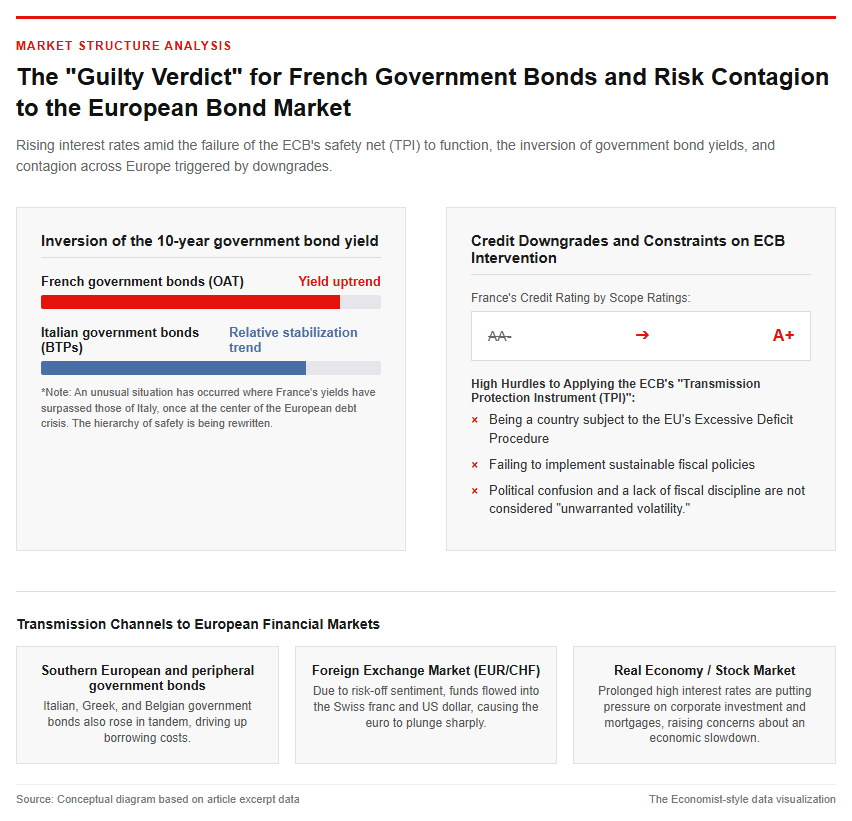
Amid the turmoil in the government bond market, expectations for a bailout intervention by the European Central Bank (ECB) were whispered in some quarters, but experts’ views are extremely skeptical. The ECB has a government bond-buying framework known as the Transmission Protection Instrument (TPI) designed to curb unwarranted spikes in interest rates. However, triggering the TPI is subject to strict requirements, such as “not being the subject of the EU’s excessive deficit procedure” and “pursuing sustainable fiscal policies.” France is currently subject to the excessive deficit procedure, and the rise in interest rates driven by political decisions lacking fiscal discipline is unlikely to be regarded as “unwarranted and disorderly market dynamics.” Therefore, it is legally and politically difficult for the ECB to prop up French government bonds. The governor of the Bank of France has also kept a check on relying on the ECB, and the realization that the central bank’s safety net will not function is further elevating the market’s perception of risk. The ECB maintains a monetary tightening stance as an inflation countermeasure, and the reality is that it has no choice but to leave interest rate hikes caused by France’s fiscal deficit and political missteps to the market’s own price adjustment.
Risk Spillover to European Markets and Future Outlook
Interest Rate Spillovers to Southern European Government Bonds and Swiss Franc Appreciation in the Foreign Exchange Market
Credit anxiety originating in France is spreading across the entire European financial market. In the bond market, the yields on government bonds of countries such as Italy, Greece, and Belgium—which had previously shown stability—also rose in tandem, driving up funding costs across Europe as a whole. Interestingly, a reversal phenomenon has occurred where France’s 10-year bond yield has surpassed that of Italy, which was once the epicenter of the European debt crisis, and the hierarchy of safety for European government bonds is being rewritten. Meanwhile, in the foreign exchange market, risk-off sentiment has strengthened the flight of capital into the Swiss franc and the US dollar. The EUR/CHF exchange rate has plummeted, highlighting a distrust of European currencies as a whole. In the stock market as well, views are strengthening that prolonged high interest rates and rising credit risks will put pressure on corporate investment and the mortgage market, developing into concerns over an economic slowdown for the European economy as a whole. Although safe-haven funds have flowed into German government bonds to some extent, this has not been enough to stop the chain reaction of “higher interest rates and lower stock prices” covering the whole of Europe.
Political Uncertainty and Key Market Focus Points Heading into the 2027 Presidential Election
Future market focus will shift to the progress of France’s budget negotiations and the presidential election scheduled for the spring of 2027. If the budget bill is not passed within the year and the previous year’s budget is carried over through special legislation, temporary market turmoil will be avoided, but delays in fiscal consolidation could lead to a further downgrade in ratings. Furthermore, if populist forces such as Marine Le Pen and Jordan Bardella of the far-right National Rally, or Mélenchon of the far-left, expand their support ahead of the 2027 presidential election, there is a risk that further credit rating downgrades and the pricing-in of sovereign default risk will proceed. Rating agency Scope Ratings has already downgraded France’s rating from AA- to A+, sounding the alarm over the prolonged political fragmentation. For investors, closely monitoring the trends of the OAT-Bund spread, as well as the fiscal pledges of each party and the movements of the ECB, is essential. The dual burden of fiscal and political challenges facing Europe’s second-largest economy is likely to continue simmering as the biggest disruptive factor in European financial markets for years to come. Please refer to the image below.
Reference page
- 【European Central Bank Monetary Policy Decisions】https://www.ecb.europa.eu/press/pr/date/2026/html/ecb.mp260910~314e508016.en.html
[#FrenchGovernmentBonds #EuropeanStocks #InterestRateHike #FiscalDeficit #ECB]


コメント