In June 2026, the Bank of Japan decided to raise its policy interest rate to around 1.0%. Behind this departure from the ultra-low interest rate environment that has persisted for many years lies caution regarding the risk of upward pressure on prices.
- The decision to raise interest rates after about 31 years and the key points of the events
- Underlying Inflation and Reassessment of Real Interest Rates
- Unwinding of the Yen Carry Trade and Market Caution
- Corporate Interest Expense Burdens and the Acquisition of Inflation Resilience
- Trends in Mortgage Interest Rates and How They Affect the Real Estate Market
- Government Pushback and the Outlook for Future Monetary Policy
The decision to raise interest rates after about 31 years and the key points of the events
In June 2026, at its Monetary Policy Meeting, the Bank of Japan decided by a majority vote to raise the target for its policy rate, the uncollateralized overnight call rate, from around 0.75% to around 1.0%. This is a historic decision, marking the first time the policy rate has reached the roughly 1.0% level in approximately 31 years, since 1995. While this decision was in line with market expectations ahead of time, it took place while Governor Kazuo Ueda, who was hospitalized, was absent from the meeting and submitted his opinions in writing. At the meeting, Deputy Governor Shinichi Uchida acted as chairman pro tempore, and he also appeared at the post-meeting press conference. Regarding the policy rate hike, Board Member Toichiro Asada emphasized the downside risks to production and employment due to the situation in the Middle East, arguing for maintaining the status quo of the monetary control guidelines and casting the sole dissenting vote. The BOJ took the step toward this tightening because price pass-through among companies, triggered by rising crude oil prices, has been progressing at a faster-than-expected pace, raising concerns that this could spill over into price increases for a wide range of consumer goods.
Underlying Inflation and Reassessment of Real Interest Rates
Behind this additional interest rate hike is a strong sense of vigilance against the risk that the underlying consumer price inflation rate will stably exceed and overshoot the Bank of Japan’s target of approximately 2%. Although the current consumer price inflation rate is temporarily sitting below the 2% level due to factors such as the government’s energy cost relief measures, price pass-through in business-to-business transactions and medium-to-long-term expected inflation rates continue to maintain an upward trend. Furthermore, the virtuous cycle mechanism of wages and prices through events like the spring labor-management wage negotiations is becoming established throughout society against the backdrop of labor shortages, with regular employee base pay projected to trend at a high level of approximately the mid-to-high 2% range year-on-year. Moreover, accompanying this rate hike, the BOJ removed from its statement the expression it had conventionally used to explain raising the policy rate—that actual real interest rates are “at an extremely low level”—and instead changed the explanation to “financial conditions remain accommodative.” This indicates that the degree of monetary easing has actually changed due to the continuation of rate hikes, resulting in a revision of the evaluation of the degree of easing down by one notch.
Ripple Effects on Markets and Corporate Activities
Unwinding of the Yen Carry Trade and Market Caution
As the Bank of Japan proceeds with gradual interest rate hikes, there is a growing sense of caution regarding the rapid unwinding (liquidation) of yen carry trades that have accumulated in international financial markets over many years. The yen carry trade is a strategy in which investors borrow extremely low-interest Japanese yen to invest in high-yield assets such as US dollars, and its scale as of 2024 was estimated to have reached approximately 40 trillion yen. However, when Japan’s policy interest rate rises and the borrowing cost of the yen increases, foreign exchange losses occur if the currency shifts toward a stronger yen, easily triggering a rush of investors buying back the yen and liquidating their positions en masse. Indeed, in August 2024, a combination of the BOJ’s additional rate hike and risk-off sentiment driven by worsening US employment statistics led to a rapid appreciation of the yen in the foreign exchange market. In a chain reaction to this, the Nikkei Stock Average recorded a historic crash exceeding roughly 12% in a single day, and highly volatile cryptocurrencies such as Bitcoin were also caught up in the plunge. Although the interest rate differential between Japan and the US remains in place, the erosion of the premise that the yen is a safe-haven asset has become the primary factor fueling market vigilance.
Corporate Interest Expense Burdens and the Acquisition of Inflation Resilience
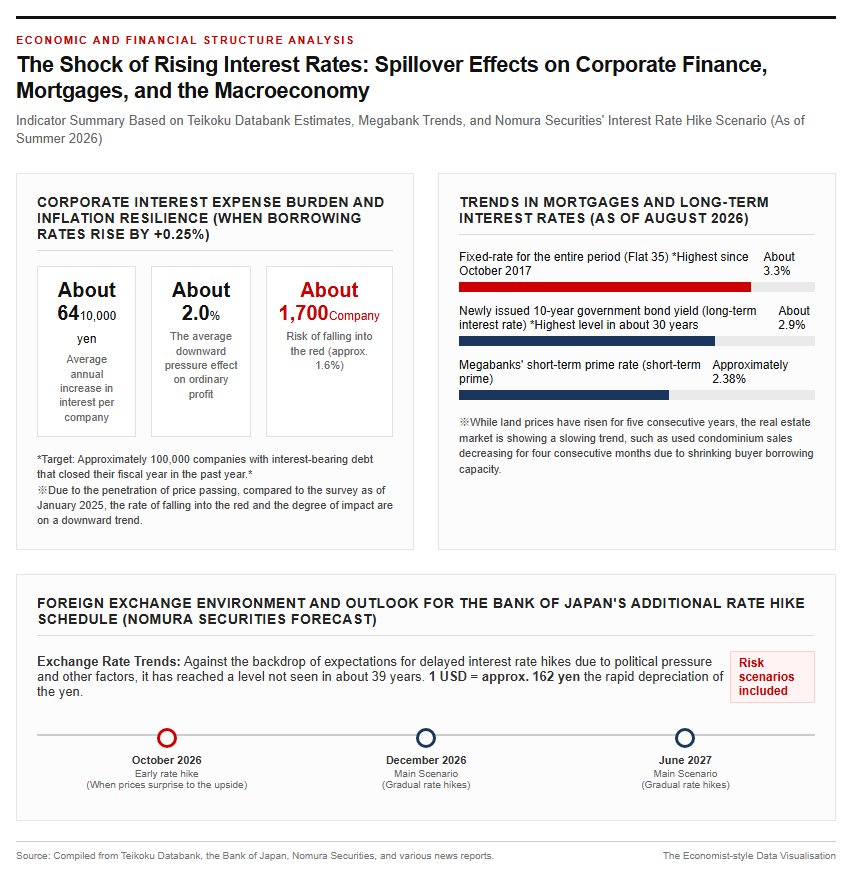
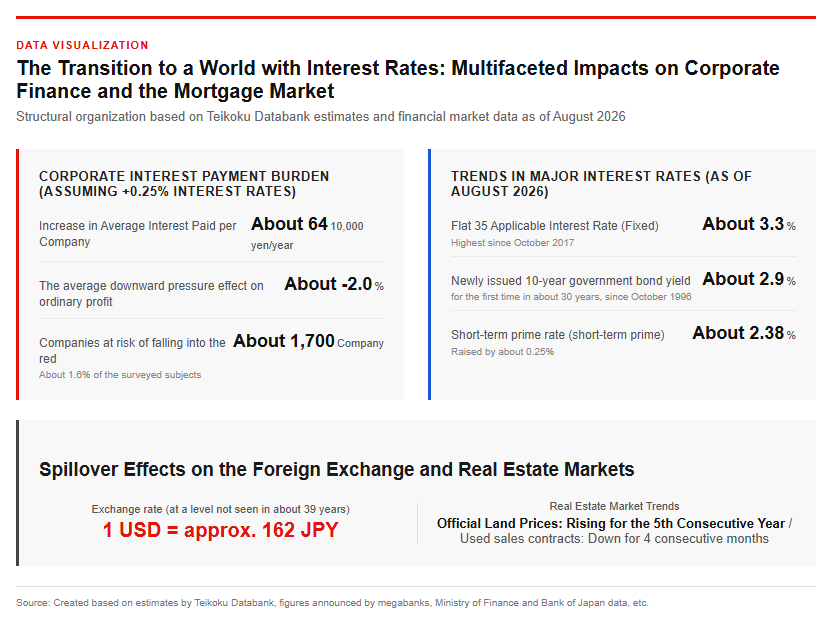
The structural change of rising interest rates is also beginning to have widespread effects on the finances and business activities of private companies. According to estimates by Teikoku Databank targeting approximately 100,000 companies with interest-bearing debt that settled their accounts over the past year, if borrowing rates were to rise by about 0.25% from current levels, the interest paid by companies would increase by an annual average of about 640,000 yen per company, having the effect of pushing down ordinary profit by an average of about 2.0%. As a result, approximately 1,700 companies—accounting for about 1.6% of those surveyed—could newly fall from ordinary surplus into the red. However, compared to survey results as of January 2025, the rate of falling into the red and the degree of impact on ordinary profit are gradually declining. Unlike the deflationary environment that persisted until recently, the penetration of price pass-through against the backdrop of rising costs has made it easier for companies to improve profitability, highlighting the reality that they are gradually building resilience against rising interest rates. At the same time, for many small and medium-sized enterprises (SMEs) that have lagged in business recovery and have managed debt through borrowings, there are concerns that the increase in interest payments will deteriorate cash flow and become a burden that deprives them of the capacity to raise wages.
Future Outlook for Personal Life and Policy
Trends in Mortgage Interest Rates and How They Affect the Real Estate Market
The rapid transition to a world with interest rates is also directly impacting personal mortgages and real estate market trends. Major banks raised their short-term prime rates by approximately 0.25% to around 2.38% in August 2026, which will be reflected in applicable interest rates from September onward. As a result, repayment interest rates will rise for many households with variable-rate mortgages tied to the short-term prime rate. Additionally, the yield on newly issued 10-year government bonds, an indicator of long-term interest rates, temporarily rose to about 2.9% in August 2026, marking its highest level in approximately 30 years since October 1996. Along with this, the applicable interest rate for the all-period fixed-rate Flat 35 mortgage reached about 3.3% as of August 2026, the highest level since the current system was launched in October 2017. Although official land prices themselves have risen for five consecutive years as of January 2026, a slowdown in the real estate market is clearly beginning to emerge, driven by shrinking borrowing capacities for buyers, as seen in falling closing prices per tsubo and four consecutive months of declines in existing condominium sales.
Government Pushback and the Outlook for Future Monetary Policy
The outlook for the pace at which the Bank of Japan (BOJ) will proceed with additional rate hikes will be a crucial turning point going forward. While setting gradual rate hikes in December 2026 and June 2027 as its main scenario, Nomura Securities also envisions an earlier rate hike in October 2026 as a risk scenario in the event of sustained underlying upward pressure on prices. However, standing in the way of the BOJ, which wants to push ahead with rate hikes, is political pressure. In the draft of its Basic Policies aiming for a Cabinet decision in mid-July 2026, the government led by Prime Minister Takaichi strongly calls for close cooperation with the government in line with the spirit of Article 4 of the Bank of Japan Act and the joint statement by the government and the BOJ, clearly showing a de facto stance of keeping rate hikes in check. Such inconsistent policy directions gave the market a sense of delayed rate hikes, resulting in a rapid depreciation of the yen to around the 162 yen per dollar level, a level not seen in about 39 years. In the history of exit strategies, the impact of the past magnitude of BOJ current account deposits and Japanese government bond holdings on fiscal costs has been viewed as an issue. Please refer to the figure below regarding the trends of JGB holdings by the BOJ and private banks at that time.
Reference page
- [Bank of Japan] Regarding the Conduct of Monetary Policy Meetings https://www.boj.or.jp/
- [Teikoku Databank] Survey on the Impact of the Bank of Japan’s Additional Rate Hike on Companies (December 2025) https://www.tdb.co.jp/report/industry/20251219-increase25y/
- [Ministry of Land, Infrastructure, Transport and Tourism] Land Price Publication Data https://www.mlit.go.jp/
[#MonetaryPolicy #BankOfJapan #InterestRateHike #WeakYen #Mortgage #JapaneseEconomy #BasicPolicies]


コメント