The Chinese government has announced a plan to invest over 5 trillion yuan in a new-type power grid by 2030. The background behind this involves a complex set of challenges: a severe surge in power demand from data centers driven by the rapid adoption of artificial intelligence, and the stabilization of renewable energy supplies.
- Surge in Power Demand Due to AI Adoption and Decision to Invest 5 Trillion Yuan
- Integrated Infrastructure Development through the Computing and Power Collaborative Strategy
- Significant Expansion of Ultra-High-Voltage Power Grids and Energy Storage Systems
- Advancements in Solid-State Transformers and Eco-Friendly Infrastructure
- Order Rushes and Overseas Expansion for Power Equipment Companies
- Construction of a Nationwide Unified Electricity Market System and Future Prospects
Surge in Power Demand Due to AI Adoption and Decision to Invest 5 Trillion Yuan
In response to the explosive surge in power consumption by data centers driven by the rapid adoption of artificial intelligence, the Chinese government has decided to make massive investments in a new type of power grid. According to the 15th Five-Year Plan for New Power System Construction released by China’s National Development and Reform Commission and the National Energy Administration on August 3, 2026, total fixed asset investment related to the national power grid during the 15th Five-Year Plan period from 2026 to 2030 is projected to exceed 5 trillion yuan (approximately 120 trillion yen). This represents a dramatic increase of more than 80% compared to the 2.8 trillion yuan invested during the preceding 14th Five-Year Plan period. The background behind this is that the training and operation of large-scale AI models have caused data center utilization rates to soar across various regions, raising concerns about severe power shortages. For example, power consumption at a data center in Shaoguan, Guangdong Province, recorded an exceptional surge in the first half of 2026, reaching approximately 5.7 times that of the same period last year. With projections indicating that power consumption by computing power centers nationwide will reach approximately 800 billion kilowatt-hours (kWh) by 2030, accounting for about 6% of total societal power consumption, upfront investment has become indispensable.
Integrated Infrastructure Development through the Computing and Power Collaborative Strategy
What the Chinese government emphasizes in this unprecedented investment is the computing-power-and-electricity coordination project, which develops computing capacity and power infrastructure in tandem. This is a national strategy that integrally links the construction of AI data centers, new-type power grids, and next-generation communication networks. As indicated by the National Energy Administration’s slogan—”empower AI with electricity, and upgrade the power system with AI”—the optimization of energy supply-demand allocation and computing infrastructure is advancing simultaneously. On August 19, 2026, the National Development and Reform Commission held a joint coordination meeting with major related companies (such as State Grid Corporation of China and China Southern Power Grid) to discuss establishing a coordination mechanism to accelerate project construction. Specific initiatives include demonstration experiments in regions with surging power consumption, such as Guangzhou, where non-urgent computing tasks are dynamically transferred to data centers in Guizhou Province, which has relatively abundant electricity. Through this mutual infrastructure complementarity, plans to alleviate temporary power grid overloads and maximize society-wide infrastructure operational efficiency are moving into full swing.
[Integration of Renewable Energy and Technological Innovation]
Significant Expansion of Ultra-High-Voltage Power Grids and Energy Storage Systems
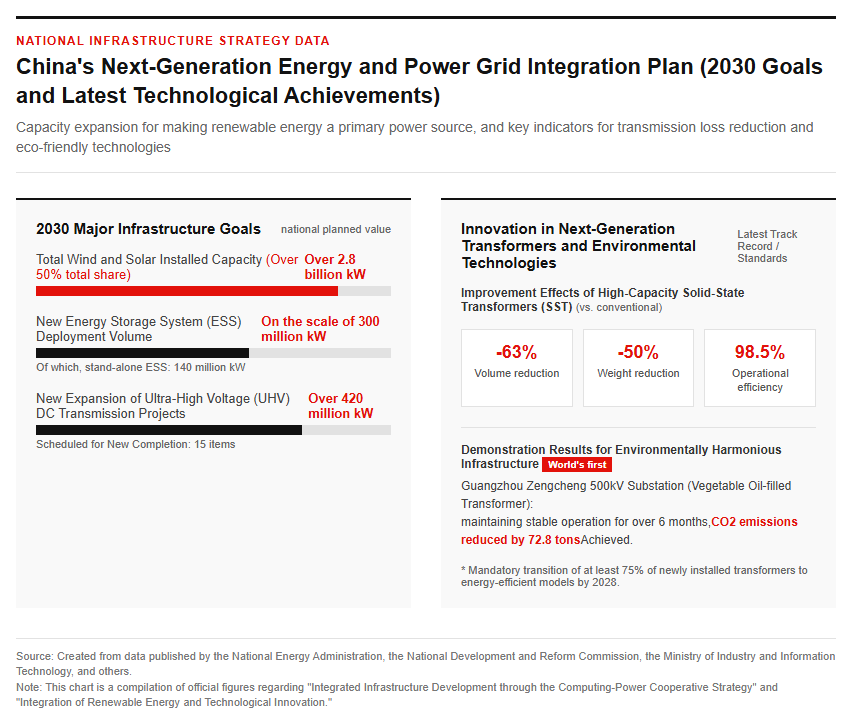
To make renewable energy the mainstay of its power supply, the Chinese government is rapidly advancing the reinforcement of power transmission routes and the expansion of energy storage systems (ESS). It has set a target to increase the total installed capacity of wind and solar power to over 2.8 billion kilowatts (kW) by 2030, accounting for more than 50% of the total. However, because these weather-dependent power sources present a challenge of supply instability, the government has announced a policy to introduce 300 million kW of new ESS facilities over the five-year period leading up to 2030. Of this amount, 140 million kW is planned to be developed as standalone ESS to support peak-hour power supply and demand. Furthermore, the “West-East Power Transmission” project, which sends electricity from the western generation regions to the eastern urban demand areas, will also be significantly expanded. Fifteen new ultra-high voltage (UHV) direct current transmission projects are scheduled to be completed, and their transmission capacity is expected to reach a scale exceeding 420 million kW. Through the construction of such wide-area power interchange and storage grids, an infrastructure is taking shape to utilize highly fluctuating renewable energy nationwide in a stable and waste-free manner.
Advancements in Solid-State Transformers and Eco-Friendly Infrastructure
The development of technology to make power grids intelligent and reduce transmission losses is also being mandated under state leadership. In March 2026, four major Chinese government agencies, including the Ministry of Industry and Information Technology, jointly released the Implementation Plan for High-Quality Development of Energy-Saving Equipment (2026–2028). This plan mandates that over 75% of newly installed transformers must be energy-saving transformers by 2028, and outlines a policy strongly promoting the adoption of large-capacity solid-state transformers (SSTs). Solid-state transformers are a next-generation technology that perform voltage conversion using semiconductor devices, successfully reducing volume by 63% and weight by 50% compared to conventional types while raising operational efficiency to 98.5%. Furthermore, the application of insulating materials that reduce environmental impact is progressing. For example, at the 500kV substation in Zengcheng, Guangzhou, which began operations in August 2025, a transformer using completely biodegradable vegetable oil went into operation as a world first. This transformer has maintained stable operation for over six months, demonstrating concrete results such as reducing carbon dioxide emissions by 72.8 tons. Please refer to the image placeholder below.
[Market Impact and Future Outlook]
Order Rushes and Overseas Expansion for Power Equipment Companies
This massive investment has brought enormous orders to manufacturers handling UHV-related equipment and materials, while also positively impacting China’s stock market (A-share market). On July 23, 2026, the bidding results for the third batch of UHV and power transmission and transformation equipment announced by the State Grid reached a total of 28.312 billion yuan, causing the share prices of many power grid-related companies to hit their daily upper limits. Looking at individual winning bids, major companies secured large-scale orders one after another, with China XD Electric winning approximately 4.129 billion yuan, Pinggao Electric about 1.818 billion yuan, and XJ Electric about 1.245 billion yuan. Moreover, having accumulated technology and reliability through robust domestic demand, Chinese companies are strongly promoting overseas expansion, centering on regions such as Southeast Asia and Africa. For instance, Sihyuan Electric has seen its overseas revenue share rise to 33.68%, and Jinpan Technology has operationalized its factory in Malaysia, thereby building overseas supply chains. Amid a surge in demand for power grid modernization driven by the global energy transition, these Chinese companies are steadily capturing market share in the global market, armed with high price competitiveness.
Construction of a Nationwide Unified Electricity Market System and Future Prospects
Parallel to hardware investments in transmission infrastructure, reforms of the market structure to optimize power trading are also being strongly promoted. The Implementation Opinions on Developing a Nationwide Unified Electricity Market System released by the General Office of the State Council of China in February 2026 (Guoban Fa [2026] No. 4) directed the creation of rules enabling diverse power sources, such as renewable energy, and power-consuming enterprises to trade directly through the market. The opinions outline a plan to enable approximately 70% of total electricity consumption to be traded on a market basis by 2030, and to fully construct a market system by 2035 that enables the optimal allocation and efficient utilization of power resources on a nationwide scale. This is expected to operationalize market mechanisms such as allocating data center computing tasks to periods of low electricity demand. Moving forward, major points of focus will likely include smart controls to cope with sudden demand surges caused by extreme heat, and the implementation of autonomous adjustment functions for the entire infrastructure through integration with AI. China’s power grid investments are moving beyond mere capacity expansion to undergo a transformation into sustainable next-generation infrastructure fused with cutting-edge digital technology.
Reference page
- 【China targets clean, low-carbon new energy system by 2030 – State Council of the People’s Republic of China】https://english.www.gov.cn/news/202606/25/content_WS6a3d2904c6d00ca5f9a0bcde.html
- 【Implementation Opinions on Building a Unified National Electricity Market System – State Council of the People’s Republic of China】https://www.gov.cn/zhengce/content/202602/content_7057744.htm
【#ChinaEconomy #AIAdoption #PowerInfrastructure #RenewableEnergy #SmartGrid】


コメント