AI development venture AIdeaLab Inc. has released the official version of its video generation AI specialized in anime expression, “AnimeGen,” free of charge. Behind this is the government-supported project “GENIAC,” which aims to resolve the severe labor shortage in Japan’s content industry and strengthen the development capabilities of domestically produced generative AI.
- Release of the official version and the role of the GENIC project
- The Foundational Model “Wan 2.2” and Anime-Specialized Mechanisms
- Operating Environment and Required Computing Resources
- Innovation in Previsualization
- Addressing labor shortages and expanding creative content
- Close Imitation of Specific Works and Legality of Training Data
- The reality of Apache-2.0 licenses and commercial use
- Questions about the identity of domestic AI
- Technical challenges and improved consistency
- Establishing guidelines for corporate adoption
Release of the official version and the role of the GENIC project
AI development company AIdeaLab Inc. released the official version of its video generation AI model specialized for anime expression, “AnimeGen,” on July 13, 2026. This model was developed with support from the “GENIAC (Generative AI Accelerator Challenge)” project, which is led by the Ministry of Economy, Trade and Industry and NEDO to strengthen generative AI development capabilities. After more than six months of safety and practicality verification in the domestic beta version that began on October 1, 2025, the official release has been made.
The publicly available repository is located on the AI model sharing platform “Hugging Face,” allowing anyone to download and use the model itself for free. The license applies under the Apache License 2.0, which allows commercial use, and is considered the first case in Japan of a domestic company releasing an animation-focused video generation AI model. For development, a vast amount of computing resources were invested in KDDI’s GPU cluster installed in Kagawa Prefecture and 24 NVIDIA H200 GPUs, making this model born under a national support system.
The Foundational Model “Wan 2.2” and Anime-Specialized Mechanisms
AnimeGen is based on the open video generation model “Wan 2.2” developed by the Wan team on Alibaba in China. This base model is further trained to enhance the unique color, composition, character expression, and temporal consistency of Japanese anime. The architecture uses the latest Diffusion Transformer, and Flow Matching is introduced as the learning objectives.
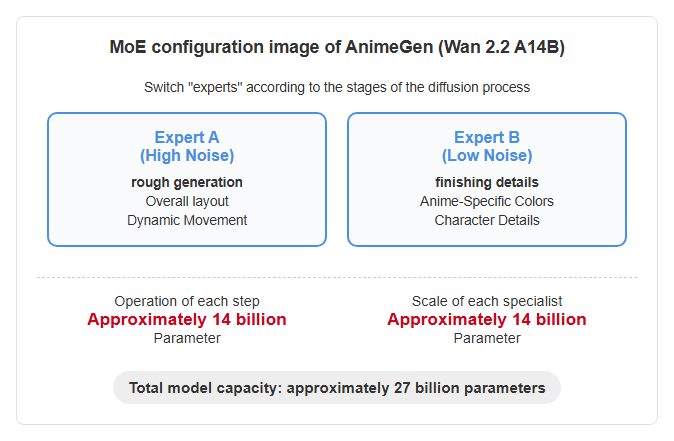
A technical feature is the Mixture of Experts (MoE) configuration derived from the Wan2.2 A14B series. This system uses different expert models according to the stage of the diffusion process: during high-noise phases, each expert handles the overall screen layout and major movements, while during low-noise phases, each expert handles detailed details. While it has a total of about 27 billion parameters, each step operates with only about 14 billion parameters, achieving efficient and high-quality output. Please refer to the following configuration image.
Operating Environment and Required Computing Resources
While AnimeGen produces high-quality videos, it requires extremely high PC specs to run locally. The official model card recommends GPUs of NVIDIA RTX 4090 or higher as the inference environment. Especially when generating high-resolution or long-form videos, larger video memory (VRAM) capacity is required, making operation on typical home PCs still a high hurdle.
The data capacity of the models is also enormous: the Text to Video (T2V) repository for creating videos from text is about 57.2GB, and the Image to Video (I2V) repository for creating videos from images reaches about 114GB. A demo environment that can be easily tried via a browser is also provided on Hugging Face Spaces, but public demos tend to cause congestion and input restrictions, so for stable use in practice, building an environment on your own server or cloud GPU is a practical choice. The high load on generation indicates that it is a cutting-edge model in video generation AI technology.
Significance and practical applications for anime production sites
Innovation in Previsualization
At present, AnimeGen’s greatest value lies not in mass-producing the final finished video, but in dramatically accelerating trial and error in the “pre-decision” production process. Specifically, it is effective for creating movie storyboards, comparing camera work, examining character movements, and exploring time changes in backgrounds (such as light transitions).
By directing multiple patterns such as “fixed camera” and “zooming on people” using text (prompts), and instantly arranging the generated temporary footage on the editing timeline, the team can quickly confirm the sense of time and direction intentions that were difficult to share with storyboards alone. This is expected to reduce retries caused by misunderstandings occurring in the middle of production and beyond, such as “the movement is different from what you expected,” thereby contributing to overall production efficiency. AnimeGen is positioning itself as a powerful previsualization tool that enables creators to bring their ideas to life.
Addressing labor shortages and expanding creative content
According to a report by the Japan Animation Association, the anime industry market in 2024 reached a record high of 3.8407 trillion yen, but at the same time, labor shortages and long working hours on site remain serious challenges. The development goal of AnimeGen is not to completely replace animators with AI, but to enable AI to support simple tasks and review processes, thereby returning time to the “acting” and “subtle direction” that humans should focus on.
Especially for individual creators and small teams, the experience of “moving your own characters,” which had previously been given up due to funding and manpower, becomes more accessible through the open-weight model. Being able to operate models on your own servers according to your own production rules, approval flows, and confidentiality agreements is a major advantage compared to using external web services. Production companies can further train their past materials or integrate them into their own pipelines, enabling them to customize AnimeGen as their own production foundation.
Debates and controversies over copyright and transparency
Close Imitation of Specific Works and Legality of Training Data
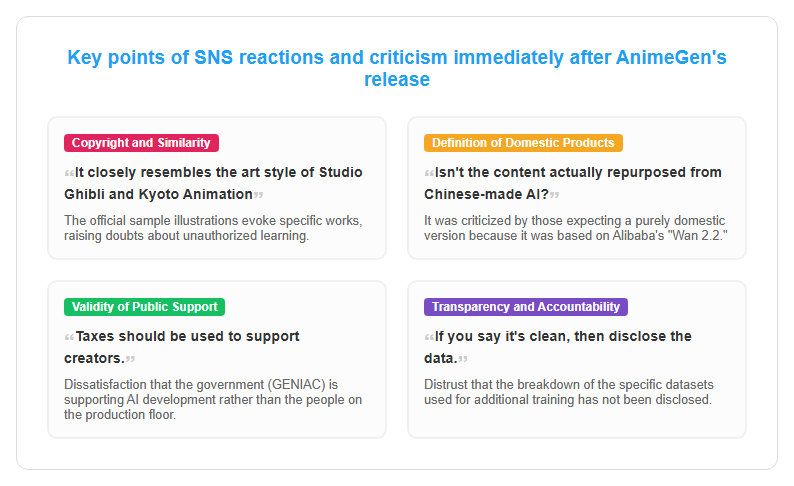
Immediately after AnimeGen’s release, social media was flooded with criticism that the official sample video styles closely resemble works by Studio Ghibli, Kyoto Animation, and Makoto Shinkai, sparking major debate. Since the AI was born from a national project supported by the Ministry of Economy, Trade and Industry, creators and anime fans have scrutinized it harshly, saying it might be unauthorized learning and threatening the workplaces that should be supported.
AIdeaLab explains that, based on Article 30-4 of Japan’s Copyright Act, it appropriately collects and utilizes training data. This provision generally states that use for purposes other than “enjoyment,” such as AI training, does not require permission from the rights holder, but there is an exception that does not apply in cases where “the interests of the rights holder are unjustly harmed,” and experts are divided on how to draw this line. Since the breakdown of the specific datasets used for additional training and details of rights handling have not been disclosed, it is difficult to audit the developer’s legitimacy statement from an external source, which also contributes to distrust. The following figure summarizes the reactions on social media.
The reality of Apache-2.0 licenses and commercial use
AnimeGen is licensed under the Apache License 2.0, allowing broad recognition of both model usage and commercial use. However, the developer cautions that “the license permitting commercial use” and “the generated product does not infringe on others’ rights” are separate issues. What Apache-2.0 guarantees is only the use of the model itself; if a video closely resembles a specific copyrighted work, such use carries the risk of copyright infringement.
According to the Agency for Cultural Affairs guidelines, copyright infringement of AI-generated works is also judged based on “similarity” and “reliability.” Using prompts that intentionally mimic the style of a particular creator increases the likelihood of credibility and raises legal risks. When companies use AnimeGen for commercial purposes, it is essential not only to license the model but also to verify the rights of the input image materials and conduct multifaceted checks by legal and intellectual property experts to ensure the output footage does not infringe on existing IP (intellectual property).
Questions about the identity of domestic AI
The fact that AnimeGen is based on “Wan 2.2” developed by China’s Alibaba also sparked controversy on social media platforms like X (formerly Twitter). Some users criticized the idea that while claiming to be domestic AI, in reality they just put Chinese AI in the shoes of the Chinese AI, and expressed dissatisfaction that projects funded by tax money were limited to expanding overseas models.
On the other hand, from a technical perspective, some view the approach of leveraging a globally advanced open foundation model and specializing Japan’s unique strength in “anime expression” as a rational strategy in terms of both speed and cost. However, for those who had high expectations for the term “domestic,” the fact that the model was fundamentally made overseas was hard to accept, leaving challenges in branding and accountability. Future evaluations will depend on how well this base model is optimized for Japan’s unique production environment and developed in a highly transparent manner.
Future Outlook and Risk Management of AI Utilization
Technical challenges and improved consistency
While AnimeGen has shown excellent performance as an anime-focused product, there are still many technical challenges to overcome. As acknowledged in the official model cards, there are limits to maintaining the continuity (consistency) of the same character across complex hand renderings, accessories, and cuts. Additionally, flicker in the direction of time and unnatural movements that ignore physical laws can occur, so human supervision and correction are essential to ensure final quality.
Going forward, the focus will be on enhancing the function to fix the same character, precise control of camera trajectory and poses, and tracking line art and color specifications, making it easier to use on set. It is expected that a workflow will progress, where humans and AI interact, such as humans editing and adding rough footage generated by AI, then using digital animation software to clean it up again. Alongside technological advancements, how to control the production process and efficiently achieve the intended results will be the key to success or failure in adoption.
Establishing guidelines for corporate adoption
To safely implement powerful AI tools like AnimeGen, companies are advised to start with small-scale proof-of-concept (PoC) and establish internal-specific guidelines. Start with verification using movie storyboards that are not publicly available or using original materials with clear rights, and measure effectiveness with specific metrics such as reduced work time and adoption rates.
Internal guidelines need to clarify definitions of prohibited materials, prohibited prompts (avoiding existing works or specific artist names), pre-publication review systems for generated works, and obligations to preserve generated logs (prompts, seed values, model versions). Additionally, policy decisions related to corporate transparency and integrity, such as whether to clearly inform viewers about the use of AI, are also important. By positioning AnimeGen not merely as a cost-cutting tool but as a foundation to expand human creativity and broaden the scope of trial and error, an attitude is required to explore new possibilities of anime expression while minimizing the risk of controversy.
[#AnimeGen #生成AI #アニメ制作 #著作権 #GENIAC #動画生成AI #AIdeaLab]
コメント