According to data released by the Bank of Japan on October 5, 2026, the supply-demand gap for the April–June 2026 quarter stood at +0.55%, marking the eighth consecutive quarter of excess demand. Behind this trend are the recovery in capacity utilization rates and tighter labor demand due to labor shortages, providing a strong basis to support the Bank of Japan’s continued implementation of additional interest rate hikes.
- Key Points of the Event and Overview of the Latest Data
- Individual Breakdown Analysis of Capital and Labor Inputs
- Financial Policy and Spillover Effects on Additional Rate Hikes
- Background of the Revision to Estimation Methods and Differences from Cabinet Office Indicators
- Impact on the Stock Market and Financial Sector
- Future Outlook and Key Points to Watch at the Monetary Policy Meeting
Key Points of the Event and Overview of the Latest Data
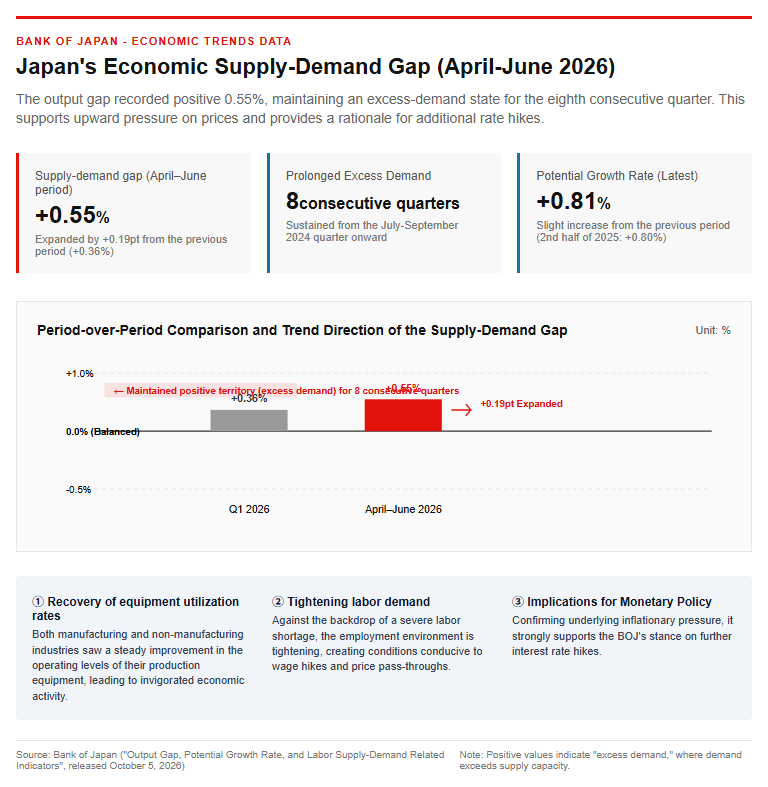
At 14:00 on October 5, 2026, the Bank of Japan released the “Output Gap, Potential Growth Rate, and Labor Supply and Demand-Related Indices” for the April-June quarter of 2026. According to the announcement, the BOJ’s version of the output gap, which indicates the degree of excess demand in the Japanese economy, stood at plus 0.55%, expanding by 0.19 percentage points from plus 0.36% in the previous January-March 2026 quarter. This marks the eighth consecutive quarter of excess demand (in positive territory) since the July-September 2024 quarter. The output gap is an indicator that represents the difference between the potential supply capacity and actual demand in the Japanese economy as a whole, with a positive value indicating a state where demand exceeds supply capacity. The continuation of excess demand means an environment where price revisions for goods and services and wage hikes are likely to occur, demonstrating that underlying upward pressure on domestic prices continues to work robustly. In addition, the potential growth rate released concurrently came in at plus 0.81%, a slight increase from plus 0.80% as of the second half of fiscal 2025. Among market participants, the release of these indicators is perceived as data that will strongly support the Bank of Japan’s goal of achieving its 2% price stability target and its policy of additional rate hikes toward the normalization of monetary policy. Please refer to the figure below for the trends and overall picture of the output gap.
Individual Breakdown Analysis of Capital and Labor Inputs
Breaking down the newly announced figures for the output gap by component, the capital input gap, which indicates the state of capital equipment, stands at plus 0.33%, while the labor input gap, which shows the degree of labor shortages, is plus 0.22%. The capital input gap indicates how fully operational capital stock—such as manufacturing equipment and retail stores—is. The background behind its continued presence in positive territory includes strong capital expenditure appetite in the manufacturing sector driven by booming demand related to semiconductors and AI, as well as a recovery in capacity utilization rates in the service sector. Meanwhile, the fact that the labor input gap is positive clearly reflects a state where the actual supply of labor is failing to keep up with the workforce demanded by companies, against the backdrop of a structural labor shortage. In recent years, due to the decline in the working-age population associated with the declining birthrate and aging population, the sense of labor shortages has reached historical levels, particularly in labor-intensive sectors such as food and lodging, construction, logistics, and medical welfare. Even when the Bank of Japan comprehensively analyzes corporate sentiment surveys such as the Tankan and employment-related indicators, the tightening of supply and demand in the labor market is evaluated as being even tighter than the output gap for the macroeconomy as a whole. Thus, the simultaneous continuation of a state where demand exceeds supply capacity on both the capital and labor fronts is the background that is generating sustainable momentum to promote the mutual rise of prices and wages.
Transmission to Monetary Policy and the Background of Estimation Methods
Financial Policy and Spillover Effects on Additional Rate Hikes
The fact that the output gap has remained positive for eight consecutive quarters and further widened its positive margin holds extremely significant implications for future monetary policy decisions by the Bank of Japan’s Policy Board. For the BOJ, which seeks to raise the policy rate, the entrenchment of a positive output gap serves as a decisive rationale reinforcing the view that “demand-driven inflationary pressure is ongoing.” Even after the policy rate reaches 0.75% following the rate hike in December 2025, real interest rates remain in negative territory, and overall financial conditions are maintained at an extremely accommodative level. BOJ board members have repeatedly emphasized the need to proceed with the “normalization of interest rates” to return real interest rates to a level that is neutral to the economy, amid the underlying inflation rate becoming anchored around 2%. With the output gap in positive territory, the probability of significant adverse effects on the economy (recession risks) arising from rate hikes is low, enabling the BOJ to calmly proceed with raising the policy rate. This data will serve as a strong backbone for the BOJ as it considers further policy rate adjustments (additional rate hikes) ahead of the Monetary Policy Meeting scheduled for October 29 and 30, 2026, and the release of the “Outlook for Economic Activity and Prices (Outlook Report).”
Background of the Revision to Estimation Methods and Differences from Cabinet Office Indicators
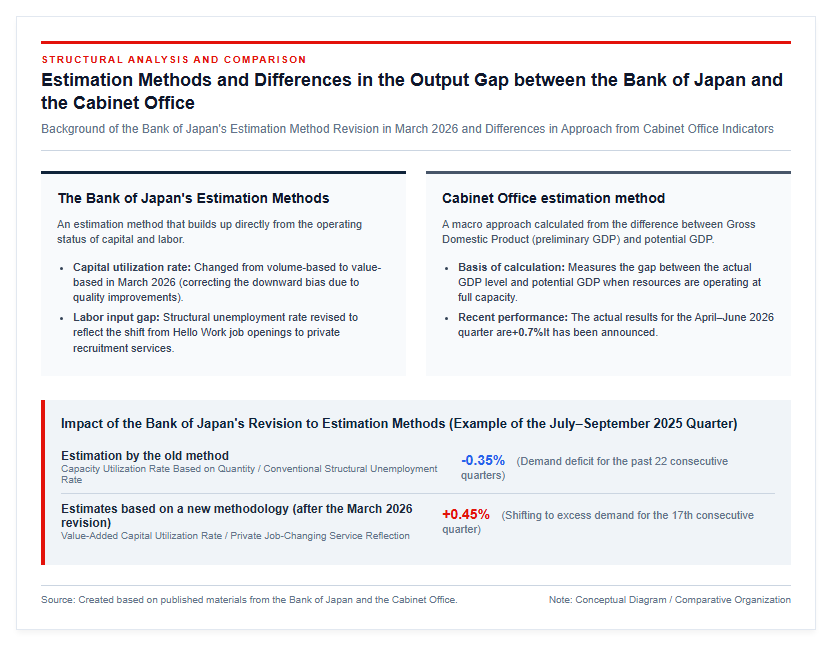
To correctly interpret the supply-demand gap, it is necessary to understand the difference between the Bank of Japan’s (BOJ) major revision of its estimation methodology in March 2026 and the GDP gap published by the Cabinet Office. On March 26, 2026, the BOJ revised its estimation method to respond to the 2020-base revision of GDP statistics and structural changes. Specifically, it changed the manufacturing capital utilization rate from conventional volume-based data (Index of Industrial Production) to value-added-based data, correcting the downward bias in the utilization rate caused by higher functionality and improved quality. Furthermore, it revised the estimation of the structural unemployment rate by reflecting the shift from Hello Work-centric public job postings to private job-hunting services. Due to this review, the figure for the same July–September 2025 quarter drastically changed from minus 0.35% under the old method to plus 0.45% under the new method, creating a historical background where the record of 22 consecutive quarters of demand deficiency was rewritten all at once into 17 consecutive quarters of demand excess. Moreover, while the BOJ’s supply-demand gap adopts an estimation method that directly accumulates data from the operating conditions of capital and labor, the Cabinet Office’s GDP gap uses a method calculated from the difference between Gross Domestic Product (preliminary GDP) and potential GDP. Therefore, differences arise between the two sets of figures due to their estimation approaches, such as the Cabinet Office’s GDP gap for the April–June 2026 quarter being announced at plus 0.7%. Please refer to the figure below for a conceptual diagram outlining the methodological differences between the Cabinet Office and the BOJ.
Impact on the stock market and points to watch in the future
Impact on the Stock Market and Financial Sector
The fact that the output gap indicates excess demand and expectations for continued interest rate hikes by the Bank of Japan are strengthening will have a profound impact on the Japanese stock market and the corporate earnings of the financial sector. In the broader stock market, while rising rate expectations tend to put the brakes on the weak-yen trend in the foreign exchange market, upward pressure is likely to be exerted on domestic long-term interest rates (the 10-year government bond yield). Particularly for the financial sector—including major financial groups such as banking and insurance stocks—rising lending rates and improved profit margins (funding gains) driven by rate hikes will serve as clear tailwinds for earnings. For instance, on the stock discussion boards of mega-banks and among investors, expectations are spreading that the rise in policy interest rates will absorb upward deviations in credit-related costs in interim and full-year financial results, leading to a stronger profit structure via increased interest income. On the other hand, concerns persist regarding the side effects of increased interest payment burdens for mid-sized and small-to-medium enterprises with high borrowing dependency and households carrying mortgages. However, in an environment where overall corporate earnings remain resilient and income conditions continue to improve through wage hikes, the earnings-boosting benefits for financial institutions brought by higher interest rates largely function as a positive underpinning factor for the stock market as a whole.
Future Outlook and Key Points to Watch at the Monetary Policy Meeting
The primary focus for the future Japanese economy and financial markets will be how the sustainability of the output gap is reflected in policy decisions at the Bank of Japan’s Monetary Policy Meeting in late October 2026. In the Outlook Report to be released on October 30, the key focus will be how the BOJ assesses the economic and price outlook and updates its scenario of a “continued modest positive” output gap. Furthermore, a speech by BOJ Governor Ueda and the release of the Regional Economic Report (Sakura Report) are scheduled just prior to the meeting, during which current supply-demand conditions and price-setting dynamics across regions and industries will be scrutinized. Potential future risk factors include sustained high crude oil prices driven by escalating Middle Eastern tensions, economic slowdowns in major overseas economies like the United States, and sharp exchange rate fluctuations. Even if terms of trade worsen due to an external shock, the Japanese economy is expected to maintain a sustainable growth trajectory, provided the domestic output gap remains positive and the cyclical structure of employment and income holds firm. Rather than reacting emotionally to the fluctuations of a single quarter’s data, it is crucial for investors and business professionals to understand macroeconomic structural changes from a multifaceted perspective, including labor supply-demand indicators and corporate price-passing trends.
Reference Page
- [Bank of Japan] Output Gap, Potential Growth Rate, and Labor Supply-Demand Related Indicators: https://www.boj.or.jp/research/research_data/gap/index.htm
- [Bank of Japan] Revision of the Output Gap and Potential Growth Rate, and Complementary Utilization of Labor Supply and Demand-Related Indicators: https://www.boj.or.jp/research/brp/ron_2026/ron260326a.htm
- [Cabinet Office] Monthly Economic Report / GDP Gap Data: https://www5.cao.go.jp/keizai3/getsurei/getsurei-index.html
【#BOJ #OutputGap #JapaneseEconomy #MonetaryPolicy #RateHike #PotentialGrowthRate #Inflation】

コメント