As part of the \$550 billion US-Japan investment and financing framework, the construction of Small Modular Reactors (SMRs) has emerged as a leading candidate for the second phase of projects. While expectations are rising amid power shortages driven by the rapid expansion of AI data centers, debate is intensifying over past construction delays, economic viability, and the risks associated with public funding.
- Overview of the Second Phase Investment Agreement and SMR Construction Plans
- Escalating Power Demand from AI Data Centers and the Role of SMRs
- Policy Push and TerraPower’s Construction Approval in Wyoming
- Economic Challenges Facing SMR Projects and Past Case Studies of Withdrawal and Downgrades
- Lessons from Past Nuclear Investment Failures: Toshiba and Westinghouse
- Risk Sharing of Public Funds and Future Outlook and Points to Watch
Overview of the Second Phase Investment Agreement and SMR Construction Plans
The Japanese and US governments are moving forward with a \$550 billion (approximately ¥87 trillion) investment and financing framework. Following first-phase projects such as synthetic diamond production and gas-fired power generation, the construction of Small Modular Reactors (SMRs)—a next-generation nuclear technology—has emerged as a top candidate for the second phase. The total scope of the second phase is expected to reach approximately \$73 billion (around ¥11.6 trillion) across three major projects, with nuclear-related investments alone projected to exceed ¥10 trillion. Specific plans under consideration include a proposal for Japan to invest and lend up to \$40 billion in an SMR co-developed by GE Vernova and Hitachi, as well as a plan to invest up to \$25 billion in SMR construction by US-based NuScale Power. In addition, there are high expectations for strengthened industrial cooperation between Japan and the US involving major Japanese heavy industry and engineering firms. This includes the potential adoption of small light-water reactors and microreactors developed by Mitsubishi Heavy Industries, as well as participation by JGC Holdings and IHI in engineering and key component manufacturing.
Escalating Power Demand from AI Data Centers and the Role of SMRs
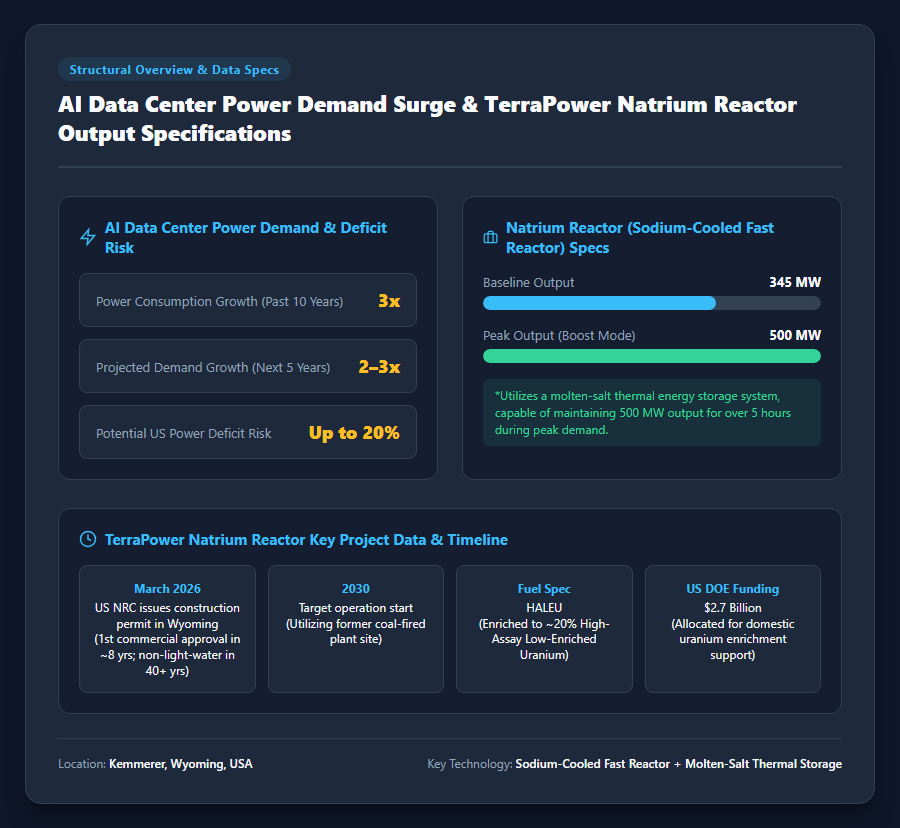
The urgency behind both governments pushing for SMR construction lies in the construction boom of large-scale data centers fueled by the rapid growth of artificial intelligence (AI), which has triggered an explosive surge in electricity demand. Power consumption by data centers has tripled over the past decade and is projected to double or triple further in the next five years. The US power grid has struggled to keep pace with this surging demand, raising concerns of potential power deficits of up to 20% in the future. US Secretary of Commerce Howard Lutnick highlighted that securing a stable baseload power supply is essential to support the AI development race and the growth of the semiconductor industry, emphasizing that nuclear plant construction represents a promising investment opportunity aligned with the long-term interests of both nations. SMRs offer key advantages, including factory-based mass production, streamlined quality control, and the ability to be constructed near high-demand locations like data centers. The Japanese government also aims to strengthen its energy security, seeking to build a joint US-Japan SMR supply chain with a view toward exporting the technology to global markets in the future.
Technical Features of SMR Development and Leading Moves in the US
Policy Push and TerraPower’s Construction Approval in Wyoming
In a concrete step forward for next-generation reactor deployment in the US, the US Nuclear Regulatory Commission (NRC) issued a construction permit in March 2026 to TerraPower, founded by Bill Gates, for its innovative “Natrium” reactor in Kemmerer, Wyoming. This marks the NRC’s first construction approval for a commercial-scale nuclear reactor since 2018, and the first approval for a non-light-water design in more than 40 years—a landmark milestone for the industry. The Natrium unit is a 345-megawatt (MW) sodium-cooled fast reactor equipped with a unique molten-salt thermal energy storage system that can boost output up to 500 MW for over five hours during peak demand. The project aims to begin commercial operation by 2030 by utilizing the site and existing infrastructure of a former coal-fired power plant. However, because the reactor uses High-Assay Low-Enriched Uranium (HALEU) enriched to nearly 20%, breaking away from past reliance on Russia and securing a stable domestic supply remain critical hurdles. To support domestic uranium enrichment, the US Department of Energy (DOE) has allocated \$2.7 billion in funding. The following diagram illustrates the concept of SMR deployment and power supply-demand dynamics.
Economic Challenges Facing SMR Projects and Past Case Studies of Withdrawal and Downgrades
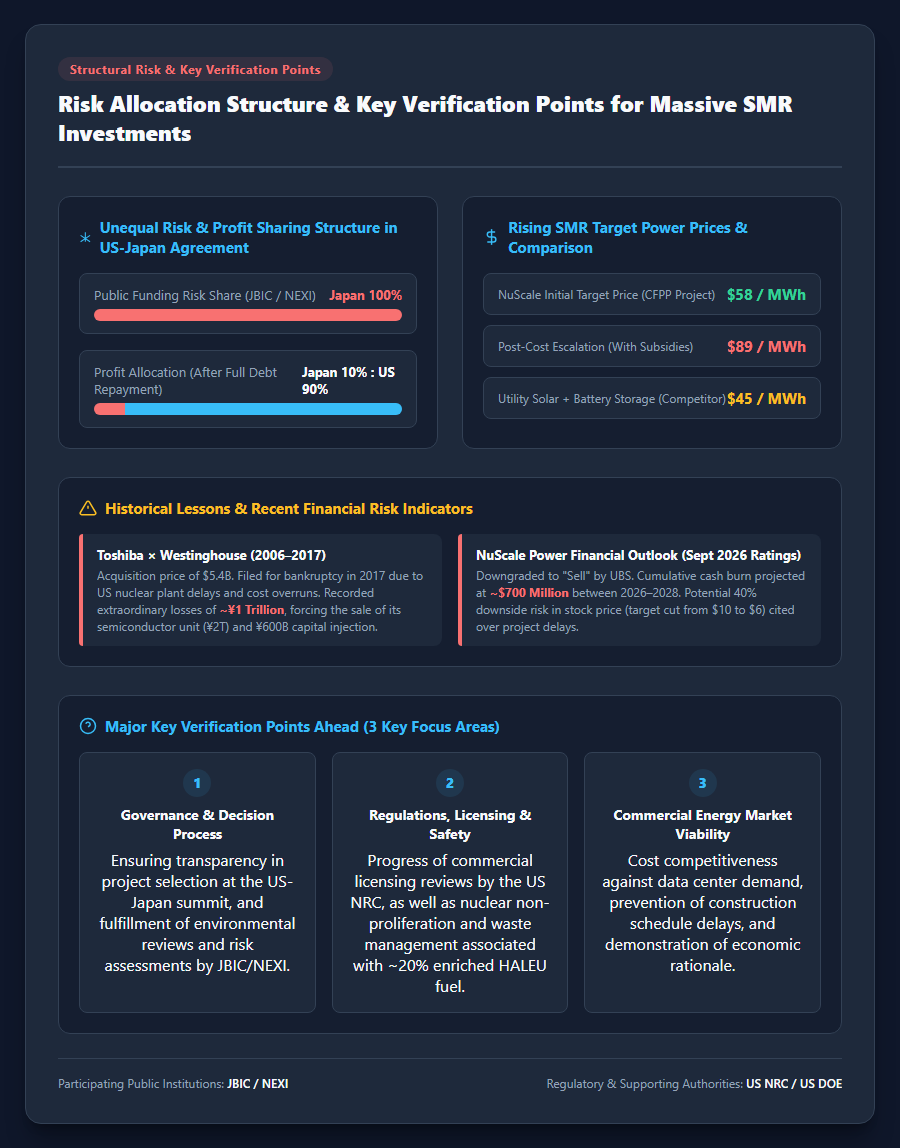
Although SMRs have been lauded as “compact and inexpensive to build,” the reality is coming to light that their cost per unit of power generation is higher than that of conventional large nuclear plants and renewable energy sources. A prominent example is the Carbon Free Power Project (CFPP) led by pioneer NuScale Power in Idaho. Due to soaring material costs and escalating construction expenses, the project’s target power price was revised upward from the initial \$58/MWh to \$89/MWh, even after factoring in heavy government subsidies. Unable to maintain price competitiveness against competing sources such as utility-scale solar paired with battery storage, the project was ultimately canceled in November 2023. Financial markets have grown increasingly cautious; in September 2026, rating agency UBS downgraded NuScale Power’s stock rating from “Neutral” to “Sell” and slashed its price target from \$10 to \$6. UBS estimates that the company will face a cumulative cash burn of approximately \$700 million between 2026 and 2028, as a lack of firm customer commitments and construction schedule delays continue to strain its finances.
Structural Risks Lurking in Massive Investments and Key Points to Watch
Lessons from Past Nuclear Investment Failures: Toshiba and Westinghouse
When considering the risks of Japanese corporations making massive investments in overseas nuclear projects, Toshiba’s 2006 acquisition of US-based Westinghouse Electric Company serves as the ultimate cautionary tale. At the time, amid global calls for a “nuclear renaissance” driven by decarbonization efforts and growing electricity demand, Toshiba acquired Westinghouse for the premium price of \$5.4 billion. However, construction projects for Westinghouse’s advanced AP1000 pressurized water reactors in states such as Georgia suffered from immature construction management, tightened safety regulations, and frequent design changes, resulting in severe schedule delays and massive cost overruns. Consequently, Westinghouse filed for Chapter 11 bankruptcy in 2017, forcing Toshiba to record an extraordinary loss of nearly ¥1 trillion and plummeting the conglomerate into a profound financial crisis. To survive, Toshiba was forced to sell its primary profit driver—its semiconductor memory business (Toshiba Memory, now Kioxia)—and execute a ¥600 billion capital injection from overseas activist funds, severely compromising the corporate independence it had built over decades. This case starkly underscores the imperative of rigorous pre-acquisition due diligence and thorough assessment of unexpected construction risks.
Risk Sharing of Public Funds and Future Outlook and Points to Watch
In response to the ¥10 trillion investment plan for SMR construction, environmental NGOs and experts have voiced grave concerns regarding the risks imposed on public funds. On March 19, 2026, international environmental NGO FoE Japan and allied organizations issued a joint statement criticizing a structure in which Japanese public financial institutions, such as the Japan Bank for International Cooperation (JBIC) and Nippon Export and Investment Insurance (NEXI), bear the brunt of project risks. Under the US-Japan agreement, profit allocation after full repayment of principal and interest is set at 90% for the US and 10% for Japan, fueling strong concerns that this represents an unfavorable deal for Japan. Furthermore, critics point to increased high-level radioactive waste per unit of electricity generated and nuclear proliferation risks associated with HALEU fuel enriched close to 20%. Moving forward, the key focus will center on the final project selection process at the US-Japan summit, the progress of licensing reviews by the US NRC, and commercial cost competitiveness in energy markets. Ensuring investment transparency and rigorous risk evaluation will be the paramount issues. The following figure outlines the major verification points for the future.
Reference Pages
- [Statement: The Second Phase of US Investment Risking Japanese Public Funds and Taxpayers is Unacceptable—Massive Investments in High-Risk Small Modular Reactors (SMRs) Should Not Be Implemented | International Environmental NGO FoE Japan] https://foejapan.org/issue/20260319/28803/
【#PoliticsAndSociety #NextGenerationNuclear #SMR #USInvestment #EnergyPolicy #USJapanRelations #EconomicSecurity】

コメント