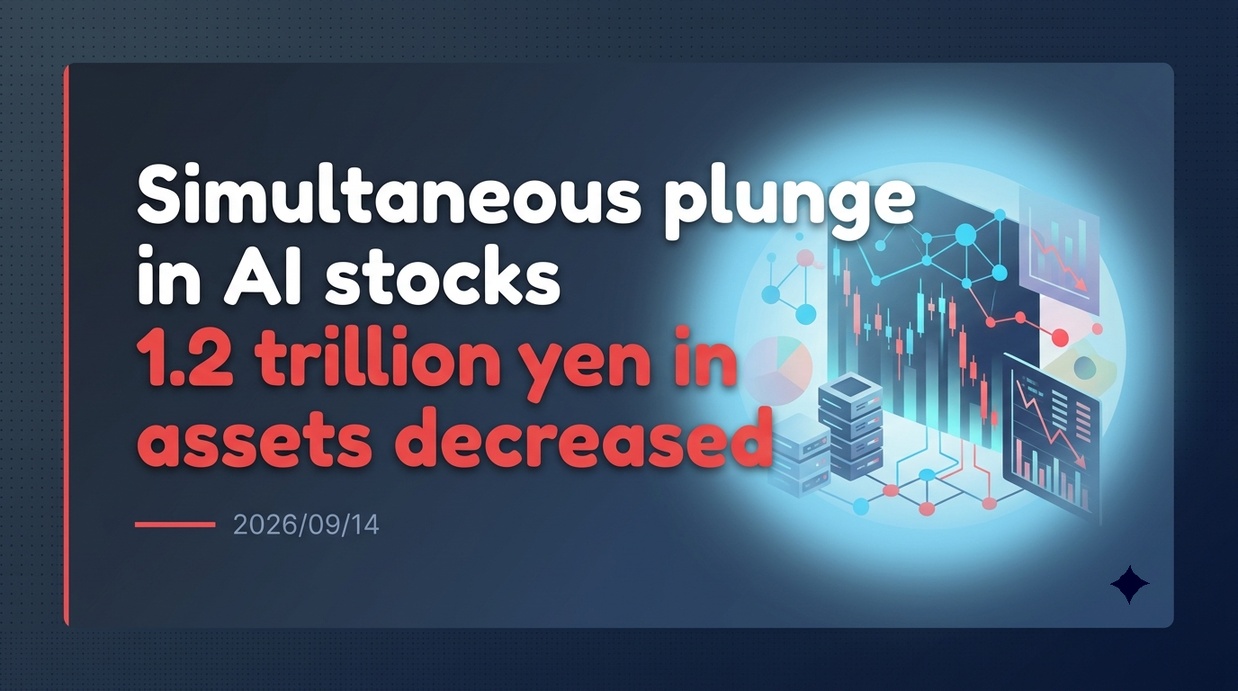
On September 14, 2026, major AI-related stocks worldwide experienced a simultaneous sharp sell-off, wiping out approximately 1.2 trillion yen (\$8 billion) from the net worth of SoftBank Group Chairman Masayoshi Son in a single day. Driven by calls from leading AI research institutions for a slowdown in development and warnings over technical risks, the market has begun rigorously scrutinizing the profitability and safety of AI investments.
- Background and Drivers of the Global AI Stock Sell-Off
- The Market Structure Behind Masayoshi Son’s $8 Billion Wealth Decline
- Spillover Effects Across Semiconductor and Tech Giants
- The Reality of a Portfolio Heavily Skewed Toward Arm and OpenAI
- Financial Health Concerns, LTV Ratios, and Credit Ratings
- The AI Slowdown Debate and the New Paradigm of Monetization
- Medium-to-Long-Term Outlook and Reassessing Investment Strategies
Background and Drivers of the Global AI Stock Sell-Off
On September 14, 2026, global stock markets witnessed a simultaneous plunge in artificial intelligence-related equities. The primary trigger for this market shock was a call from within leading AI research laboratories—including Anthropic and OpenAI—to slow down the pace of AI development. Concerns that rapid technological advances could pose existential risks to humanity quickly spread anxiety among investors. In the U.S. stock market, tech-heavy Nasdaq futures fell 1.6%, while AI chip giant Nvidia dropped 2.13% to \$213.84. Furthermore, semiconductor leaders AMD fell 4.77%, Intel declined 5.29%, and Qualcomm slipped 4.11%, with memory chipmaker Micron joining the downturn with a 5% drop to \$926. The contagion spread globally, with European semiconductor equipment giant ASML dropping 4.53%. Please refer to the diagram below.
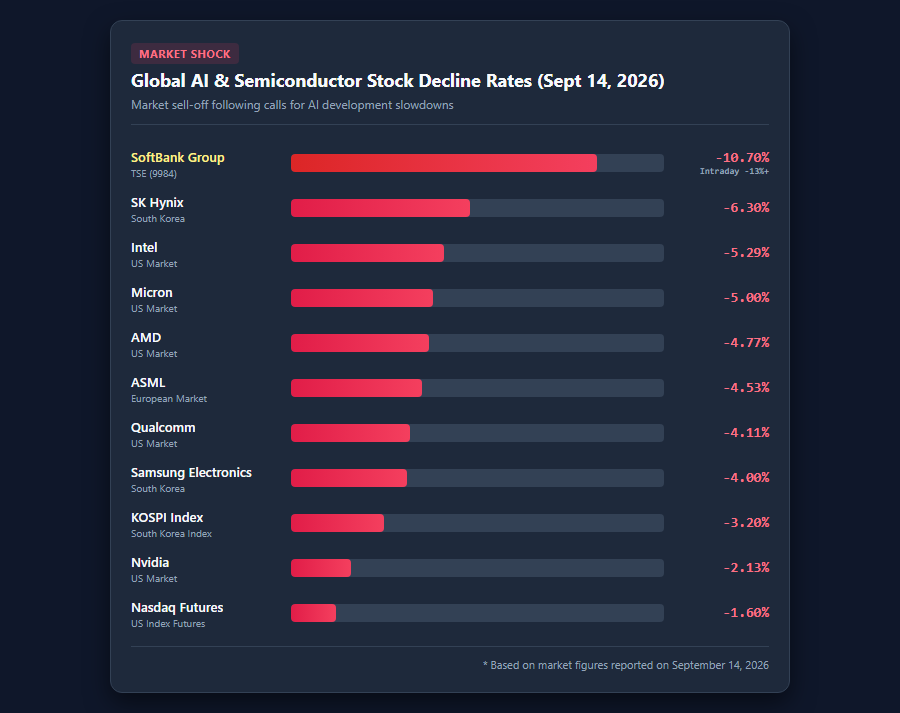
In Asian markets, South Korea’s KOSPI index slid more than 3.2%, dragged down by steep losses in Samsung Electronics (-4%) and SK Hynix (-6.3%). Market sentiment is undergoing a fundamental shift from unbridled growth expectations to heightened concern over safety and overheating risks.
The Market Structure Behind Masayoshi Son’s $8 Billion Wealth Decline
The most dramatic impact of the global AI equity rout was felt by SoftBank Group (SBG) and its Chairman and CEO, Masayoshi Son. On the Tokyo Stock Exchange on September 14, SBG shares temporarily plummeted over 13% before closing down 10.7% at 5,839 yen compared to the previous week’s close. According to Forbes estimates, this sudden share price decline erased \$8 billion (approx. 1.23 trillion yen) from Masayoshi Son’s net worth in a single day. This brought his total fortune to \$72.5 billion (approx. 11.2 trillion yen), pushing his ranking on the Forbes Billionaires List down from 27th to 29th globally. In Asia, he slipped to 4th place, trailing India’s Mukesh Ambani and ByteDance founder Zhang Yiming. The structural reason behind this massive wealth erosion lies in SBG’s heavy concentration in the AI sector, including its 13% stake in OpenAI. Because SBG’s underlying asset value is directly tethered to the valuations of AI enterprises, broader market recalibrations translate immediately into fluctuations in Son’s personal net worth.
Spillover Effects Across Semiconductor and Tech Giants
This widespread sell-off went beyond a routine equity adjustment, rippling through the entire supply chain from semiconductors to cloud infrastructure and data centers. In the memory semiconductor sector, companies like Micron—whose stock had surged over 240% year-to-date driven by explosive AI demand—suddenly experienced sharp reversals. Stock drops in South Korean semiconductor giants Samsung Electronics and SK Hynix served as a primary drag on broader Asian equity indices. Meanwhile in Europe, Netherlands-based ASML, a producer of lithography systems critical for chip miniaturization, fell 4.53%, spreading anxiety to global semiconductor equipment manufacturers. Please refer to the diagram below.
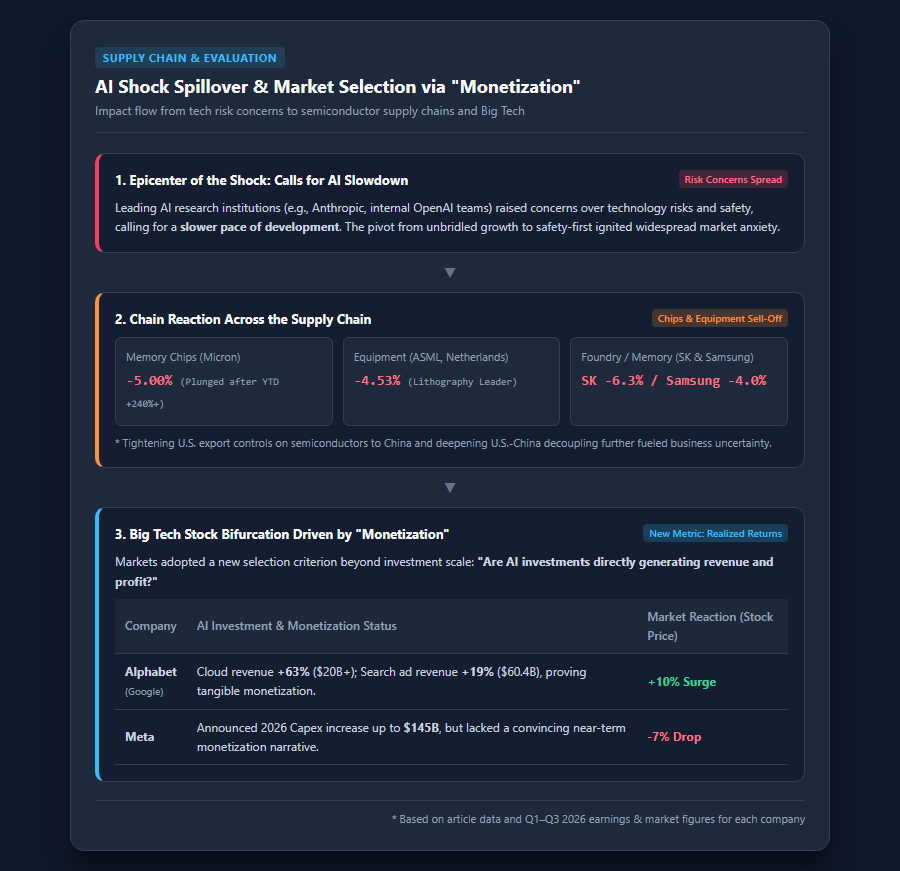
Escalating U.S. export controls on semiconductor technology toward China and accelerating U.S.-China decoupling further heightened operational uncertainty. While global tech giants continue to deploy astronomical capital expenditures, the market is shifting its evaluation criterion from the sheer scale of investment to tangible profitability, sparking a clear bifurcation across the tech supply chain.
SoftBank Group’s Concentrated AI Bets and Risk Profile
The Reality of a Portfolio Heavily Skewed Toward Arm and OpenAI
SoftBank Group’s corporate valuation and Net Asset Value (NAV) exhibit an intense concentration in specific AI assets. UK-based semiconductor designer Arm Holdings forms the largest share of SBG’s equity holdings, accounting for roughly 60% (50%–60%) of total asset value. As of the end of June 2026, Arm’s market value contribution to SBG reached 49.9 trillion yen, serving as the core engine of the group. Additionally, SBG has deepened its commitment to leading AI model developers, executing \$30 billion in additional capital injections into OpenAI through SoftBank Vision Fund 2 and related entities. Having pivoted away from its historical holdings in Alibaba and telecom-centric assets to center its portfolio on Arm and OpenAI, SBG’s NAV experienced sharp volatility—dropping from a record peak of 72.3 trillion yen in late June 2026 to 58.3 trillion yen by August 5. This concentrated portfolio structure delivers massive upside during AI rallies but drastically compresses the group’s financial buffer during downturns.
Financial Health Concerns, LTV Ratios, and Credit Ratings
As SBG accelerates aggressive capital allocation into AI assets, market scrutiny over its financial headroom and credit risk has intensified. S&P Global Ratings maintains an issuer credit rating of “BB+” (speculative grade) on SBG, highlighting risks that expanding unlisted tech investments and Arm stock volatility could strain its balance sheet. SBG maintains a self-imposed financial policy of keeping its Loan-to-Value (LTV) ratio—calculated as net debt divided by equity holdings—below 25%, which stood at a healthy 13% at the end of June 2026. However, driven by aggressive capital deployment and equity price drops, estimates for late December 2025 indicated an LTV rise to around 33%, nearing S&P’s 35% threshold for downgrade review. Please refer to the diagram below.
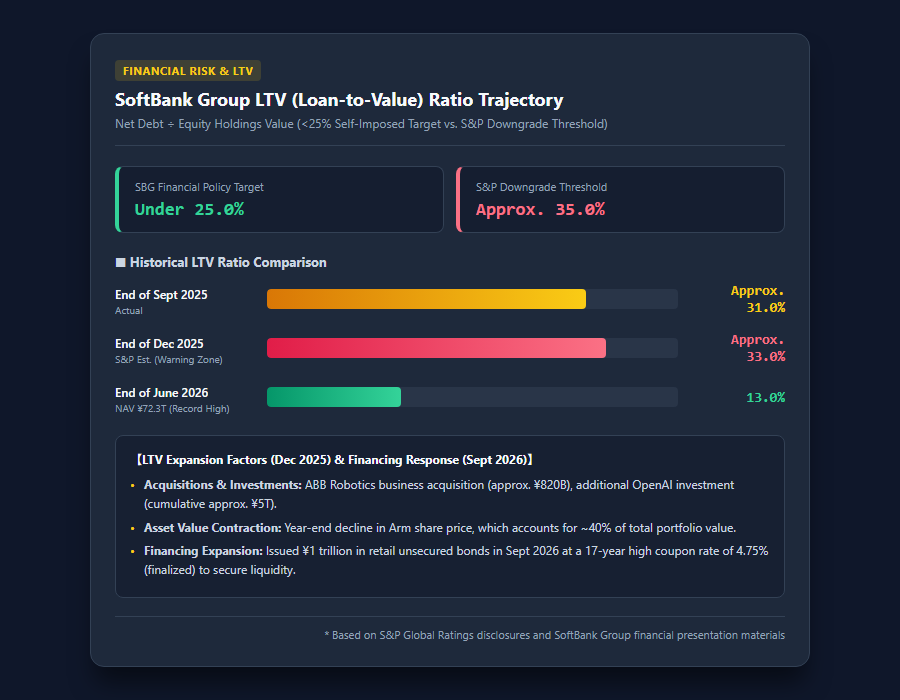
Furthermore, in September 2026, SBG issued 1 trillion yen in unsecured retail bonds at interest rates between 4.30% and 4.90% (finalized at 4.75%), marking its highest coupon in 17 years. While high-yield offerings successfully attract retail capital, they underscore growing interest burdens and repayment risks should the AI market undergo prolonged downturns.
Future AI Investment Climate and Market Challenges
The AI Slowdown Debate and the New Paradigm of Monetization
The investment landscape for AI markets and tech corporations faces a critical juncture defined by two emerging evaluation metrics: ensuring development safety and delivering monetization. Top executives at cutting-edge AI research labs, such as OpenAI and Anthropic, are calling for a moderated pace of development and robust safety standards to mitigate existential human risks, putting a damper on the unbridled speed race. Concurrently, equity markets are rigorously testing whether the hundreds of billions of dollars in annual AI infrastructure and capital expenditures deployed by Big Tech are producing tangible profits. Companies offering clear proof of AI-driven revenue—such as Alphabet, whose cloud revenue surged 63% year-over-year to surpass \$20 billion—have seen their stock rewarded. Conversely, firms like Meta, which expanded capital expenditure plans without a clear near-term timeline for investment returns, faced severe market penalties. The era of market rewards for mere capital deployment in AI is officially over.
Medium-to-Long-Term Outlook and Reassessing Investment Strategies
Prompted by AI stock volatility and ongoing slowdown debates, investors and corporate leaders are forced to recalibrate their long-term investment strategies. SoftBank Group’s ambitious visions—such as pursuing Artificial Superintelligence (ASI) and constructing 1.2-gigawatt data center infrastructure under the Stargate Project—represent long-term strategies aimed at future paradigm shifts. However, in the short term, asset illiquidity and rising borrowing costs in an inflationary environment present formidable headwinds. Unlisted holdings like OpenAI carry substantial liquidity risks during market panics, creating a divergence between paper valuations and real-world cash convertibility. For investors, rather than rushing toward high-yield bonds or seemingly discounted equities, a comprehensive analysis of LTV trajectories, asset concentration, and split credit ratings is essential. As AI technology matures into fundamental social infrastructure, the market will increasingly favor sustainable growth models that combine real profitability with safety over transient hype.
Reference Pages
- [S&P Global Ratings Credit Ratings & Announcements] https://www.spglobal.com/ratings/jp/regulatory/article/-/view/type/HTML/id/3499186
[#Economy #AISTockPlunge #MasayoshiSon #SoftBankGroup #WealthDecline #StockMarket #Semiconductors #FinancialRisk]

コメント