Toyota Tsusho Corporation recorded the highest stock price growth rate among Japan’s seven major general trading companies. This momentum is driven by a strategic pivot away from reliance on vehicle production volumes toward growth centered on Africa and the circular economy, supported by market-conscious capital policies including a large-scale share buyback.
- Event Highlights and Market Valuation
- Shifting Hierarchies Among Trading Houses and Toyota Tsusho’s Unique Edge
- Transforming the Automotive Business and Increasing Value Addition
- Four Unique Focus Areas Driving the Next Engine of Growth
- Breakthrough in the Africa Segment, the Only Standalone Regional Segment Among Trading Houses
- Expansion of Resource Recycling Business and Full Acquisition of Radius Recycling
- Unwinding Cross-Shareholdings via a Discount Tender Offer
- Shareholder Return Policy and Capital Efficiency Targets Under “To the Next Dimension 2028”
- Challenges and Scenarios for Medium-to-Long-Term Value Creation
- Growth Expectations Toward the Fiscal Year Ending March 2028
Event Highlights and Market Valuation
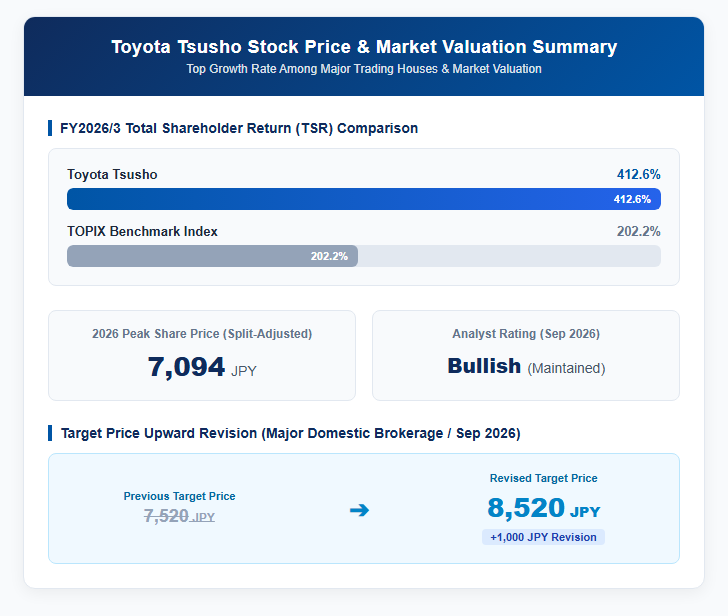
In the Japanese stock market, Toyota Tsusho’s stock price growth rate surged to the top spot among the nation’s seven major general trading companies. For the fiscal year ending March 2026, the company achieved a Total Shareholder Return (TSR) of 412.6%, substantially outperforming the benchmark TOPIX comparison index of 202.2%. Market valuation has risen rapidly, with its split-adjusted share price reaching a record high of 7,094 yen in 2026. Investor sentiment was further boosted in September 2026 when a major domestic brokerage maintained its “Bullish” rating while raising its target price from 7,520 yen to 8,520 yen. While traditional trading houses have historically been valued based on earnings tied to volatile resource markets such as iron ore and crude oil, Toyota Tsusho has demonstrated robust earning power in non-resource sectors and proprietary niche markets. Backed by a favorable market environment and solid fundamentals, the stock has attracted strong investor demand. Please refer to the following diagram.
Shifting Hierarchies Among Trading Houses and Toyota Tsusho’s Unique Edge
Japan’s trading house sector—comprising Mitsubishi Corporation, Mitsui & Co., Itochu Corporation, Marubeni Corporation, Sumitomo Corporation, Sojitz Corporation, and Toyota Tsusho—is undergoing a significant structural shift. In consolidated net profit forecasts for the fiscal year ending March 2026, Itochu Corporation expects 900 billion yen, positioning it to reclaim the top spot for the first time in five years over zaibatsu-linked peers. Amid this shifting landscape, Toyota Tsusho is pursuing a distinct strategy. While major resource-focused trading companies face commodity price volatility, Toyota Tsusho has concentrated capital in specialized areas. For the fiscal year ending March 2026, the company posted consolidated revenue of 11,561.9 billion yen (up 12.1% year-on-year) and net profit of 370.5 billion yen. By enhancing capital efficiency and leveraging a unique business foundation less vulnerable to commodity price fluctuations, Toyota Tsusho has translated its strategy into top-performing share price growth.
Pivoting from Volume Dependence to a Quality-Driven Earnings Model
Transforming the Automotive Business and Increasing Value Addition
Historically, Toyota Tsusho faced the challenge of volume dependence, where its earnings were directly linked to the new vehicle production and sales volumes of its parent company, Toyota Motor Corporation. A stark lesson occurred in the fiscal year ended March 2016, when a sharp drop in commodity prices forced an impairment loss of 92.7 billion yen, leading to a net loss attributable to the parent company of 43.7 billion yen. Driven by this experience, the company restructured its earnings model by upgrading vehicle grade mix, increasing electronic device components per vehicle, and expanding into metal processing. By the fiscal year ended March 2024, revenue reached 10,188.9 billion yen with net profit of 331.4 billion yen, establishing a resilient business structure capable of generating steady profit even without a surge in vehicle sales. Beyond vehicle export and distribution brokerage, Toyota Tsusho has established a quality-driven model across the automotive value chain, spanning assembly, aftermarket services, and sales finance.
Four Unique Focus Areas Driving the Next Engine of Growth
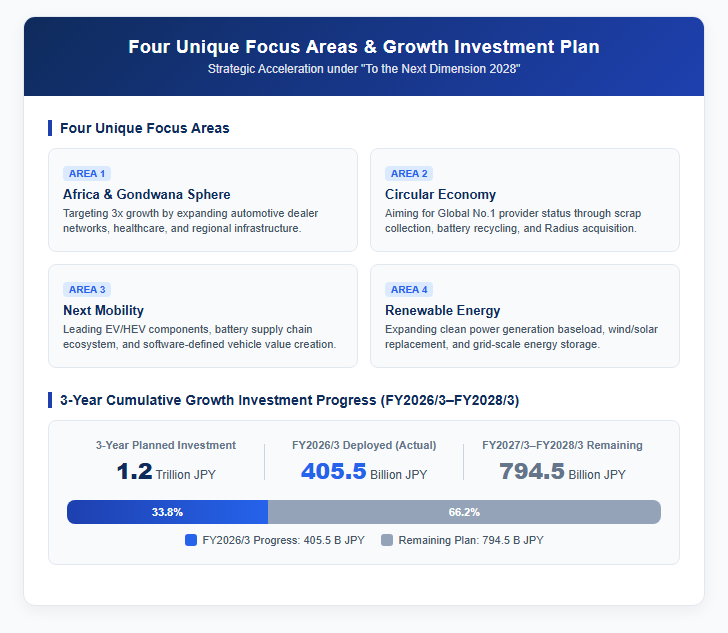
To differentiate itself from competitors, Toyota Tsusho has focused management resources on four unique business areas under the slogan of becoming a “sogo shosha with unique capabilities.” Specifically, these include triple-digit growth in its Africa business and expansion across the Gondwana economic sphere, establishing a global leadership position as a circular economy provider, leading next-generation mobility, and strengthening its renewable energy infrastructure. The company plans cumulative growth investments of 1.2 trillion yen over the three-year period from the fiscal year ending March 2026 to March 2028, with approximately 405.5 billion yen already deployed as of the fiscal year ending March 2026. Unlike traditional trading commission models, these businesses feature high entry barriers and generate sustainable added value, contributing to long-term earnings stability. Please refer to the following diagram.
Dominant Advantage in the African Market and Circular Economy
Breakthrough in the Africa Segment, the Only Standalone Regional Segment Among Trading Houses
Toyota Tsusho’s greatest competitive advantage lies in its Africa segment, which is established as a standalone reporting segment unique among major trading companies. Net profit in the Africa segment for the fiscal year ending March 2026 reached 94.0 billion yen, up 18.2% from 79.5 billion yen in the previous year, accounting for 25.3% of total consolidated net profit as the company’s largest profit contributor. Building on its presence since the 1950s and the acquisition of France-based CFAO SAS in December 2012, the company has established an unparalleled logistics and distribution network. Its operations extend beyond new and used vehicle distribution into healthcare, pharmaceutical manufacturing and wholesaling, and renewable energy development. Having expanded revenue threefold from approximately 500 billion yen to 1.5 trillion yen between 2017 and 2024, Toyota Tsusho is accelerating local investment to target an additional threefold growth by 2035.
Expansion of Resource Recycling Business and Full Acquisition of Radius Recycling
The Circular Economy segment is another key catalyst enhancing the company’s market valuation. External revenue for this segment reached 2,221.0 billion yen for the fiscal year ending March 2026 (up 25.0% year-on-year), representing the largest scale among all operating segments. Segment assets also expanded significantly by 50.3%, growing from 929.9 billion yen to 1,397.7 billion yen. In July 2025, Toyota Tsusho completed the full acquisition of US-based Radius Recycling, Inc., which operates over 100 recycling locations across the United States and Canada. Combining Radius Recycling’s operational footprint with Toyota Tsusho’s expertise in recycling technology, quality control, and closed-loop creation, the company is deepening synergies across scrap metal, end-of-life vehicle (ELV) recycling, and battery material reuse to lead global circular economy supply chains.
Toyota Group Restructuring and Large-Scale Capital Policy
Unwinding Cross-Shareholdings via a Discount Tender Offer
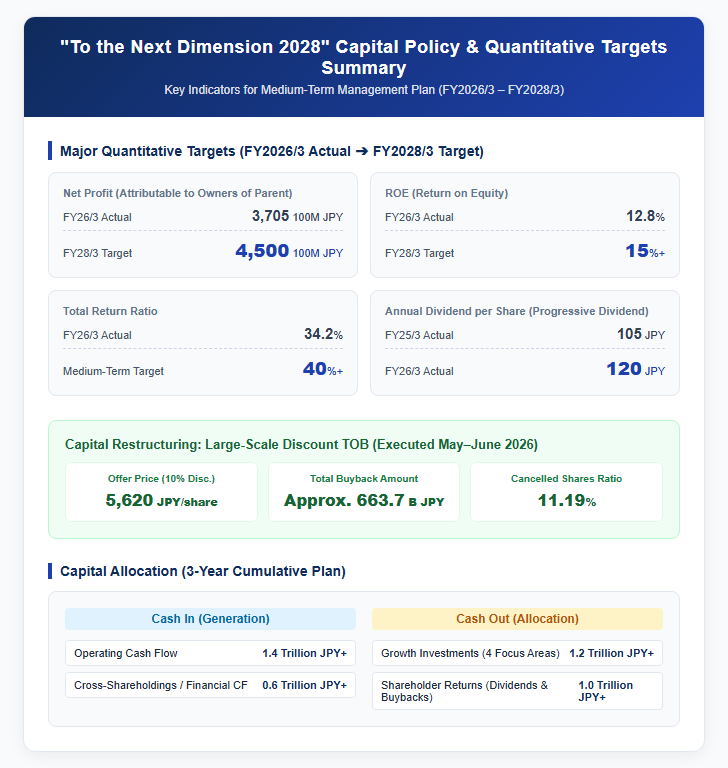
A major catalyst driving the surge in Toyota Tsusho’s stock price was a large-scale self-tender offer (discount TOB) executed between May and June 2026. This transaction formed part of a broader Toyota Group capital restructuring aimed at unwinding cross-shareholdings and privatizing Toyota Industries Corporation. The offer price was set at 5,620 yen per share, repurchasing all 118,095,402 shares (11.19% ownership stake) held by Toyota Industries for approximately 663.7 billion yen. By employing a discount TOB priced below prevailing market rates, the company avoided market supply overhang and share price depression risks while facilitating a major shareholder’s exit strategy. The acquired treasury shares were fully cancelled on June 30, 2026, directly enhancing earnings per share (EPS).
Shareholder Return Policy and Capital Efficiency Targets Under “To the Next Dimension 2028”
Under its medium-term plan “To the Next Dimension 2028” announced in April 2025 (covering fiscal years ending March 2026 to March 2028), Toyota Tsusho shifted toward management focused on improving Price-to-Book Ratio (PBR). This strategy aims to enhance PBR by driving improvements in both Return on Equity (ROE) and Price-to-Earnings Ratio (PER). Targets for the fiscal year ending March 2028 include net profit of 450 billion yen, ROE of 15% or higher, and a total return ratio of 40% or higher. Regarding dividend distribution, the company intends to maintain its progressive dividend policy, marking an expected 18 consecutive fiscal years of dividend increases, with the dividend per share for the fiscal year ending March 2026 raised to 120 yen from 105 yen in the prior year. Capital allocation that optimizes cash flow generation (three-year cumulative operating cash flow of 1.4 trillion yen or more) and proceeds from cross-shareholding divestments toward growth investments and shareholder returns has earned strong trust from the capital markets. Please refer to the following diagram.
Outlook and Key Watchpoints for Investors
Challenges and Scenarios for Medium-to-Long-Term Value Creation
While growth expectations remain elevated, the company faces structural risks and operational challenges. According to risk disclosures in its annual securities report, revenue dependence on the Toyota Motor Group rose to 20.0% in the fiscal year ending March 2026 (up from 18.6% in the previous year), leaving performance partially exposed to parent production trends. Geopolitical and currency risks also persist across Africa and other emerging markets. Furthermore, the Green Infrastructure segment, which handles renewable energy operations, recorded a fixed asset impairment loss of 12.4 billion yen in the fiscal year ending March 2026, highlighting the need for project reassessments and risk management. In response, Toyota Tsusho is enforcing strict risk-asset controls and portfolio realignments to build organizational resilience.
Growth Expectations Toward the Fiscal Year Ending March 2028
Overall, Toyota Tsusho has successfully evolved beyond its traditional role as a procurement trading arm for the Toyota Group into a global trading powerhouse with unique capabilities. The alignment of three core pillars—deepening first-mover advantages in Africa, building a global circular economy network, and driving capital efficiency through group restructuring—has propelled its stock performance to the top among major trading companies. Moving forward, the key focus will be how effectively the company deploys its 1.2 trillion yen investment framework for M&A and business expansion toward achieving its 450 billion yen net profit target for the fiscal year ending March 2028. Guided by its vision “Be the Right ONE,” Toyota Tsusho’s continued pursuit of distinct capabilities is set to command sustained attention across capital markets.
Reference Pages
- 【Toyota Tsusho Corporation IR Information】https://www.toyota-tsusho.com/ir/
【#ToyotaTsusho #SevenMajorTradingHouses #StockPricePerformance #ShareBuyback #ToTheNextDimension2028 #AfricaBusiness #CircularEconomy #ToyotaGroupRestructuring】
コメント