vLLM v0.30.0, an open-source inference engine designed to accelerate large language model operations, has been officially released. The launch comes amidst strong market demand for faster model startup times and more efficient long-context processing as generative AI accelerates its deployment across enterprise environments.
- Key Takeaways: Next-Generation Inference Engine Powered by 762 Commits
- Accelerating Cold Starts: Fast Start and the Weight-Caching Daemon
- Supporting Ultra-Long Contexts: HiSparse and Hierarchical KV Cache Management
- Model Runner V2 Evolution: Faster Initialization and Graph Capture
- Native Text Watermarking for Secure AI Governance
- Immediate Support for Cutting-Edge Models: DeepSeek-V4.1-Flash and GLM-5.3-Flash
- Future Outlook: Standardizing Enterprise AI Infrastructure
Key Takeaways: Next-Generation Inference Engine Powered by 762 Commits
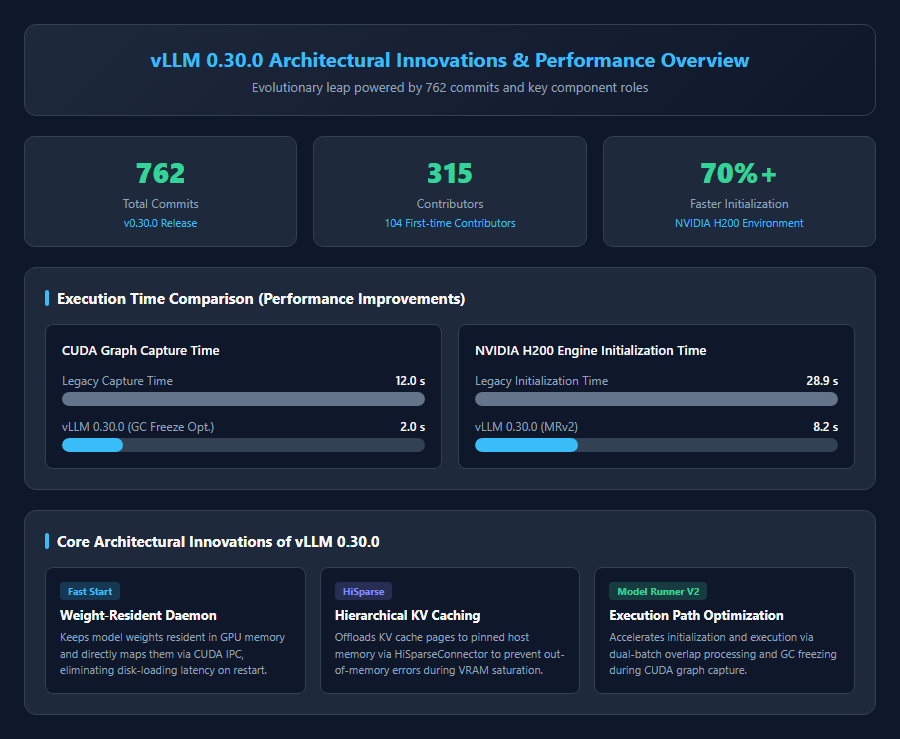
The v0.30.0 release of vLLM, the open-source Large Language Model (LLM) inference engine, is now officially available. This major release incorporates 762 commits contributed by 315 developers, including 104 first-time contributors. Beyond improving inference throughput, the development community focused heavily on streamlining practical deployment, delivering features that reduce cold-start latency during server restarts and prevent memory congestion through a multi-tiered caching architecture. Key innovations include “Fast Start”—a daemon that keeps quantized weights resident in GPU memory—and “HiSparse,” which offloads KV cache memory to host RAM to prevent out-of-memory errors. These capabilities directly address key operational bottlenecks in enterprise LLM serving, reducing latency and operational costs. Furthermore, v0.30.0 brings day-zero support for the latest open-weight models, including DeepSeek-V4.1-Flash and GLM-5.3-Flash. As illustrated in the diagram below, vLLM continues to consolidate its role as the foundational serving engine for modern AI deployments.
Accelerating Cold Starts: Fast Start and the Weight-Caching Daemon
In traditional deployments, restarting an LLM inference engine or recovering from a fault required reloading tens of gigabytes of model weights directly from disk storage, incurring significant startup latency. vLLM 0.30.0 resolves this bottleneck by introducing Fast Start, a persistent GPU weight-caching daemon. Under this mechanism, pre-quantized and tensor-parallel (TP-sharded) model weights remain pinned in GPU memory via a daemon process. Upon restarting, the serving engine directly maps into this existing memory space via CUDA Inter-Process Communication (IPC) instead of performing slow disk reads. Users can enable this feature using the --load-format ipc_cache command-line argument, which supports FP4 checkpoints and multi-node tensor-parallel setups. By minimizing service downtime, Fast Start drastically enhances operational efficiency across high-utilization inference environments.
Supporting Ultra-Long Contexts: HiSparse and Hierarchical KV Cache Management
Processing long prompt contexts and managing high-concurrency requests place heavy demands on GPU memory (VRAM), primarily driven by the key-value (KV) cache storing past token activations. To overcome VRAM constraints during sparse-MLA decoding, vLLM 0.30.0 introduces “HiSparse,” a host-resident caching tier managed by the HiSparseConnector. When GPU memory pressure crosses a predefined threshold, HiSparse automatically offloads KV cache pages into host-side pinned memory. In the event of top-k cache misses during incoming requests, data is swiftly re-supplied from a per-request GPU hot buffer. Backed by shared host caching across tensor-parallel ranks and Prometheus metric tracking, HiSparse ensures stable execution of prompt contexts spanning tens of thousands of tokens without triggering out-of-memory crashes.
Infrastructure Optimization and Enhanced AI Governance
Model Runner V2 Evolution: Faster Initialization and Graph Capture
Model Runner V2 (MRv2), which fundamentally revamped the inference execution pipeline in prior releases, receives significant performance upgrades in v0.30.0. The updated execution path supports dual-batch overlap processing across eager mode and full CUDA graph execution for micro-batching. Additionally, by freezing Python garbage collection (GC) during CUDA graph capturing, capture time was cut dramatically from 12 seconds down to just 2 seconds. Consequently, full engine initialization on an NVIDIA H200 system dropped from 28.9 seconds to 8.2 seconds—achieving a total speedup of over 70%. The release also improves speculative decoding efficiency (such as MTP, EAGLE3, and DFlash) in pipeline-parallel configurations, adds dynamic validation via online acceptance estimators, and optimizes sampling mask kernel execution on the GPU to reduce reinforcement learning (RL) step latency.
Native Text Watermarking for Secure AI Governance
Tracing synthetic content and preventing misuse have become essential requirements for enterprise AI deployments. vLLM 0.30.0 introduces native text watermarking based on the Gumbel-max algorithm to embed invisible, cryptographically verifiable tracking patterns into generated outputs. Utilizing a keyed Pseudo-Random Function (PRF), the system inserts imperceptible token-level markers directly during inference. The feature operates on an opt-out, per-request basis and provides dedicated sample-detection endpoints for verification. Furthermore, by implementing a dual-key architecture, vLLM achieves seamless integration between watermarking and speculative decoding without compromising generation throughput. These security parameters remain fully controllable even through experimental Rust frontends, offering robust content governance directly at the inference infrastructure layer.
Expanding Model Support and Future Outlook for AI Infrastructure
Immediate Support for Cutting-Edge Models: DeepSeek-V4.1-Flash and GLM-5.3-Flash
vLLM’s hallmark capability—rapidly supporting state-of-the-art open models—is fully showcased in this release. Newly supported architectures include DeepSeek-V4.1-Flash, which leverages FlashMLA V4.1 kernels on SM100 hardware to store all KV caches in MXFP8 format, as well as models incorporating DeepGEMM Mega-mHC kernels. Out-of-the-box compatibility extends to GLM-5.3-Flash with Expert Parallelism Load Balancing (EPLB), K2-Horizon with specialized reasoning/tool-call parsers, Cohere Compass, and Bailing V3 VL. Cross-hardware support across NVIDIA GPUs, AMD ROCm, and CPU backends has also been expanded. For CPU-only servers, new AVX512 and AMX kernels enable sparse-MLA, indexer, and compressor execution for DeepSeek-V4 models, unlocking viable inference speeds on non-accelerated enterprise hardware.
Future Outlook: Standardizing Enterprise AI Infrastructure
The launch of vLLM 0.30.0 signals a clear shift in the AI landscape: competitive advantage is no longer determined solely by model size, but by the design and efficiency of the serving stack. Legacy gRPC server entry points have been consolidated into vllm serve --grpc, streamlining deployment workflows. Scale-out endpoints are now explicitly managed via the --enable-scale-out CLI flag, facilitating safer production deployments. Moving forward, as hardware optimizations deepen across NVIDIA Blackwell, AMD ROCm, and Intel XPU architectures, vLLM is poised to solidify its role as the industry standard for hybrid cloud and on-premise AI infrastructure. To maximize ROI, organizations must look beyond model selection and actively optimize their serving stack configurations.
References
- [vllm-project/vllm v0.30.0 Release Notes (GitHub)] https://github.com/vllm-project/vllm/releases/tag/v0.30.0
- [vllm-project/vllm Official GitHub Repository] https://github.com/vllm-project/vllm
【#vLLM #LLMInference #OpenSource #AIInfrastructure #DeepSeek #NewFeatures】

コメント