Meta and EssilorLuxottica have officially unveiled the third-generation “Ray-Ban Meta (Gen 3)” AI glasses and introduced a new category, “Ray-Ban Meta Audio.” This move comes amid rapid technological advancements in wearable AI and soaring demand for seamless, everyday audio and visual interfaces.
- Announcement Overview and the Evolution of the “Ray-Ban Meta (Gen 3)”
- Audio-Centric “Ray-Ban Meta Audio” and Diverse Style Expansion
- On-Device AI and Multimodal Breakthroughs Transforming User Experience
- Strict GDPR Scrutiny in Europe and Criminal Voyeurism Charges in Germany
- Course Correction at Reality Labs and Building an AI Ecosystem via Muse
- Future Projections for the Smart Glasses Market and Key Watchpoints
Announcement Overview and the Evolution of the “Ray-Ban Meta (Gen 3)”
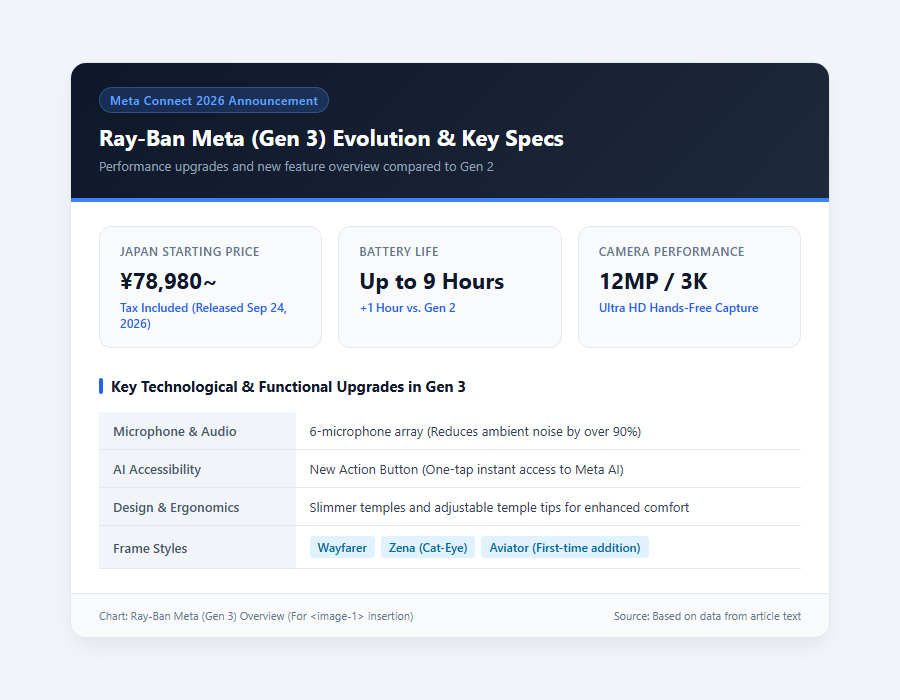
On September 24, 2026, Meta and EssilorLuxottica officially announced their next-generation AI smart glasses, “Ray-Ban Meta (Gen 3),” at their annual Meta Connect 2026 conference, launching sales globally on the same day, including in Japan. Prices at direct retail stores and official online channels start at 78,980 yen (tax included). The third-generation model delivers substantial performance upgrades over its predecessor (Gen 2). In terms of design, the glasses feature slimmer temples and adjustable temple tips to maximize wearing comfort during extended use. Battery life has been extended to up to 9 hours, marking a 1-hour improvement compared to Gen 2. Functionally, the device is equipped with a 12MP 3K Ultra HD camera for hands-free capturing and a 6-microphone array that reduces ambient noise by over 90 percent. Furthermore, a newly added Action Button on the side allows users to access Meta AI with a single tap, enabling seamless hands-free AI experiences such as photography, real-time translation, checking messages, and setting reminders without pulling out a smartphone. Alongside the classic Wayfarer, the line now includes the cat-eye Zena and Ray-Ban’s iconic Aviator, marking its first-ever appearance as an AI glass.
Audio-Centric “Ray-Ban Meta Audio” and Diverse Style Expansion
The announcement also marked the debut of “Ray-Ban Meta Audio,” a brand-new category designed specifically for audio experiences and voice calls by stripping away the camera and complex AI features. Meta’s internal research revealed that audio functionality is among the most frequently used features among smart glasses owners, prompting the creation of this targeted lineup. Weighing just 43 grams, it stands as the lightest smart glasses model in Meta’s history, engineered for effortless all-day wear. The standalone battery lasts up to 12 hours, which extends to up to 48 hours when paired with the companion charging case. Featuring classic frames such as the Clubmaster and the rectangular Burbank, pricing starts at \$349 in the United States (with a Japan launch scheduled for 2027). To further broaden eyewear diversity, Meta introduced celebrity collaboration models including “Meta Glasses by LISA” and “Meta Glasses by Kylie Jenner” (priced at 68,200 yen including tax), as well as a limited-edition autumn color collection. Expanded lens options—such as prescription lenses and “Transitions” light-intelligent lenses—offer consumers a rich array of choices tailored to their specific lifestyles and visual needs.
Technological Innovations in Wearable AI and Privacy & Regulatory Challenges
On-Device AI and Multimodal Breakthroughs Transforming User Experience
At the heart of the Ray-Ban Meta (Gen 3) is a sophisticated synthesis of on-device AI processing and multimodal capabilities. Through the built-in camera and microphones, users can instantly share their field of view and audio environment with the AI. They can ask questions about landmarks or signs in front of them, receive real-time speech translations, or discover nearby recommended spots in an intuitive, hands-free manner. In addition, new visual and auditory capture capabilities—such as Dynamic Photo, which automatically selects the best shot from multiple frames, and support for 360-degree spatial audio recording/playback powered by Dolby Atmos (a consumer device first, scheduled via an upcoming software update)—deliver deeply immersive recording experiences. These advancements signify a major paradigm shift from traditional smartphone screen-based interactions toward ambient computing, where digital information is naturally overlaid onto the physical world. As highlighted in McKinsey’s Technology Trends Outlook 2026, smart glasses are evolving from output devices that simply display content into intelligent input devices that perceive surrounding context and respond immediately, laying the foundation for real-time decision support across daily life and enterprise environments.

Strict GDPR Scrutiny in Europe and Criminal Voyeurism Charges in Germany
While technological breakthroughs have drawn praise, the legal concerns and societal friction stemming from privacy risks associated with always-worn cameras and microphones are rapidly intensifying. In August 2026, the German digital rights advocacy group HateAid filed criminal charges with the ZIT (Central Office for Cybercrime) under the Frankfurt Public Prosecutor’s Office against Meta, EssilorLuxottica, and major retailers. The suit alleges that the Ray-Ban Meta Wayfarer’s design enables illicit surreptitious recording without making surrounding individuals aware of being captured. The lawsuit contends that the LED recording indicator light is insufficient, violating German laws prohibiting unauthorized recording using telecommunication equipment. Furthermore, under the European Union’s General Data Protection Regulation (GDPR), the transparency of data flows—specifically how captured facial images and voice data are transmitted to the cloud and utilized for AI model training—and adherence to data minimization principles face rigorous scrutiny. For enterprise, public space, and healthcare deployments, relying solely on LED indicators is no longer sufficient; establishing clear operational guidelines, providing prior notification, and performing Data Protection Impact Assessments (DPIAs) have become mandatory.
Meta’s AI Integration Strategy and Future Market Outlook
Course Correction at Reality Labs and Building an AI Ecosystem via Muse
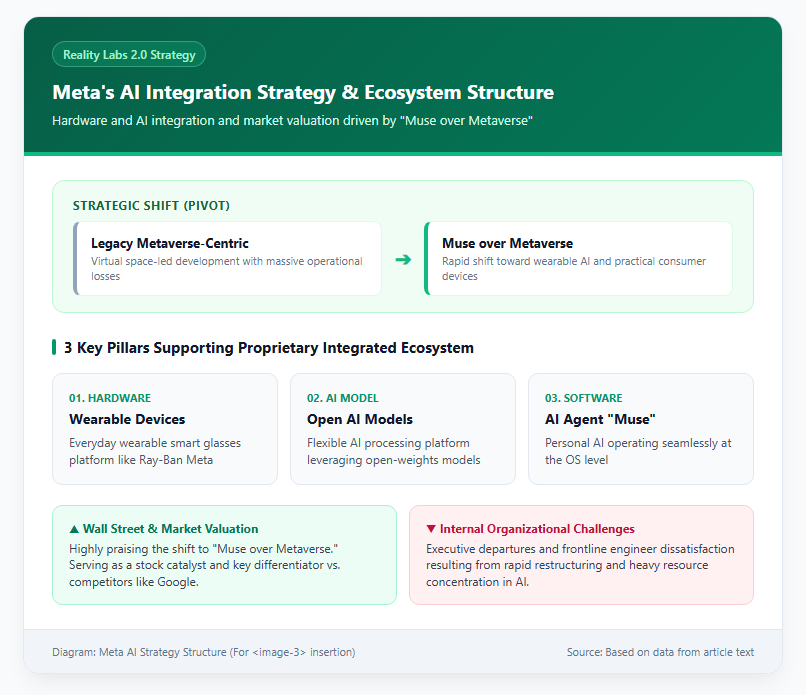
The commercial success of the smart glasses business has become a central pillar in Meta’s long-term AI and hardware integration strategy. Reality Labs, which previously posted massive operational losses while pursuing metaverse development, has rapidly pivoted toward practical wearable AI devices, driven by explosive smart glasses growth and the introduction of the personal AI agent “Muse.” Wall Street analysts have strongly endorsed this shift—termed “Muse over Metaverse”—viewing it as a major catalyst for elevating Meta’s stock valuation. At the same time, internal reports highlight friction, including dissatisfaction among frontline engineers and executive departures resulting from rapid organizational restructuring and heavy resource concentration in AI divisions. Nevertheless, under CEO Mark Zuckerberg’s resolute leadership, Meta is steadily constructing an integrated proprietary ecosystem uniting hardware, open-weights AI models, and OS-level software—establishing a clear competitive advantage over rivals like Google.
Future Projections for the Smart Glasses Market and Key Watchpoints
The smart glasses market is projected to expand at a pace significantly outperforming traditional, bulky VR/MR headsets. Market research data shows that smart glasses shipments in early 2026 surged by 167 percent year-over-year, reflecting rapid consumer acceptance of lightweight, everyday wearable devices. Global expansion into regions such as Turkey, Poland, South Africa, and Southeast Asia is expected to broaden market reach, while the anticipated full-scale entry of competitors like Samsung Electronics and Apple into the AI eyewear segment will further intensify market rivalry. Looking ahead, key watchpoints include: first, improving on-device AI inference speeds and battery efficiency; second, establishing privacy-conscious designs compliant with personal data protection regulations, particularly in Europe; and third, demonstrating tangible return on investment (ROI) across enterprise, healthcare, and educational applications. When both technological evolution and legal/societal consensus are achieved, AI glasses will solidify their position as the next-generation standard computing platform replacing smartphones.
References
- [Ray-Ban Meta Official Website] https://www.ray-ban.com/japan/l/discover-ray-ban-meta-ai-glasses
- [Meta Official Leadership & Corporate Info] https://www.meta.com/ja-jp/about/
【#Meta #RayBanMeta #AIGlasses #SmartGlasses #WearableAI #GDPR #Privacy】


コメント