Zoho Japan Corporation has announced a full-stack technology strategy centered around its proprietary large language model “Zia LLM” and in-house developed server “Nathu La.” This is driven by the growing market demand to overcome the limitations of general-purpose AI while simultaneously achieving customer data protection and operational cost reduction.
- Key Points of the Announcement and Overview of Full-Stack Vertical Integration
- Features and Technical Rationale of the Proprietary LLM “Zia LLM”
- TCO Reduction Benefits of the In-House Developed Server “Nathu La”
- A privacy-first architecture that does not use customer data for training
- Domestic Business Promotion Structure through Workforce Doubling and Office Expansion
- Future Developments and Key Points to Watch in the Enterprise AI Market
Key Points of the Announcement and Overview of Full-Stack Vertical Integration
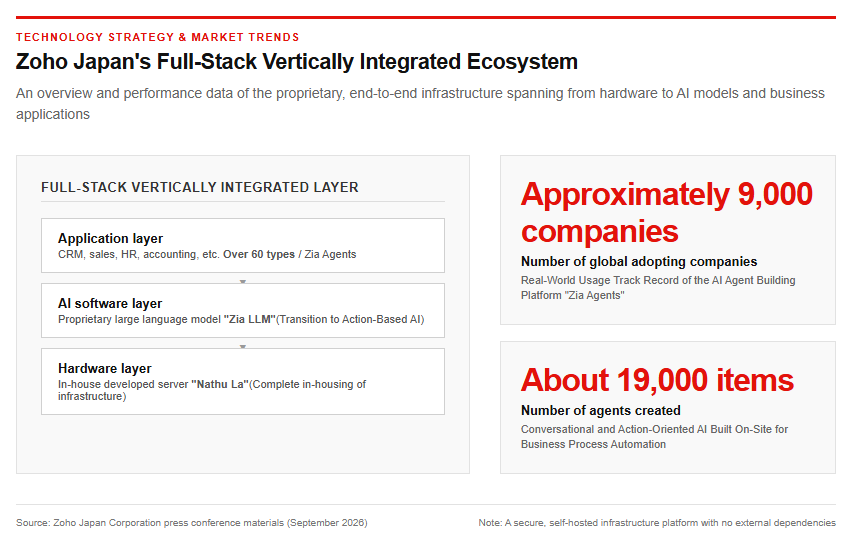
Zoho Japan Corporation held a press conference on September 25, 2026, to unveil its product development based on a proprietary technology infrastructure and its strategy to accelerate investment in the Japanese market. The company offers more than 60 types of applications, including customer relationship management (CRM), sales, marketing, human resources, accounting, and collaboration tools. The presentation showcased a unique full-stack approach that vertically integrates everything in-house, from server hardware to the software layer of AI models.
The presentation featured Ramprashanth Ramamoorthy, Head of AI Research at Zoho India, and Hideki Hattori, Executive Officer and General Manager of the Zoho Division at Zoho Japan. Zia Agents, the AI agent building platform provided by the company, is already used by approximately 9,000 companies globally, with the number of created agents reaching about 19,000. As the industry transitions from conventional conversational AI to action-driven AI that automatically executes business processes, the company presented a self-contained architecture that does not rely on external infrastructure or third-party models. Please refer to the schematic diagram below.
Features and Technical Rationale of the Proprietary LLM “Zia LLM”
At the core of Zia, the proprietary AI assistant deployed by Zoho Japan, is the in-house researched and developed large language model, Zia LLM. While general-purpose large models consume vast parameters and computational resources, Zia LLM is characterized by a parameter design specialized for corporate business domains. This significantly reduces the computational costs required for inference processing while achieving practical response accuracy and high-speed responses.
Zia LLM serves as a common infrastructure for each business agent, handling specialized processing tailored to individual domains. To resolve issues faced by general-purpose AI, such as a lack of domain knowledge and the generation of unnecessary context, it incorporates context-comprehension capabilities that naturally integrate with internal corporate data. Unlike the approach of calling other companies’ generative AI services via API integration, it maintains everything from the model’s algorithms to the infrastructure in-house, thereby avoiding technical black-boxing and enabling the long-term, stable provision of services.
Custom Hardware and Privacy Protection as a Competitive Advantage
TCO Reduction Benefits of the In-House Developed Server “Nathu La”
The company has not only engaged in the in-house development of software and AI models, but has also embarked on developing server hardware for use in data centers. The in-house developed server “Nathu La,” announced in June 2026, has already been integrated as part of the company’s business infrastructure and is operational. By handling board design and architectural optimization in-house, the company has succeeded in reducing power consumption by 12% to 18% compared to general-purpose third-party servers.
Furthermore, building proprietary infrastructure offers significant economic benefits, achieving a 20% to 30% reduction in total cost of ownership (TCO). While the global AI boom has brought growing concerns over increased data center power consumption and soaring server procurement costs, in-house development from the hardware level has reduced operating costs. As shown in the architectural diagram below, a structure has been established to pass these cost savings on to product pricing and service quality.
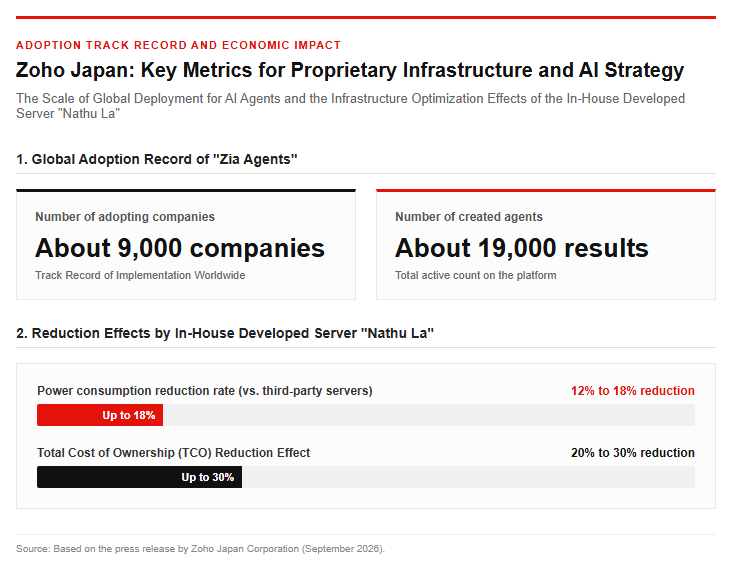
- Reduction in power consumption: 12% to 18% reduction compared to other companies’ servers
- Reduction in Total Cost of Ownership (TCO): 20% to 30% reduction compared to other companies’ servers
A privacy-first architecture that does not use customer data for training
Ensuring data security and privacy is the biggest concern for enterprises adopting AI. Zia LLM enforces an architecture that ensures data entered by enterprise customers and confidential information within Customer Relationship Management (CRM) systems are never used to retrain AI models. Each customer’s data environment is strictly isolated, structurally eliminating the risk of information leakage to other customers or data breaches through the model.
Since its inception, Zoho Japan has steadfastly maintained a business model that does not monetize data through advertising. Its commitment to data protection is ensured not only at the contractual level but also at the system design level. For users in Japan, it stores data utilizing domestic data centers and operates Japanese-language databases, providing a robust infrastructure that can be securely adopted even by financial institutions and enterprise companies that prioritize data sovereignty.
Expanding Investment in the Japanese Market and Future Market Outlook
Domestic Business Promotion Structure through Workforce Doubling and Office Expansion
Regarding the expansion in the Japanese market, Hideki Hattori, Executive Officer of Zoho Japan, emphasized that the company has entered a “reinvestment phase.” The Japanese subsidiary, which currently has a workforce of about 160, plans to gradually double this number to over 300, aiming to strengthen domestic customer acquisition and support systems. Along with this organizational strengthening, the sales base in Shinagawa, Tokyo, and the Osaka office will be expanded, ramping up sales and technical support activities not only in the Tokyo metropolitan area but also in the western Japan region.
In addition to supporting small and medium-sized enterprises (SMEs)—which has traditionally been a core strength—the company is also launching a full-scale approach targeting mid-market and enterprise segments. Having completed the Japanese translation and localization of its entire lineup of over 60 products, it is also expanding the provision of new programs that provide hands-on support for initial setup and operational establishment. Through the reinforcement of personnel and locations, the company is poised to drive the digital transformation (DX) of Japanese enterprises and accelerate the adoption of autonomous AI.
Future Developments and Key Points to Watch in the Enterprise AI Market
The most anticipated development for the future is the realization of autonomous workflows where AI agents autonomously collaborate across various business applications. The company plans to provide an environment by 2026 where AI autonomously judges and executes business procedures spanning multiple applications. It aims for a world that goes beyond mere question-answering or text generation, completing a series of operations end-to-end from the back office to sales front lines.
The future focus will be on how deeply full-stack technology, integrating everything from hardware to AI models, can penetrate a massive user base of over 150 million users and more than 1 million customer organizations worldwide. For companies looking to optimize AI operational costs while avoiding vendor lock-in, the company’s vertically integrated model can serve as a viable option. It will be closely watched whether their proprietary infrastructure technology and privacy-focused policy will reshape the competitive dynamics of the enterprise AI market moving forward.
Reference page
- [Zoho Japan Corporation Official Website] https://www.zoho.co.jp/
- [Zoholics Japan 2026 Special Site] https://events.zoho.jp/zoholics2026
[#ZohoJapan #GenerativeAI #LLM #InHouseDevelopment #AIAgents #DataCenter #ITInfrastructure]

コメント