The Ministry of Land, Infrastructure, Transport and Tourism (MLIT) has decided to integrate AI capabilities into the Application Service Provider (ASP) systems used for information sharing between contractors and clients, aiming to streamline operations and facilitate smoother communication at direct-control construction sites. This initiative is driven by severe labor shortages in the construction industry, the overtime caps introduced in April 2024, and the broader nationwide push toward AI-driven transformation.
- Key Upgrades for Operational Efficiency through AI-Enabled ASPs
- Transitioning to Structured HTML to Enhance AI Readability of Design Documents
- Addressing Severe Labor Shortages and Overtime Restrictions
- Implementing “AI Inspections” to Streamline Supervision and Quality Control
- Deploying Physical AI for Autonomous Field Operations
- Building a Tripartite Consortium and Expanding to Local Governments and SMEs
Key Upgrades for Operational Efficiency through AI-Enabled ASPs
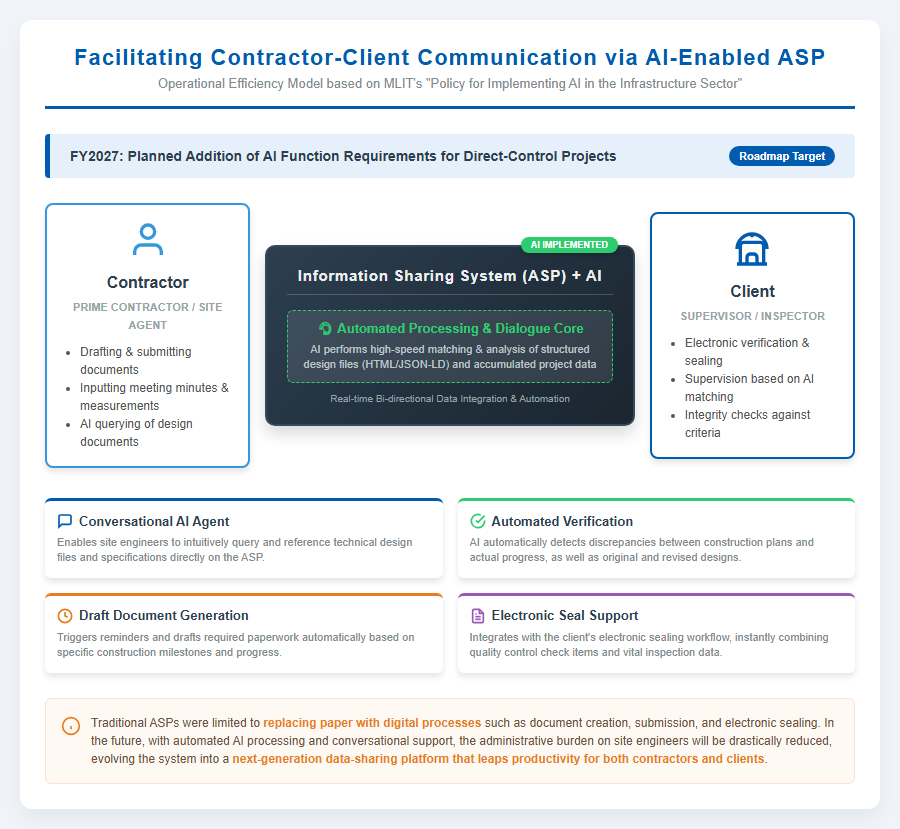
On September 4, 2026, the Ministry of Land, Infrastructure, Transport and Tourism (MLIT) released its “Policy for Implementing AI in the Infrastructure Sector.” A central component of this policy is the integration of AI capabilities into the contractor-client information sharing systems (ASPs) utilized at construction sites. While ASP systems are currently mandatory for all national direct-control projects and have been adopted by all prefectures and designated cities, their use has been largely restricted to basic digital document submission and electronic seal verification. Under the new policy, MLIT plans to add advanced AI functional requirements to direct-control project ASP specifications starting in fiscal year 2027, urging private software vendors to upgrade their platforms. Once implemented, these upgrades will allow interactive AI agents to help site engineers search and reference design technical documents or project records on the fly. Furthermore, the system will offer automated verification features, such as comparing construction plans with real-time progress and detecting discrepancies between original and revised designs. The AI will also predict upcoming administrative milestones to draft and remind engineers of required paperwork. These capabilities are expected to dramatically reduce the administrative burden on site managers and significantly enhance communication between clients and contractors. The following diagram illustrates this improved operational workflow:
Transitioning to Structured HTML to Enhance AI Readability of Design Documents
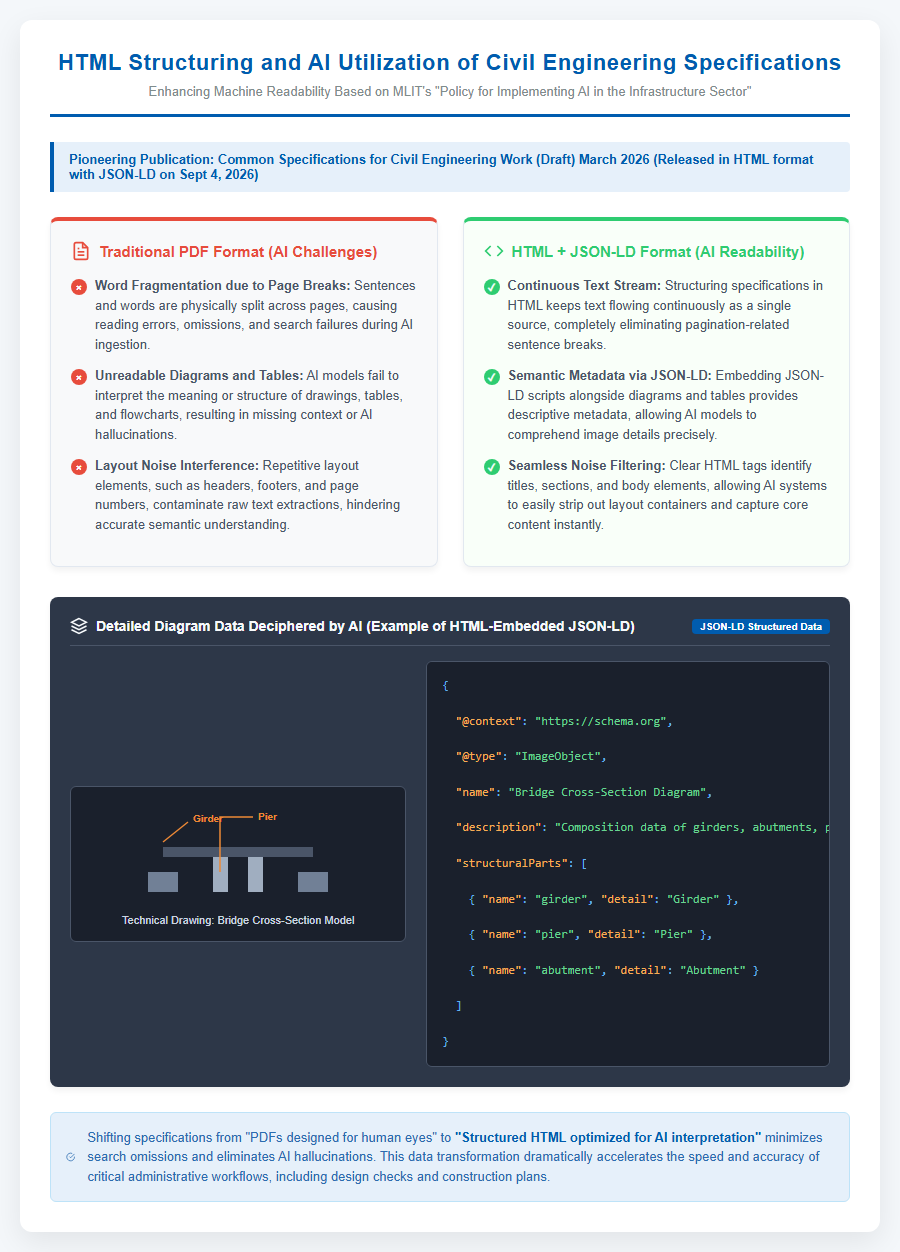
To enable advanced document generation and accurate search capabilities, MLIT has initiated a fundamental overhaul of technical document data formats. Historically, design documents and technical manuals have been compiled as PDFs. While convenient for human reading and printing, PDFs pose significant challenges for AI systems. Page breaks often fragment words and sentences, layouts introduce noise like headers and footers, and complex tables or flowcharts remain virtually uninterpretable to standard algorithms. This frequently results in search failures and AI hallucinations. To resolve these issues, MLIT is shifting away from PDF-centric deliverables toward “structured data formats” optimized for machine learning and AI processing. As a pioneering step, the ministry published the “Common Specifications for Civil Engineering Work (Draft) for March 2026” on September 4, 2026, in an HTML format enriched with JSON-LD metadata. Transitioning to HTML eliminates the sentence fragmentation caused by page breaks, while the JSON-LD tags allow AI models to accurately interpret the semantic structure of tables and diagrams. Moving forward, MLIT plans to gradually standardize data structures for contractor-submitted paperwork, such as meeting minutes and site logs, establishing a unified database that AI can cross-reference seamlessly. The concept of specification HTML structuring and AI utilization is shown below:
Background and Urgency of AI Implementation in Infrastructure
Addressing Severe Labor Shortages and Overtime Restrictions
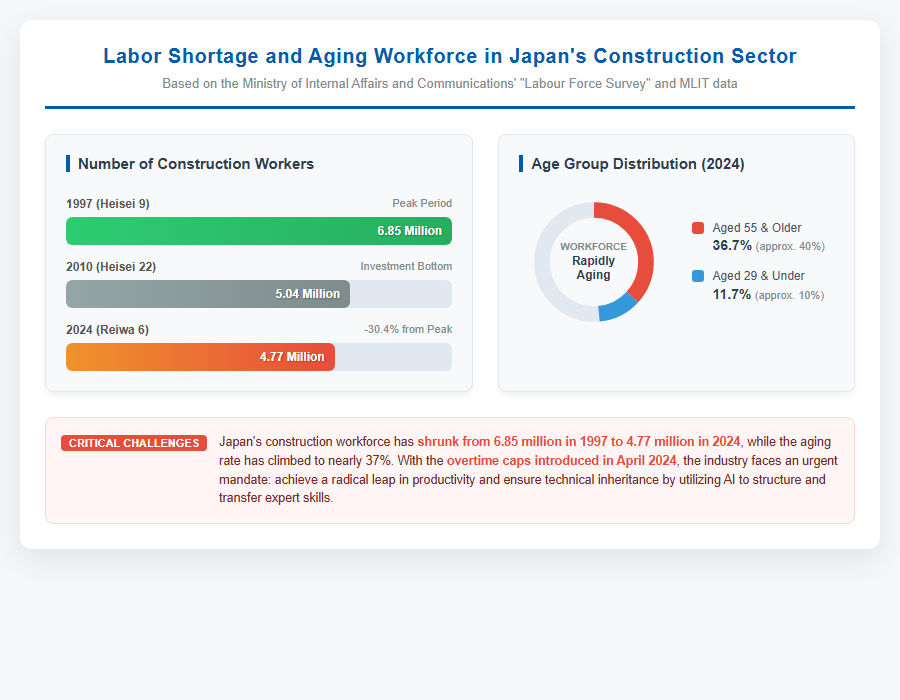
The urgency surrounding infrastructure AI implementation is primarily fueled by a shrinking labor pool and an aging workforce. According to MLIT data based on the Internal Affairs Ministry’s Labour Force Survey, as of 2024, workers aged 55 or older accounted for 36.7% of the construction workforce, while those aged 29 or younger represented a mere 11.7%. This stark demographic imbalance threatens the long-term survival of crucial engineering skills. The total number of construction workers in Japan peaked at 6.85 million in 1997 and fell to 4.77 million by 2024, with projections suggesting further declines. Compounding this challenge, legally binding caps on overtime hours with strict penalties were applied to the construction industry in April 2024, ending the traditional reliance on extended working hours. To maintain aging infrastructure and respond to increasingly severe natural disasters with fewer workers, a radical leap in productivity is non-negotiable. MLIT views AI not merely as a tool for automation but as an essential platform to augment human capabilities, enabling a smaller workforce to operate safely, comfortably, and productively. By structuring and digitizing the tacit knowledge and decision-making processes of veteran engineers, the ministry aims to preserve and pass down vital skills to the next generation. The long-term trend of construction employment is shown here:
Implementing “AI Inspections” to Streamline Supervision and Quality Control
To streamline construction supervision and quality control, MLIT is actively preparing the groundwork for “AI-assisted inspections” (AI Rinjo). Under this framework, AI will automatically cross-reference structured design criteria and tolerance standards set by the client against 3D as-built data and laser scanning measurements captured by the contractor. By identifying structural deviations and detecting defects automatically, this technology will drastically reduce the need for supervisors to conduct physical, on-site visual checks, thereby shortening the time required for final handovers. Realizing this vision requires seamless data integration across BIM/CIM workflows, converting text and numerical entries into structured datasets. On November 4, 2025, MLIT took a major step forward by releasing its Model Context Protocol (MCP) server, which enables secure, seamless data sharing between distinct systems and interactive AI models. Through close collaboration between industry, academia, and government, the ministry seeks to establish an integrated data pipeline spanning construction planning through final inspection, ushering in an era of automated quality assurance.
Future Outlook and Public-Private Physical AI Strategies
Deploying Physical AI for Autonomous Field Operations
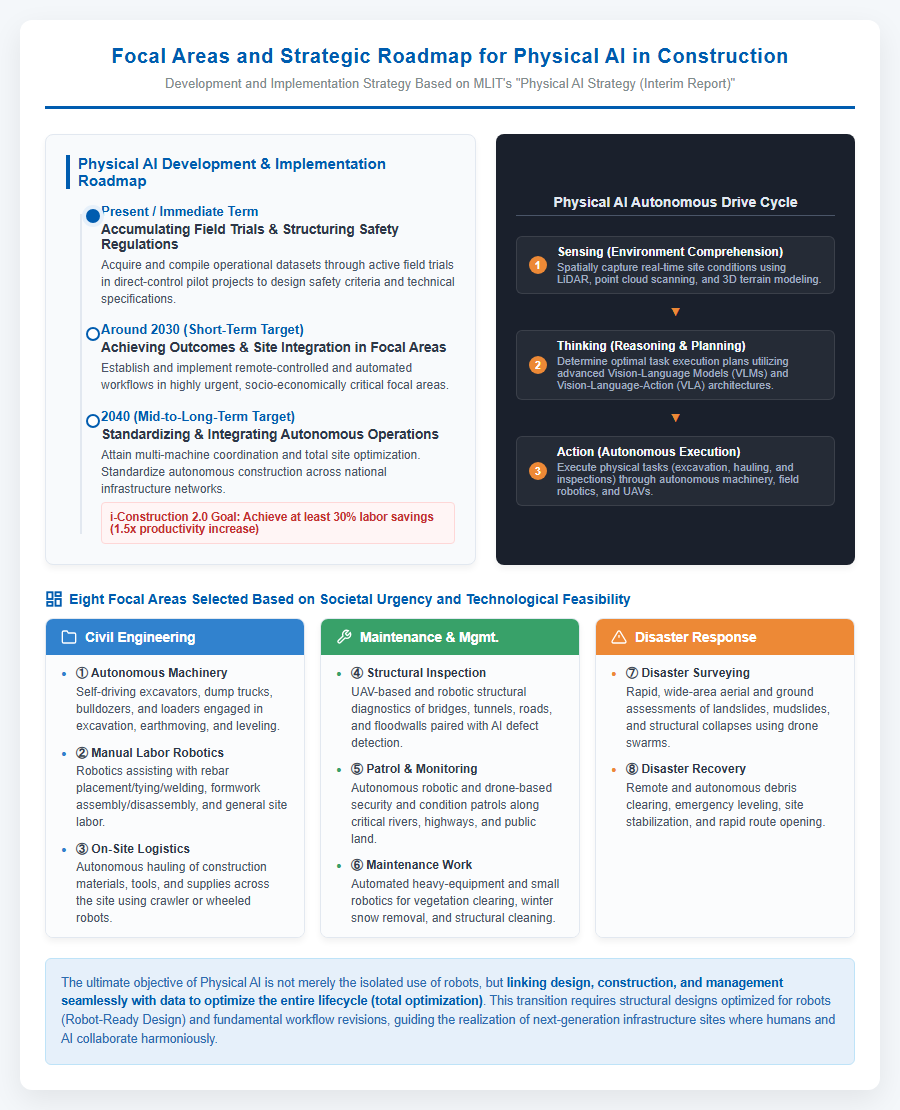
Concurrent with the new implementation policy, MLIT released its “Physical AI Strategy for the Construction Sector (Interim Report).” This strategy shifts the focus from administrative document generation to “Physical AI”—systems capable of sensing, reasoning, and acting autonomously in real-world outdoor environments. Because construction sites deal with custom, non-repetitive tasks under highly unpredictable outdoor conditions, traditional factory robotics have struggled to adapt. To overcome this hurdle, the strategy leverages cutting-edge artificial intelligence, such as Vision-Language Models (VLMs) and Vision-Language-Action (VLA) models, to allow machinery to comprehend dynamic site conditions and make real-time operational decisions. Based on societal urgency and technological readiness, MLIT has designated eight focal areas for physical AI deployment. These include “autonomous machinery” (for excavation and hauling), “manual labor robotics” (for rebar tying and formwork assembly), “autonomous hauling” within sites, “structural inspection,” “regular patrol,” “vegetation and snow removal,” “disaster surveying,” and “emergency disaster response.” With a short-term target set around 2030 and a mid-to-long-term milestone for 2040, MLIT will run extensive field trials to standardize autonomous and remote-controlled operations. The following diagram illustrates the deployment of Physical AI in these key areas:
Building a Tripartite Consortium and Expanding to Local Governments and SMEs
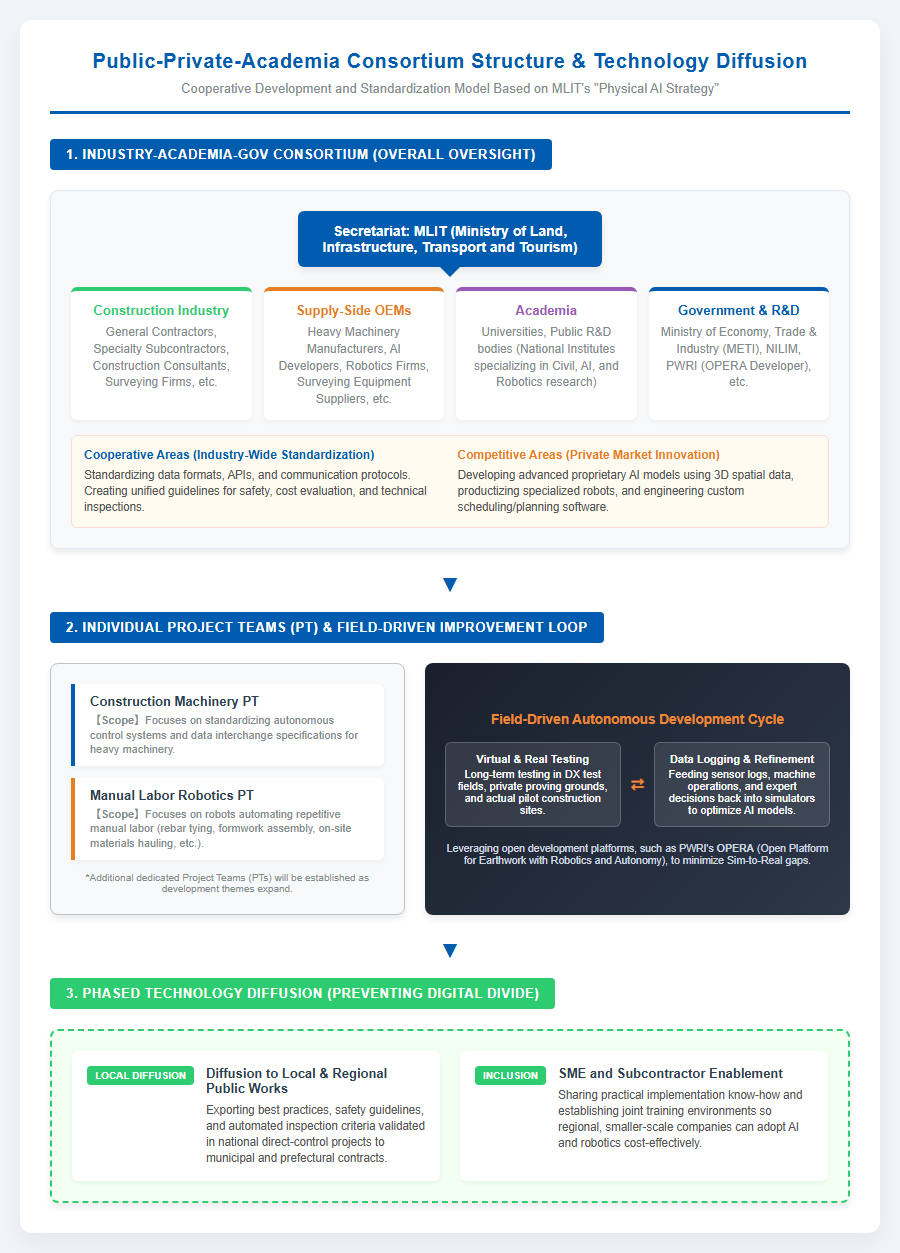
To ensure the sustainable and secure development of infrastructure AI, MLIT plans to establish a new industry-academia-government consortium. This collaborative body will bring together general contractors, specialty subcontractors, heavy machinery manufacturers, AI developers, universities, public research bodies like the Public Works Research Institute (PWRI), and government agencies. The consortium will focus heavily on standardizing data formats, communication protocols, and safety guidelines as “cooperative areas” for the entire industry, while leaving proprietary AI model development and advanced robotics to “competitive areas” to stimulate private innovation. Recognizing that the vast majority of Japan’s construction sector comprises small and medium-sized enterprises (SMEs) and local subcontractors, the ministry is committed to ensuring that these technologies are not restricted to mega-projects. By gradually exporting standardized specs, safety criteria, and best practices developed in national direct-control projects to local governments and smaller businesses, MLIT aims to prevent a digital divide and foster an inclusive, industry-wide digital transition. The cooperative framework is illustrated below:
Reference Pages
- 【Ministry of Land, Infrastructure, Transport and Tourism: Infrastructure DX Promotion Headquarters】https://www.mlit.go.jp/tec/tec_tk_000073.html
- 【Common Specifications for Civil Engineering Work (Draft) March 2026】https://www.mlit.go.jp/tec/r08dobokukoujikyoutsuusiyousyo/index.html
【#MLIT #ConstructionDX #AIImplementation #ASP #InfrastructureDX #ProductivityImprovement #RegionalRevitalization】


コメント