ELYZA, a KDDI Group company, has released free of charge the domestic-based AI model “ELYZA-Thinking-1.0-llm-jp-4-33b” and other models, which feature enhanced Japanese processing and reasoning performance. Behind this move is the aim to accelerate the social implementation of AI in Japan and secure technological autonomy.
- Key point of the event: Free public release of a domestic AI model by ELYZA
- Technical Features and Background of Performance Enhancements
- Establishment of “ELYZA RSI Research” Aiming for Recursive Self-Improvement
- Apache 2.0 license available for commercial use and open deployment
- Corporate Adoption and Functional Expansion into Multimodal
- Future Outlook and Key Points: The Evolution of Domestic AI and Its Impact on Society
Key point of the event: Free public release of a domestic AI model by ELYZA
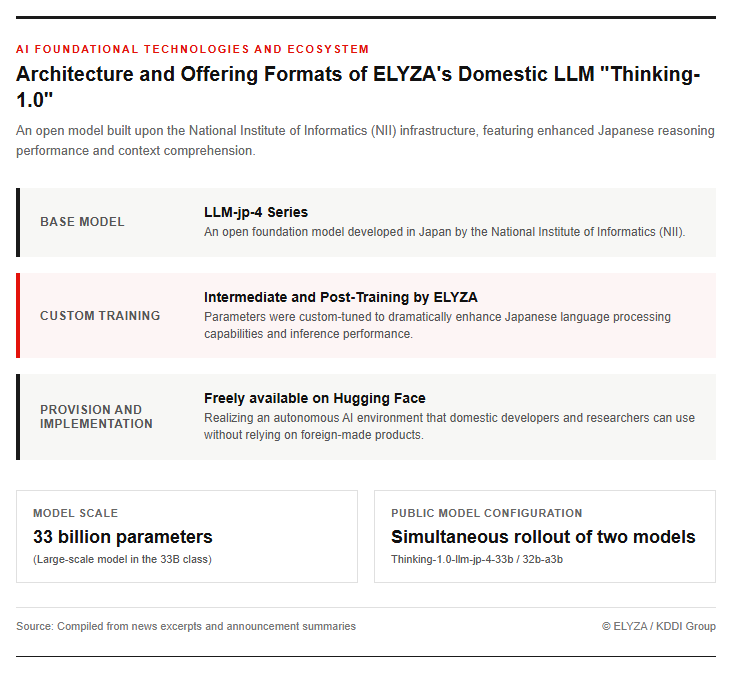
On October 2, 2026, ELYZA, Inc., an AI development company within the KDDI Group, released two new AI models for free: “ELYZA-Thinking-1.0-llm-jp-4-33b” and “ELYZA-Thinking-1.0-llm-jp-4-32b-a3b,” which feature enhanced Japanese language processing and reasoning performance. These models are based on the “LLM-jp-4” series of open, domestically developed foundational models created by the National Institute of Informatics (NII), with their performance further boosted through ELYZA’s proprietary intermediate and post-training.
Despite its massive scale of 33 billion parameters (33B), the newly released model is freely available for anyone to download and use via the Hugging Face platform. For domestic developers, researchers, and creators, gaining a practical option capable of capturing the delicate context and nuances unique to Japanese without relying on overseas general-purpose models represents a major step forward for Japan’s AI ecosystem. The figure below is an image illustrating the overview and distribution format of the model.
Since joining the KDDI Group in April 2024, ELYZA has been leveraging its abundant computing infrastructure and network resources, and this latest announcement can be said to be the fruit of that large-scale R&D environment.
Technical Features and Background of Performance Enhancements
The most distinctive feature of this model is, as indicated by “Thinking” in its model name, that it has been tuned for reasoning performance to handle complex queries involving logical inference and multi-step processes. In comprehensive evaluations using a total of 20 types of benchmark tests, multiple items were confirmed to have scored higher than the improved “LLM-jp-4.1” series released by NII on September 28, 2026, demonstrating the high precision of its post-training.
It has often been pointed out that overseas-made AI models face challenges where subtle nuances of expression, the use of honorifics, and cultural context are lost in Japanese translation and summarization. In response to this, ELYZA has applied practical-oriented tuning to “LLM-jp-4″—a domestically produced foundational model with high academic reliability—thereby achieving a high-level balance between Japanese expressive power and practical response accuracy.
Specifically, application is expected in areas such as the following:
– Creative tasks such as character dialogue and scenario writing
– Organizing complex business processes and structuring logical sentences
– Building a Complex Q&A System Based on Laws and Internal Regulations
Thus, behind the free availability of a domestically developed model featuring the high accuracy required for practical use lies a strong technical background: the desire to build Japanese AI that is genuinely useful in the field.
Research Infrastructure and Open-Source Deployment
Establishment of “ELYZA RSI Research” Aiming for Recursive Self-Improvement
This model release is deeply connected to the initiatives of “ELYZA RSI Research,” a new research organization whose launch was announced by ELYZA on the same day (October 2, 2026). The organization was established with the purpose of advancing research into “Recursive Self-Improvement (RSI),” a process in which AI evaluates and improves itself to iteratively enhance its capabilities.
In global AI development, the shift from manual tuning to “AI-driven AI development” is progressing rapidly. At ELYZA, leveraging KDDI’s abundant GPU resources, we have reached Step 3, which automates the improvement process for model peripheral systems (harnesses), and Step 2, which semi-automatically generates evaluation benchmarks. As part of this initiative, we have developed and published our own “Inquiry Response Benchmark,” which measures the ability to respond to customer inquiries and complete tasks all the way to data rewriting.
The two models announced today are the results produced through the process of elemental research toward this RSI, demonstrating that advanced approaches to autonomously evolving AI are being applied in actual model development.
Apache 2.0 license available for commercial use and open deployment
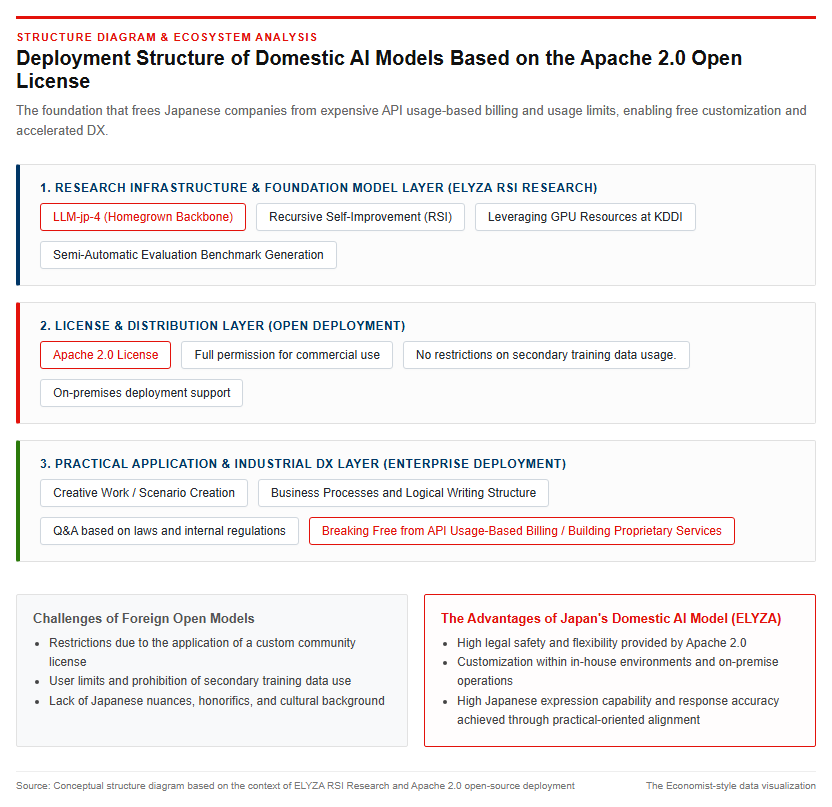
One of the biggest strengths of “ELYZA-Thinking-1.0-llm-jp-4-33b” and “ELYZA-Thinking-1.0-llm-jp-4-32b-a3b” is the adoption of the “Apache 2.0” license. Apache 2.0 is an open-source license widely recognized for commercial use, which significantly lowers the legal barriers for companies looking to integrate the models into their own products or internal systems for commercial deployment.
In recent years, an increasing number of major overseas open models have adopted proprietary community licenses, imposing restrictions such as user limits and prohibitions on the use of secondary training data. In contrast, domestic AI models released under the Apache 2.0 license represent an extremely safe option for Japanese companies seeking in-house customization and on-premise operations, as they help avoid legal risks.
By providing foundation models in open formats, Japanese startups and enterprises can build their own AI services without being tied to expensive usage-based API fees. This is expected to serve as a catalyst to accelerate the digital transformation (DX) of the entire Japanese industry. The diagram below illustrates the concept of system construction utilizing open licenses.
Impact and Outlook for Social Implementation
Corporate Adoption and Functional Expansion into Multimodal
ELYZA goes beyond merely researching and publishing models, actively promoting a vertical AI (domain-specific AI) business that generates value in actual business settings. On the same day, the company also announced the commercialization of the “ELYZA Voice Agent,” a voice-based conversational AI agent that interacts with customers through natural dialogue and integrates with business systems. This system incorporates an evaluation mechanism that performs self-scoring, featuring a built-in mechanism where response quality automatically improves with continued operation.
Furthermore, as a future technological expansion, plans have been announced to transition from traditional text-based Large Language Models (LLMs) to Vision-Language Models (VLMs), which handle visual information, and Vision-Language-Action (VLA) models, which integrate vision, language, and action. Through this, applications in the physical AI domain—such as robot control that operates autonomously in retail and logistics settings—are being advanced.
To address concerns regarding AI safety associated with such advanced capabilities, thorough safety-conscious designs are implemented, such as the strict isolation of development environments during the development phase and the introduction of safety guards in products.
Future Outlook and Key Points: The Evolution of Domestic AI and Its Impact on Society
This recent free public release of a domestic AI model by ELYZA can be considered a landmark event in the trend of Japan’s AI development and societal implementation. By combining the academic foundation “LLM-jp-4” with advanced tuning technology from the private sector, a model combining practicality and transparency has been born. Going forward, it is expected that there will be a rapid increase in cases where companies and local governments leverage their proprietary data to safely operate customized AI.
Key areas to watch moving forward include the following three points:
– Evolution of AI Autonomous Development (RSI) by “ELYZA RSI Research” and the Update Speed of Frontier Models
– Multifaceted societal implementation integrated with actual business operations, such as voice AI agents and physical AI (robotics)
– Growing adoption of domestic Apache 2.0 models in security-conscious fields such as government agencies and finance
Breaking away from the structure of complete dependence on black-box models provided by major overseas tech companies and building a domestic foundation capable of fulfilling accountability is extremely important from the perspectives of data sovereignty and economic security. The key focus moving forward will be whether domestic AI can continue to evolve by combining “ease of use” with “peace of mind,” ultimately leading to improved productivity across Japan’s entire industrial sector.
Reference page
- 【Hugging Face – ELYZA-Thinking-1.0-llm-jp-4-33b】https://huggingface.co/elyza/ELYZA-Thinking-1.0-llm-jp-4-33b
- 【Hugging Face – ELYZA-Thinking-1.0-llm-jp-4-32b-a3b】https://huggingface.co/elyza/ELYZA-Thinking-1.0-llm-jp-4-32b-a3b
- [ELYZA Press Release] https://elyza.ai/news/2026/10/02/rsiresearch
- [KDDI CORPORATION News Release] https://news.kddi.com/kddi/corporate/newsrelease/2024/03/18/7333.html
【#ELYZA #JapaneseAI #LLMjp4 #OpenSource #GenerativeAI #KDDI】

コメント