On June 23, 2026, French AI company Mistral AI announced its next-generation OCR model, Mistral OCR 4. This model supports over 170 languages, including Japanese, and by featuring advanced structured data extraction capabilities, it aims to revolutionize corporate document processing.
- Key Points of the Event and Overwhelming Benchmark Results
- Extensive support for 170 languages, including Japanese
- Precise extraction using coordinate information and confidence scores
- Integration with RAG and Agent Workflow
- Flexible deployment environment and enterprise-oriented pricing structure
- Risks of Hallucination and Legal Liability
- Human Participation (HITL) Governance and Future Developments
Key Points of the Event and Overwhelming Benchmark Results
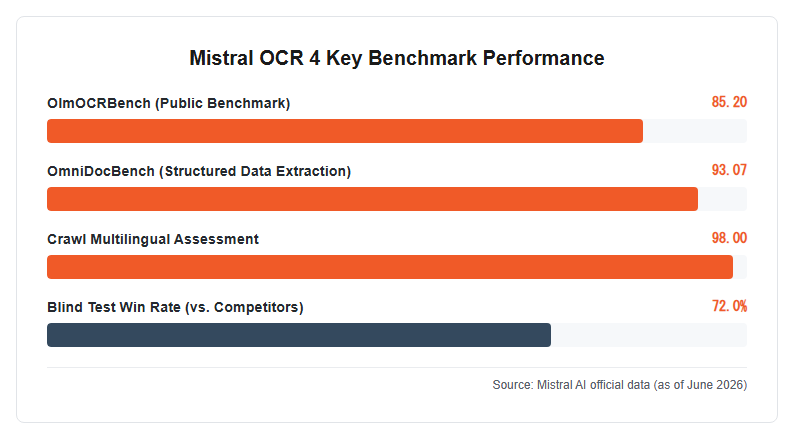
Mistral AI released “Mistral OCR 4,” released on June 23, 2026, is an advanced document understanding model that goes beyond traditional text extraction. This new model recorded a high win rate of 72% in blind tests using over 600 real documents, beating competing major OCR systems. On the public OlmOCRBench benchmark, it achieved a score of 85.20, and on OmniDocBench, it achieved an impressive 93.07.
Technical advancement is not limited to precision alone. Users have reported that per-page processing speed has increased by four times compared to leading providers, and for financial Q&A workloads, they have succeeded in reducing costs to one-eighth of agent-based document parsers while reducing latency to one-seventeenth. This is expected to deliver practical performance in enterprise environments with large volumes of documents. The chart below shows the score trends across key benchmarks.
Extensive support for 170 languages, including Japanese
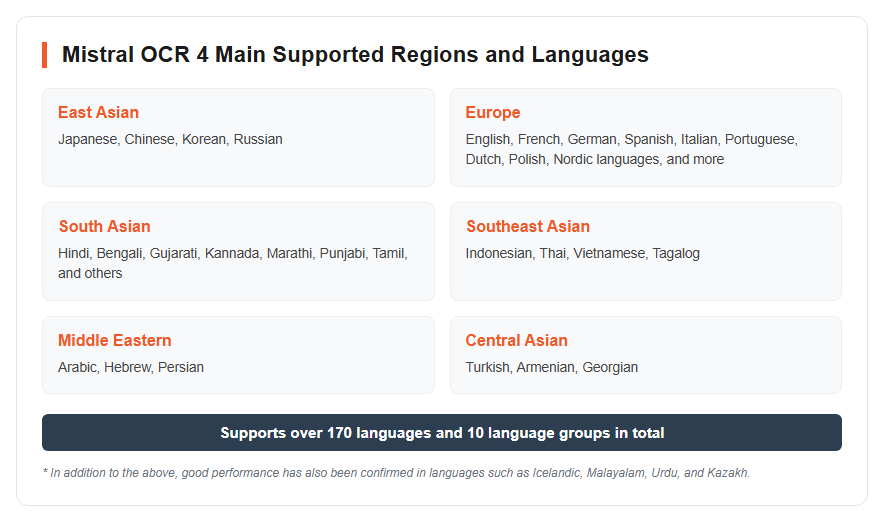
One of the major features of Mistral OCR 4 is its overwhelming multilingual support. It covers a total of 170 languages and 10 language groups, delivering strong performance in East Asian languages such as Japanese, Chinese, and Korean. According to source materials, significant accuracy improvements have been observed, especially for rare languages with limited resources, overcoming areas where traditional OCR systems struggled.
In Japanese document processing, the ability to analyze documents that include vertical writing or complex layouts has also improved. Mistral AI’s official documentation clearly states that Japanese, Chinese, Korean, and Russian are the main supported languages in the East Asian region, making them a powerful tool for companies expanding globally. It is also expected to be applied for academic purposes such as deciphering historical manuscripts, suggesting that its multilingual support may go beyond mere business use. The table below lists the major supported languages.
Technological Innovation Brought by Structured Output
Precise extraction using coordinate information and confidence scores
Mistral OCR 4 not only reads characters but also understands the “position” and “role” of each element within a document. The ability to return bounding boxes (bounding frames) per paragraph allows you to precisely identify where the text is on the page. Additionally, it includes a function to classify extracted blocks into types such as “Title,” “Table,” “Formula,” “Signature,” and “Chart.”
What is especially important for developers is the reliability score, which is output at the word level and per page. This allows the AI to automatically detect areas where it is not confident in reading, and flags only the parts that require human confirmation. This structured data is different from mere text listings; it enables digitization while maintaining document layout, forming the foundation for advanced processing such as accurate information citation and automatic masking of confidential data.
Integration with RAG and Agent Workflow
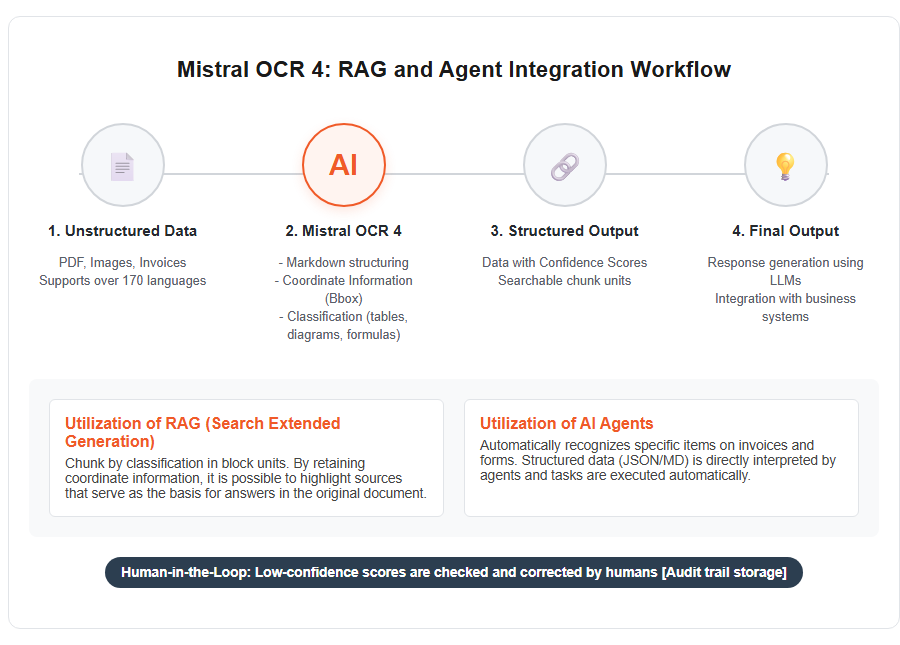
In modern enterprise AI, OCR does not operate in isolation but is incorporated as part of RAG (Search-Augmented Generation) and AI agents. Mistral OCR 4 outputs extracted data in markdown format, making it highly compatible with downstream LLMs (large language models). Structured blocks are ideal as search units in RAG, dramatically improving the accuracy of AI responses based on internal documents.
It also functions as a data input component for the “Mistral Search Toolkit,” which Mistral AI has launched in public preview. This makes it easy to build automated workflows such as invoice processing agents automatically reading specific items on invoices and entering values into forms. The true value of this model lies in providing primitives that allow AI not only to “read” documents but also to “understand” and “manipulate” their structure. The diagram below illustrates the role of OCR 4 in the RAG pipeline.
Flexible deployment environment and enterprise-oriented pricing structure
Balancing cost and data privacy is a challenge faced by many companies. Mistral OCR 4 is offered at a competitive price of $4 per 1,000 pages via API ($2 for batch processing). Additionally, the “Document AI Mode,” which allows you to define schemas and extract JSON in specific formats, is available for $5 per 1,000 pages.
Notably, it offers the option of “self-hosting with a single container” that can be run within a company’s own infrastructure. In highly regulated industries such as finance, healthcare, and legal affairs, sending confidential documents to external cloud APIs may be restricted. By leveraging self-hosting, you can enjoy the latest document analysis capabilities while maintaining data sovereignty. It is also available on major cloud platforms such as Amazon SageMaker and Microsoft Foundry, with smooth implementation in mind for existing enterprise environments.
Building Legal Responsibility and Governance
Risks of Hallucination and Legal Liability
Even with advanced processing combining AI-OCR and LLMs, there is still a risk of telling plausible lies known as “hallucinations.” For example, AI might arbitrarily infer and adjust the amount from context to the date on the invoice or a very thin amount. In areas like accounting work, where even a 1-yen deviation is not tolerated, such behavior can pose a fatal risk.
From a legal perspective, since AI itself lacks responsibility capacity, responsibility for mispayments or underreporting due to AI errors generally falls on the company (user) that used it. Directors and representatives may be subject to ‘duty of care,’ and the disclaimer clauses included in the AI vendor’s terms of use generally place the final verification duty on the user company’s side. Therefore, when introducing technology, it is essential to build a legal defense line based on the assumption that AI is a “system that can make mistakes.”
Human Participation (HITL) Governance and Future Developments
The solution to maximize the benefits of AI-driven automation while minimizing risks lies in “abandoning full automation” and designing “human-in-the-loop” operations. It is recommended to utilize the confidence score provided by Mistral OCR 4 and always build a flow with human approval when confidence falls below a certain threshold or when transaction amounts are high.
Going forward, to ensure the “truthfulness” of documents, it will become important to have systems that store logs of what AI has read and corrected as audit trails. Ensuring transparency in AI processing, considering compliance with Japan’s Electronic Book Storage Act and invoice system, will be key to successful accounting DX. The emergence of high-precision models like Mistral OCR 4 not only streamlines administrative tasks but also serves as a catalyst to redefine corporate governance frameworks themselves. The future of document AI is expected to evolve into a form of “collaboration” that combines advanced technology with appropriate human supervision.
[#MistralAI #OCR #AI技術 #Japanese Compatible #RAG #ドキュメント解析 #DX #科学技術]
コメント