Prime Minister Sanae Takaichi sought understanding for a reduction in the consumption tax on food in her policy speech at the 222nd extraordinary Diet session. This move is driven by the aim to alleviate the burden on households amid prolonged price hikes and to signal to the market a stance that prioritizes the economy above all.
- Key point of the event: Announcement of tax cuts in the policy speech
- Policy Background: Persistent Inflation and the Urgent Need for Household Support
- Overview of the System Design: Reduction to 1% for Food and Temporary Measures
- The Revenue Debate and Market Confidence: Avoiding Deficit Bonds and the Potential Upside in Tax Revenues
- Impact on Industries and Businesses: Mixed Reactions and Contrasting Fortunes Between Eating In and Dining Out
- Future Developments and Key Points: Focus on the Autumn Extraordinary Diet Session and Tax System Reform
Key point of the event: Announcement of tax cuts in the policy speech
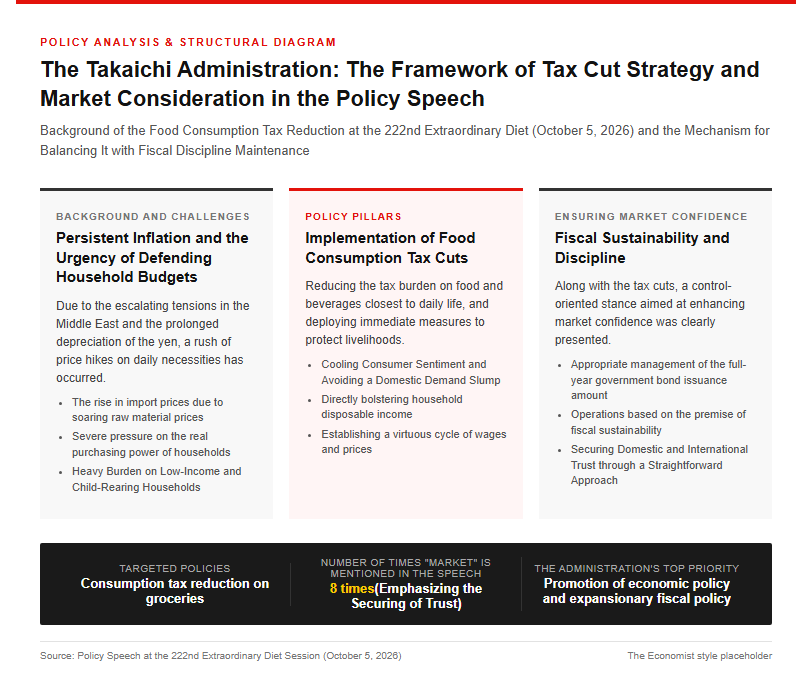
On the afternoon of October 5, 2026, Prime Minister Sanae Takaichi delivered a policy speech at a plenary session of the House of Representatives upon the convocation of the 222nd extraordinary Diet session. In her speech, the Prime Minister pledged to promote her signature policy of responsible proactive fiscal management, emphasizing her strong commitment to tackling economic policy as her top priority. The centerpiece of the speech was a consumption tax cut on food items, positioned as a seamless measure against high prices to counter the prolonged rise in living costs. “We want to ease the tax burden on food and beverages, which are closest to daily life, and bring a little breathing room to household budgets,” the Prime Minister said, asking for the understanding and cooperation of the public and opposition parties. She also invoked the traditional Chinese concept of keiseisaimin (managing the state and relieving the people), appealing for the resolute execution of the tax burden reduction as a vital policy to govern the nation and save the public. At the same time, consideration was given to securing market confidence in this policy speech. She used the word “market” eight times during the speech, clearly demonstrating that fiscal sustainability is a fundamental prerequisite. She strongly signaled her stance to properly control the annual issuance of government bonds and steadily enhance market trust both at home and abroad through orthodox means.
Policy Background: Persistent Inflation and the Urgent Need for Household Support
Behind the sudden rise of the proposed food consumption tax cut is a wave of price hikes on daily necessities, caused by surging resource prices amid escalating Middle East tensions and the prolonged depreciation of the yen. Rising prices for raw materials such as crude oil and fertilizer continue to push up domestic food and beverage prices through import prices, squeezing households’ real purchasing power. The Japanese economy stands at a critical juncture regarding whether it can step into a virtuous cycle of growth, making direct support to prevent the cooling of consumer sentiment indispensable. Food expenses account for a significant share of household spending, and because they are necessities with low price elasticity—especially for low-income households and child-rearing families—the blow from high prices is particularly pronounced. Directly reducing the tax burden on food amid sluggish real wage growth has garnered high expectations as an immediate, fast-acting livelihood protection measure. With the aim of avoiding a stall in domestic demand caused by cooling consumption and entrenching a virtuous cycle of wages and prices, the government has also reached a Cabinet decision on the tax cut proposal as a powerful redistribution policy to directly prop up household disposable income. As shown in the figure below, the proportion of food expenses in households and the necessity of support are closely related.
Implementation of Tax Cut Measures and Funding Challenges
Overview of the System Design: Reduction to 1% for Food and Temporary Measures
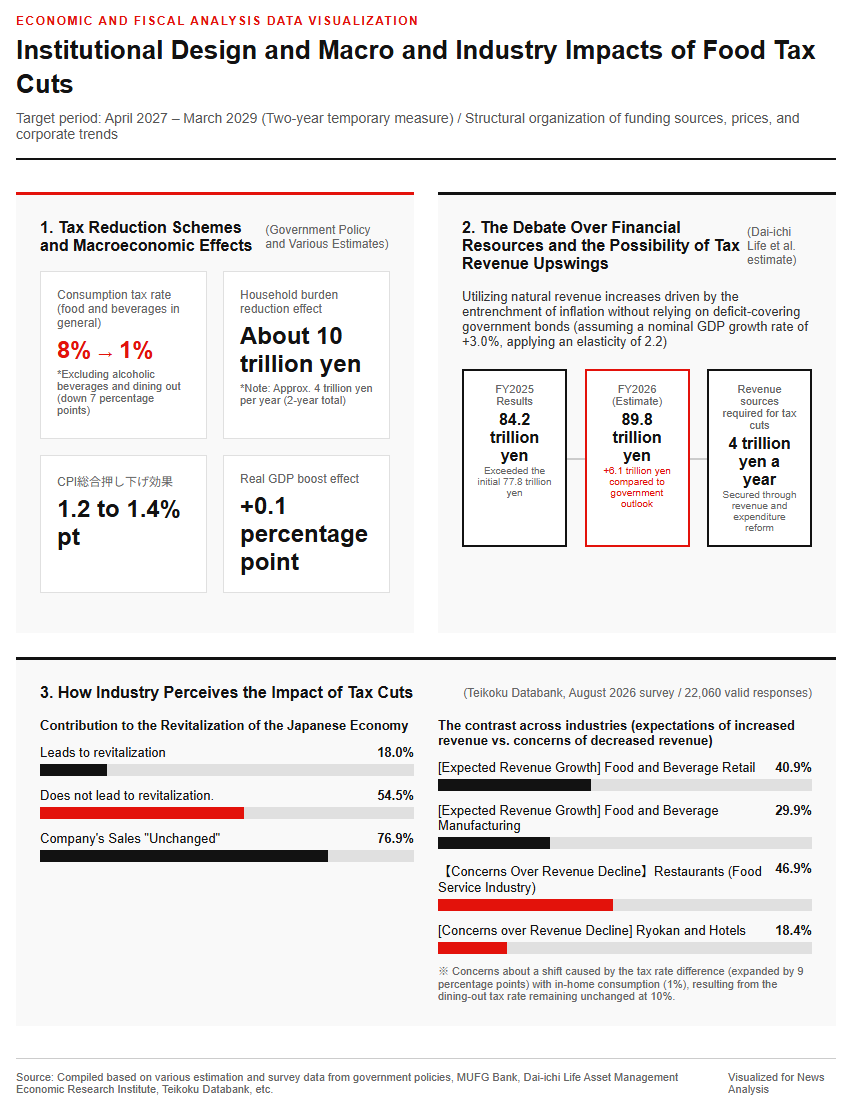
According to government policy, the consumption tax rate on all food and beverages, excluding alcoholic beverages and dining out, which are currently subject to the reduced 8% tax rate, is planned to be significantly reduced by 7 percentage points to 1% starting in April 2027. This tax reduction measure is expected to be implemented as a temporary measure limited to a two-year period from April 2027 to March 2029. Food items account for a little over 20% of the weight in the Consumer Price Index (CPI), and if the tax rate is reduced to 1%, it is expected to have a direct price-lowering effect that will push down the overall CPI by approximately 1.2 to 1.4 percentage points annually. On a monetary basis, this is calculated to bring a massive burden-reducing effect to households of about 4 trillion yen annually, totaling approximately 10 trillion yen over the two-year period. According to estimates by institutions such as MUFG Bank, this tax cut will increase households’ real disposable income and is expected to have an economic-supporting effect that will boost the real GDP growth rate by about 0.1 percentage points. However, experts from institutions such as the Daiwa Institute of Research and the Japan Research Institute have also pointed out that, in order to maintain the consumption tax’s function as a stable revenue source for social security, a smooth transition to a permanent system such as a refundable tax credit will be necessary after the two-year expiration.
The Revenue Debate and Market Confidence: Avoiding Deficit Bonds and the Potential Upside in Tax Revenues
Regarding the implementation of the consumption tax cut, the primary focus of debate is how to secure financial resources amounting to 4 trillion yen annually. In a speech to the Diet, Prime Minister Takaichi emphasized, “To gain the market’s trust, we will secure them without relying on special public bonds (deficit-covering bonds),” striving to dispel concerns about fiscal deterioration caused by the additional issuance of government bonds. The government has indicated a policy of generating financial resources through comprehensive revenue and expenditure reforms, such as reviewing subsidies and special tax measures, and securing additional non-tax revenue. As background to the funding debate, estimates by Toshihiro Nagahama and other researchers at the Dai-ichi Life Research Institute show that in recent years’ Japanese economy, the tax elasticity—which indicates the growth of tax revenue accompanying nominal growth—has remained at a high level. Tax revenues for the fiscal 2025 settlement exceeded the initial forecast of 77.8 trillion yen, rising to 84.2 trillion yen. Assuming that the nominal GDP growth rate for fiscal 2026 achieves the government’s projected +3.0%, applying the historical average elasticity of 2.2 could bring tax revenue to 89.8 trillion yen, potentially exceeding the government forecast by +6.1 trillion yen. If the natural increase in tax revenue resulting from entrenched inflation can be utilized, a path for implementing tax cuts while maintaining fiscal discipline is also being presented.
Impact on the Economy and Industry, and Future Outlook
Impact on Industries and Businesses: Mixed Reactions and Contrasting Fortunes Between Eating In and Dining Out
Regarding the impact of the food tax cut on the overall economy, reactions from the industrial sector are mixed depending on the industry. According to a questionnaire survey conducted by Teikoku Databank in August 2026 targeting 22,060 companies nationwide, only 18.0% of companies—about 20%—answered that the food tax cut would lead to the revitalization of the Japanese economy. On the other hand, companies answering that it “will not lead to revitalization” accounted for a majority at 54.5%. Regarding the impact on their own sales, 76.9% of companies answered “no change.” Looking at the details by industry, the highest proportions expecting increased sales are 40.9% for food and beverage retailers and 29.9% for food and beverage manufacturers, where expectations are placed on increased purchasing motivation due to lower prices. In contrast, concerns about decreased sales are raised by 46.9% of the restaurant industry and other dining establishments, and 18.4% of ryokan and hotels. This is because the tax rate for dine-in consumption will remain at 10%, widening the tax rate gap with household food items reduced to 1% to 9 percentage points, raising concerns about a shift in demand from eating out to eating at home. Please refer to the figure below regarding changes in the industry structure.
Future Developments and Key Points: Focus on the Autumn Extraordinary Diet Session and Tax System Reform
The biggest point of focus moving forward is how the deliberations on bills related to the consumption tax cut will unfold during the convened extraordinary 222nd Diet session in autumn. Prime Minister Takaichi has emphasized the commonalities with the tax cut arguments traditionally advocated by opposition parties, aiming for the early enactment of the bills through consensus-building between the ruling and opposition parties. In the parliamentary debate, strict scrutiny is expected from the opposition regarding concrete funding measures that do not rely on deficit-financing bonds and the feasibility of expenditure reviews. Furthermore, securing a practical preparation period for private businesses, such as system modifications and cash register upgrades for implementation starting in April 2027, will also be a major issue. In financial markets, although concerns over fiscal deterioration have been somewhat eased by the latest speech, worries persist regarding rising term premiums, as 10-year bond yields remain at high levels. Whether concrete backing for securing financial resources will be demonstrated in the FY2027 tax reform outline and budget compilation process to be finalized toward the end of the year will be the deciding factor for market confidence. Future Diet debates and the government’s policy execution capability will be closely watched to see whether the administration can balance growth investment with fiscal consolidation and achieve a virtuous cycle of price stability and economic expansion.
Reference Page
- [Tax Revenue Expected to Exceed Projections Again This Fiscal Year ~Possibility of Reaching the 90-Trillion-Yen Range If the Government Achieves Its Projected Nominal Economic Growth Rate~] https://www.dlri.co.jp/report/macro/666059.html
- 【The Growing Likelihood of a “Consumption Tax Cut on Food”: What Are Its Effects and Post-Implementation Challenges?】https://www.dir.co.jp/report/research/economics/japan/20260609_025816.html
- [How to View the Economic Policies of the Takaichi Administration ~Aspects Aligned with Global Trends Praised, Challenges Are Fiscal Consolidation and Inflation Control~] https://www.jri.co.jp/page.jsp?id=114858
【#PrimeMinisterTakaichi #PolicySpeech #ConsumptionTaxCut #ResponsibleProactiveFiscalPolicy #InflationCountermeasures #JapaneseEconomy】


コメント