Tokyo Artisan Intelligence Inc., an AI venture based in Yokohama, has officially launched the human flow analysis software “NIGIWAI,” which leverages edge AI technology. The background is the severe labor shortage of traditional face-to-face surveys and the urban development side’s need to collect detailed behavioral data while protecting privacy.
- Launch of “NIGIWAI,” born from Kitakyushu City’s demonstration experiment
- Limitations of Traditional Traffic Volume Surveys Caused by Severe Labor Shortages
- How Edge AI Processing Works That Leave No Video Data
- Advanced algorithms that detect behavior and development of dedicated semiconductors
- Demonstration Results from the Kitakyushu City Prototype City Initiative
- Nationwide Deployment and Promotion of Responsible AI Utilization After 2026
Launch of “NIGIWAI,” born from Kitakyushu City’s demonstration experiment
Tokyo Artisan Intelligence Inc. (hereafter, TAI), a startup company originating from Tohoku University, officially launched the general-purpose solution “NIGIWAI,” which visualizes urban vibrancy using AI human flow analysis technology on June 19, 2026. This software is being developed based on the results of a demonstration experiment conducted in Kitakyushu City, Fukuoka Prefecture from February to March 2026, with the aim of supporting evidence-based smart city building.
Hirotaka Nakahara, President and CEO of TAI, established a system tailored to on-site challenges while receiving startup support from his hometown of Kitakyushu City. The company has demonstrated outstanding technical capabilities in image recognition, achieving over 99 percent accuracy in fish species identification, and this expertise is being incorporated into this human flow analysis. The following diagram illustrates how human flow analysis is utilized in urban development.
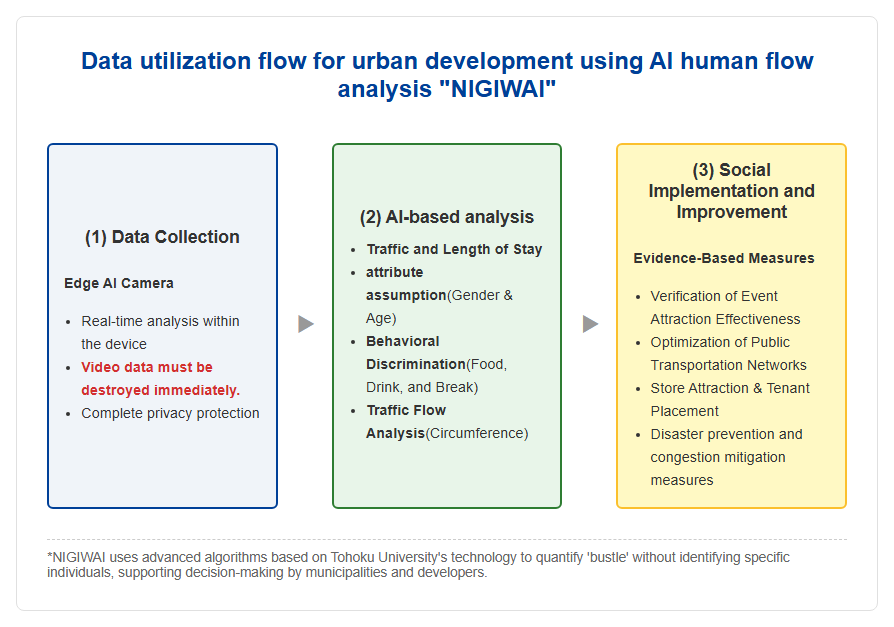
With the introduction of this software, municipalities and developers will be able to obtain objective statistical data in real time without relying on the subjective opinions of surveyors. This made it possible to verify the effectiveness of urban policies and analyze event attendance more scientifically and efficiently.
Limitations of Traditional Traffic Volume Surveys Caused by Severe Labor Shortages
The background to NIGIWAI’s development lies a strong demand for the digitization of measures and verification in urban planning. Traditional traffic volume surveys and event effectiveness measurements relied heavily on fragmented traffic counting and the experience of those involved, limiting the ability to accurately grasp data. In recent years, in addition to rising labor costs, a serious labor shortage has become a social issue, making it extremely difficult to secure the necessary personnel using traditional methods of assigning surveyors in person.
According to a survey published by the Ministry of Land, Infrastructure, Transport and Tourism in March 2025, about 70% of municipalities have no experience utilizing human flow data, cited as reasons such as cost issues and a lack of staff skills. In this context, introducing AI-based automatic detection and aggregation is expected to be a solution that eliminates the need for on-site visual inspection and enormous aggregation time, dramatically reducing survey costs and labor-saving.
NIGIWAI is designed with the top priority for streamlining survey operations, aiming to be a powerful support tool for municipalities and businesses nationwide struggling with labor shortages. An objective understanding of the current situation based on data is a crucial factor in enhancing persuasiveness in budget requests and explanations to parliament.
Technology that balances privacy protection and high-precision analysis
How Edge AI Processing Works That Leave No Video Data
One of NIGIWAI’s greatest features is its thorough privacy protection through the adoption of edge AI technology. In traditional cloud-based AI analysis, it was common to send video data captured by cameras to a server via the internet, where processing was performed. However, this method posed challenges such as the risk of personal information leaks, communication costs, and delays.
In contrast, NIGIWAI enables edge AI processing that instantly analyzes and erases data on the camera device side. Because the footage is not transmitted externally but is quantified internally by the camera and the original video data is destroyed at the moment analysis is complete, it does not retain identifiable information for specific individuals. This enables data utilization in a secure environment while fully protecting passersby’s personal information and privacy.
The Personal Information Protection Commission’s guidelines also state that the operation of immediately deleting images after extracting attribute information from camera images can reduce risks under the Personal Information Protection Act when combined with appropriate notifications or public announcements. TAI has technically addressed these legal and ethical requirements, greatly contributing to fostering a sense of security among residents in smart cities.
Advanced algorithms that detect behavior and development of dedicated semiconductors
NIGIWAI is equipped with functions that not only count pedestrian counts but also detailed identification and data of travelers’ stays, specific actions such as dining, eating, and resting. This is achieved through proprietary neural network compression technology and hardware implementation technology developed at the Nakahara Laboratory at Tohoku University.
Furthermore, TAI has completed approximately 1.11 billion yen in Series B+ funding by June 2025 and is advancing the development of reconfigurable AI semiconductor chips for edge AI platforms. This chip applies FPGA (rewriteable semiconductor) technology, allowing circuits optimized for specific AI processing needs of customers. This solves the heat generation problem associated with advanced AI processing, enabling long-term stable operation even in harsh environments. The diagram below provides an overview of AI semiconductor chips currently under development.
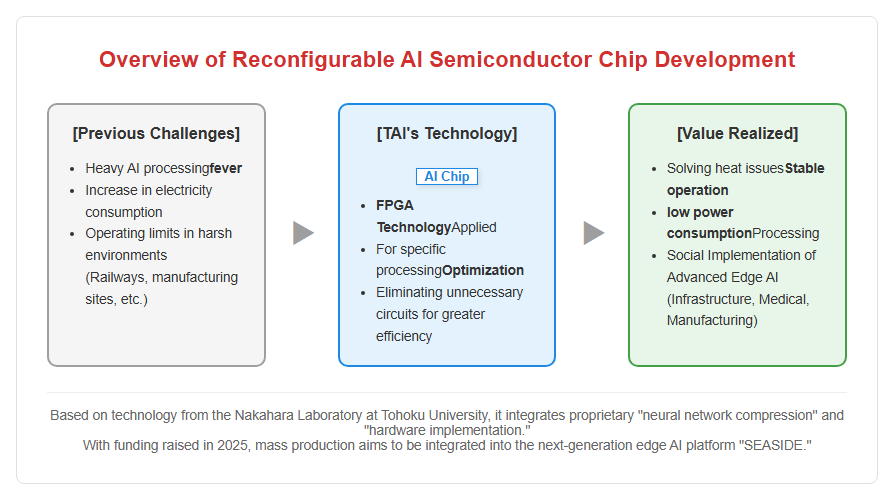
With this technology, it has become possible to analyze people flow in real time and with low power consumption, even in places where advanced AI was previously difficult, such as inside railway stations, large commercial facilities, and outdoor public spaces. Capital and business alliances have also been signed with JR East and JR Kyushu, accelerating social implementation in infrastructure fields such as Shinkansen inspections and creating liveliness around stations.
Future Prospects for Realizing Smart Cities
Demonstration Results from the Kitakyushu City Prototype City Initiative
Prior to the official launch of NIGIWAI, a demonstration experiment conducted in Kitakyushu City from February to March 2026 marked an important milestone in proving the system’s effectiveness. This experiment, conducted under the city’s prototype city initiative, confirmed that pedestrian behavior can be visualized as objective statistical data, allowing for accurate understanding and verification of the effectiveness of these measures based on evidence.
In actual settings, not only did people pass through, but detailed insights were gained into which groups stopped in which areas and what actions they take. For example, by tracking which age groups stayed the most during specific events and how they led to dining at nearby stores, insights have been gained that directly contribute to optimizing future event planning and store attraction.
Thanks to these demonstration results, NIGIWAI has positioned itself not just as a measurement tool but as a strategic platform to maximize regional value. By delivering this successful model, which began in Kitakyushu City, nationwide, we are now ready to contribute to solving the challenges of economic revitalization faced by regional cities.
Nationwide Deployment and Promotion of Responsible AI Utilization After 2026
Going forward, TAI will package NIGIWAI for municipalities and developers nationwide. From 2026 onward, the trend toward smart cities is accelerating, and as seen in the Ministry of Land, Infrastructure, Transport and Tourism’s case studies, the utilization of human flow data across all administrative sectors, including tourism promotion, disaster prevention measures, and urban planning, is required.
On the other hand, ethical considerations are essential for the social implementation of AI. The 1.2 edition of the Japanese AI Business Guidelines published on March 31, 2026, added the scope of regulations for physical AI and AI agents, and explicitly stated consideration of the Human-in-the-Loop, which involves human judgment. TAI’s edge AI technology minimizes the risk of privacy breaches from the design stage, aligning with the spirit of these new guidelines.
Going forward, it is expected to be utilized in broader fields, such as analyzing inbound demand for large-scale events like the 2026 Asian Games and reorganizing public transportation networks. By balancing technological advancement with ethical controls, safe and comfortable urban operations where everyone can benefit from digital technology will be realized.
[#NIGIWAI #人流解析 #エッジAI #スマートシティ #スタートアップ #DX #TokyoArtisanIntelligence #北九州市]
コメント