Orbius has announced a new solution that fully integrates Multi-LEO satellite communications and edge AI computing. Behind this launch is the rapid surge in demand for real-time AI adoption at remote sites and the growing requirement to protect data sovereignty.
- Complete Integration of Multi-LEO Satellite Communications and Modular AI
- Traditional Challenges in Remote Locations and the Shift to On-Site AI
- Establishing Data Sovereignty via the Layer 2 Dedicated Route “PNI”
- A Full-Stack Ecosystem Supporting Rapid Deployment
- Specific Use Cases in the Maritime, Energy, and Defense Sectors
- Future Outlook and Challenges for Technology Diffusion
Complete Integration of Multi-LEO Satellite Communications and Modular AI
On October 13, 2026, Orbius Communications (Fort Lauderdale, Florida, USA) announced a new edge cloud solution combining its StarEDGE satellite platform with Armada’s edge computing infrastructure. This solution is the world’s first fully integrated system that covers everything end-to-end, from wide-area connectivity via multi-low-earth-orbit (Multi-LEO) satellite constellations to on-site AI computing, within a single stack. As shown in the diagram below, satellites and edge nodes are managed in an integrated manner.
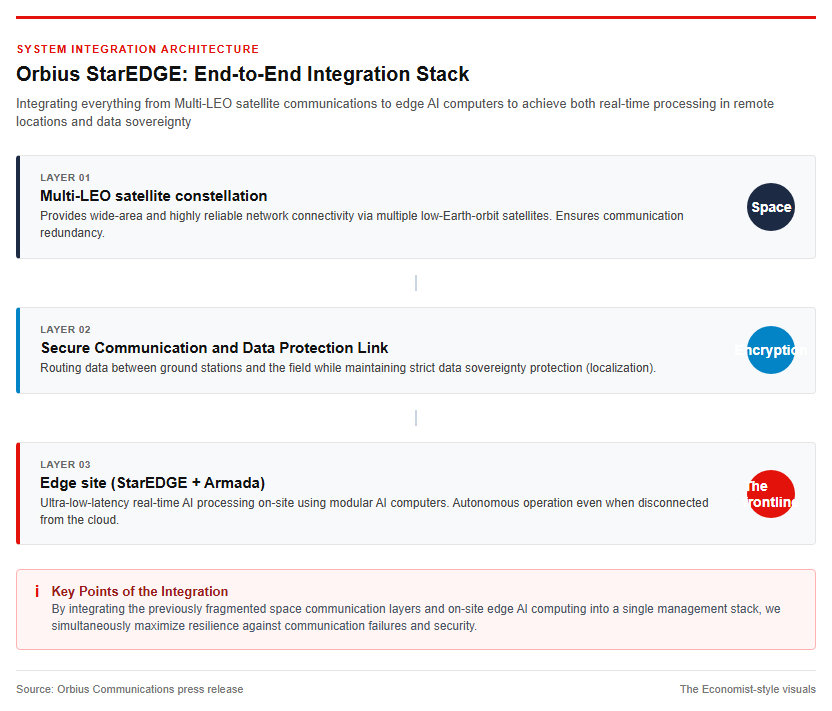
Traditionally, satellite communication providers and computer hardware vendors have operated separately, requiring user companies to handle multiple contracts and system integration on their own. Through this initiative, by having a single partner manage the entire process from signal reception to AI inference and decision-making, we offer the following operational benefits.
- Accelerating Production Environment Setup: Drastically reducing the multi-year timeframe required to build traditional fixed data centers down to just a few weeks.
- Rugged Portable Infrastructure: The Integration of Rugged Modular Computers and Multi-Networks Specifically Designed for Field Environments
- Centralized Management System: Secure APIs, proactive NOC monitoring, and elimination of integration risks through contractual SLAs
This makes it possible to instantly build advanced AI operational environments even in areas where it was previously difficult to set up communication infrastructure, such as over the oceans, in mountainous regions, in conflict zones, and at disaster relief sites.
Traditional Challenges in Remote Locations and the Shift to On-Site AI
Historically, industries operating in remote locations such as maritime, telecommunications, energy, and mining have faced severe challenges regarding insufficient network bandwidth and communication latency. For instance, in mission-critical operations such as maintaining vessel navigation, continuously monitoring power grids, and controlling remote plants in real time, the conventional approach of transmitting the massive amounts of data generated on-site to a centralized cloud data center and waiting for the computation results has failed to ensure the necessary response speeds.
According to preliminary research by research organizations, global edge computing-related spending is projected to exceed approximately $317 billion by 2031, surging to nearly triple the 2025 level as the transition from centralized cloud to on-site processing rapidly accelerates. The adoption of edge computing, which performs real-time processing and data analysis right at the data source, achieves exceptionally high uptime at Six Sigma standards and has become a strategic requirement for enterprises to maximize the value of AI across their entire operations.
As Halldor Sigurdsson, CEO of Orbius, points out, the era in which remote locations act as a constraint on business and operations is coming to an end. By directly linking ultra-high-speed communication with edge AI computing power in the field—whether on land or at sea—latency-free, on-site decision-making becomes possible.
Proprietary Architecture and Data Sovereignty Protection
Establishing Data Sovereignty via the Layer 2 Dedicated Route “PNI”
A crucial technical feature of this edge cloud solution is that the preservation of data sovereignty is built into it from the design stage. In regulated industries such as government, energy, finance, and healthcare, transmitting sensitive data collected and generated on-site to foreign countries or third-party servers via the public internet is strictly restricted from the perspective of legal risk and compliance.
To address this challenge, Orbius has deployed Private Network Interconnect (PNI), a global private network infrastructure utilizing a low-Earth orbit satellite constellation. PNI transmits customer communication traffic over secure Layer 2 paths terminating at regional data centers without exposing it to the public internet.
- Maintaining private network communication across the entire process from satellite links to edge workloads
- Keep data and decision-making processes within the field, the organization, or domestic borders.
- Complete compliance with the laws, regulations, and management/security requirements of each country and industry.
In this way, by integrating the network and edge computing environments rather than keeping them separate, we physically and logically block the risks of external cyberattacks and unauthorized incoming connections, thereby achieving truly robust data governance.
A Full-Stack Ecosystem Supporting Rapid Deployment
To ensure the success of AI implementation in the field, flexible scalability tailored to the specific characteristics of the installation environment and a stable operation and maintenance system are essential. The full-stack solution realized through the technological integration of the StarEDGE platform and Armada centers on an environmentally resistant, portable modular infrastructure, and is designed to operate immediately even in harsh field environments.
At the communication layer, heterogeneous communication links—such as 5G/LTE and High-Throughput Satellites (HTS)—are combined redundantly, centering on global Multi-LEO (multi-Low Earth Orbit satellite networks). This prevents communication disruptions caused by single satellite network failures or adverse weather, achieving high availability by automatically maintaining the optimal connection path at all times.
Furthermore, enterprises can start with a pilot deployment at a single remote location and smoothly scale to a globally interconnected network of AI nodes as their business expands, without needing to redesign their connectivity architecture or system configurations. With standardized interfaces and APIs, 24/7 monitoring by a proactive NOC (Network Operations Center), and strict contractual SLAs, the operational burden on adopting companies is significantly reduced.
Ripple Effects on Industry and Future Prospects
Specific Use Cases in the Maritime, Energy, and Defense Sectors
This solution demonstrates its greatest power in geographically isolated environments and regions with vulnerable infrastructure. It has already been rolled out for the maritime, energy, government, telecommunications, and enterprise markets, bringing about tangible innovation across diverse industrial sites. The following architecture diagram shows the overall picture of integrated AI operations in remote areas.
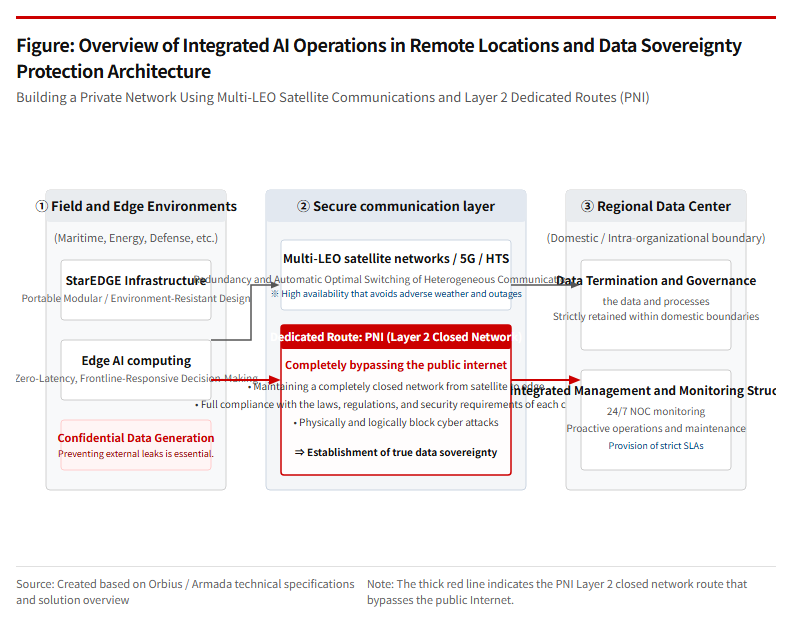
Specific use cases include the following examples:
- Maritime sector: Real-time onboard monitoring of engine operating status and optimization calculations for routes and fuel consumption on ocean-going vessels and workboats.
- Energy and Resources: Predictive maintenance and anomaly detection combining sensor data and image analysis AI at remote oil fields, mines, and power transmission facilities
- Defense and Disaster Relief: Instantly setting up portable AI data centers in conflict zones and disaster-stricken areas where communication infrastructure has been severed to carry out rapid situational analysis.
For example, in the maritime industry, transmitting all the terabyte-scale video and image data generated onboard to land consumes vast bandwidth and enormous communication costs. By performing AI-based filtering and preliminary analysis at the edge, and transferring only the necessary analysis results and anomaly notifications via low-Earth orbit satellites, it is possible to minimize bandwidth costs while maximizing responsiveness.
Future Outlook and Challenges for Technology Diffusion
Currently, the integrated solution of Orbius and Armada is being globally deployed through key global locations such as the United States, Iceland, Brazil, Ireland, France, Spain, Norway, and the United Arab Emirates (UAE). Against the backdrop of increasing AI demand in remote locations, this new business model, which provides a bundled offering of satellite communications and edge computers, is expected to lead future trends in the telecommunications and cloud industries.
On the other hand, there are also several technical and operational challenges toward its full-scale adoption in the future.
- Power Supply and Thermal Management in the Field: Edge computers executing high-load AI inference consume massive amounts of power and generate heat, making the securing of a stable power supply and the construction of efficient cooling systems in the field essential.
- Verification of Actual Results: Accumulation and Optimization of Empirical Data on Long-Term Availability (SLA) in Harsh Environments
- Compliance with Domestic and Inter-Regional Regulations: Organization of country-specific radio wave usage regulations and cross-border data transfer rules
Even in the Japanese market, the areas where this solution can contribute are extremely vast, including remote islands, offshore wind farms, domestic and ocean-going vessels, and temporary communication hubs during major disasters. A distributed infrastructure in which space (satellites), ground stations, the cloud, and on-site edge computers are connected via a single secure path will serve as an indispensable foundation supporting the next-generation digital society.
Reference Page
- [Orbius Communications Official Press Release] https://www.prnewswire.com/news-releases/orbius-unveils-new-edge-cloud-solution-through-its-staredge-platform-to-unlock-ai-anywhere-302906000.html
- [Orbius Communications Official Website] https://www.orbius.com/
【#EdgeComputing #EdgeAI #SatelliteCommunications #MultiLEO #Orbius #StarEDGE #Armada #DataSovereignty】

コメント