S&I Co., Ltd. has released an enhanced version of “AI Dig,” an AI knowledge utilization solution for contact centers, realizing a fully cloud-based speech recognition environment through integration with Genesys Cloud. In the background lies a common industry challenge: the increasing burden of device configuration and operational management associated with the widespread adoption of work-from-home operations and site expansion.
- Achieving a Fully Cloud-Based Architecture via AudioHook Integration
- Technical mechanisms that dramatically reduce implementation and operational burdens
- The Wave of Cloud Shifts and Expanding Work-from-Home Operations
- The Wall of Large-Scale Deployment Faced by Device-Dependent Systems
- Standardizing Customer Support Quality through Generative AI and Multi-LLM Utilization
- The Future Vision of Next-Generation Contact Centers and Key Points to Watch
Achieving a Fully Cloud-Based Architecture via AudioHook Integration
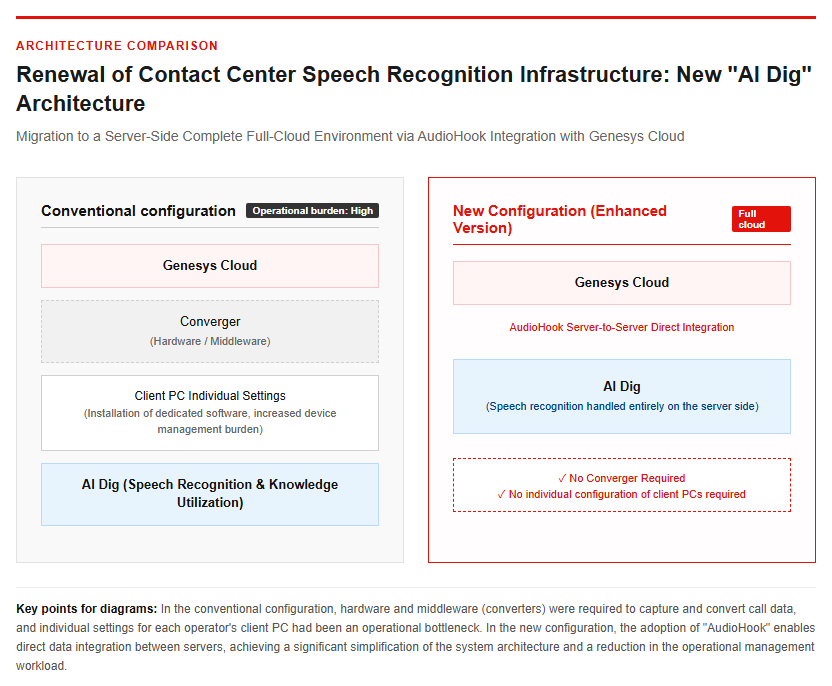
On October 14, 2026, S&I Co., Ltd. released an enhanced version of AI Dig, an AI knowledge utilization solution for contact centers. The key highlight of this update is the strengthened functional integration with Genesys Cloud, which boasts a high market share as a cloud-based contact center platform. Specifically, by supporting AudioHook—an audio streaming integration feature—a mechanism has been established to directly integrate call data from Genesys Cloud into AI Dig. This realizes a cloud-native architecture that completes speech recognition processing on the server side, without the need for hardware or middleware called “converters,” which were previously required for audio capture and conversion. In the conventional configuration, it was necessary to install dedicated software and perform individual settings for each client PC used by operators, which tended to complicate the overall system architecture. However, because call data is now sent and received directly between servers through this AudioHook integration, a significant simplification of the configuration has been achieved. Please refer to the diagram below for an illustration of the new configuration.
Consequently, a new service plan built on AudioHook integration is now available for companies using Genesys Cloud, enabling reductions in initial implementation costs and deployment time compared to traditional methods.
Technical mechanisms that dramatically reduce implementation and operational burdens
The newly realized full-cloud speech recognition environment features a mechanism that fundamentally eliminates technical bottlenecks in contact center system operations. First, by completely centralizing speech recognition processing on the server side, software installation on client PCs and environment configuration work for each terminal have become entirely unnecessary. This significantly reduces the preliminary verification work and individual kitting tasks that were previously required during periodic PC replacements and OS updates. Second, it improves operator usability and stabilizes voice quality. Because high-quality digital audio streams are acquired directly from Genesys Cloud, degradation and dropouts in sound quality are less likely to occur, allowing for stable speech recognition accuracy to be maintained. Furthermore, operators no longer need to manually perform start and stop operations for speech recognition corresponding to the start and end of calls, enabling them to naturally receive AI assistance during daily handling tasks without being conscious of the system at all. For system administrators, it also brings the major benefit of significantly reducing operation and management man-hours for the entire center, as the burden of troubleshooting terminal-side issues and version management is alleviated.
Challenges Facing Contact Centers and Their Background
The Wave of Cloud Shifts and Expanding Work-from-Home Operations
In recent years, the cloud shift of operational infrastructure (transition to CCaaS) has been progressing rapidly in Japan’s contact center industry. Behind this trend are pressing social demands, such as a severe labor shortage caused by a declining population, the strengthening of business continuity plans (BCP), and the promotion of diverse work styles. Especially since the 2020s, there has been a sharp increase in companies adopting work-from-home operations, allowing operators to handle customer inquiries from their own homes. A strong demand has emerged to transition away from the conventional operational model—which consolidates operators within facility-based contact centers—toward a flexible framework that enables distributed operations regardless of location.
However, deploying systems in remote environments has brought to light new challenges, including ensuring security, dealing with a diversity of communication environments, and managing operator terminals. Particularly when implementing speech recognition systems, the need to install and configure software on every individual home client PC and verify its proper functioning has placed an extremely heavy burden on IT departments. In remote operations involving diverse terminal environments and network pathways, there has been an urgent desire to achieve a streamlined system configuration that is unaffected by physical location or device specifications.
The Wall of Large-Scale Deployment Faced by Device-Dependent Systems
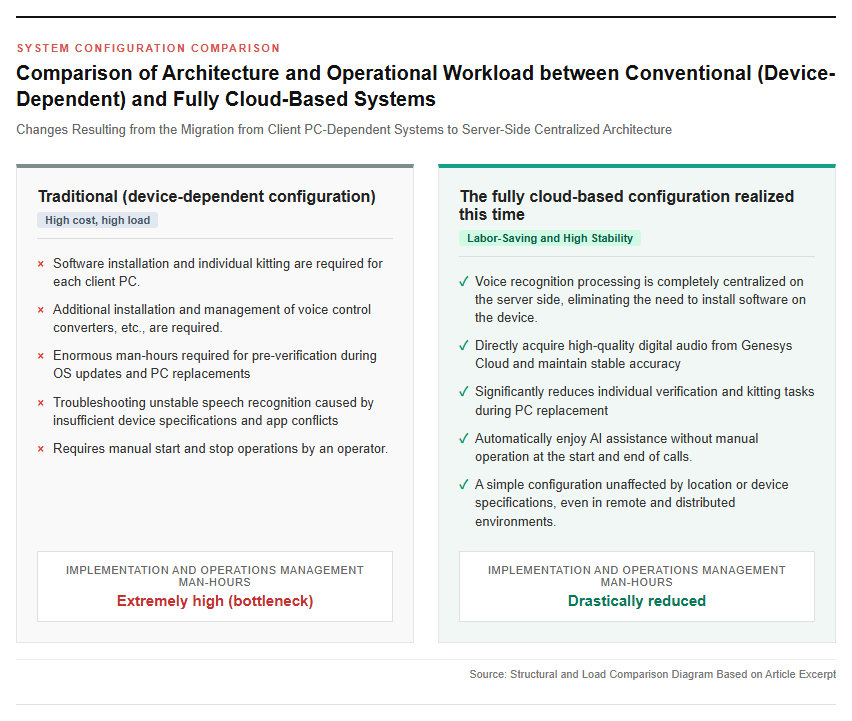
The biggest challenges in conventional speech recognition systems were their high dependency on client PCs and the complexity of their system configurations. In conventional configurations, it was essential to install software running on operator terminals and a converger to control and branch call audio. As a result, for large-scale contact centers with over 100 seats or enterprises with multi-site deployments, an enormous amount of man-hours and costs were incurred just for configuration work during system construction. In addition, it was difficult to respond flexibly and swiftly to changes such as sudden increases or decreases in the number of seats, the opening of new sites, or annual terminal replacements. Issues where speech recognition became unstable due to insufficient client PC specs or conflicts with other applications were also occasionally observed, requiring individual troubleshooting each time. The following image shows a comparison of the operational load between the conventional terminal-dependent configuration and the new full-cloud configuration.
Breaking through such barriers of device dependency and simplifying the system configuration to the utmost limit had become a paramount imperative for building contact center infrastructure in the cloud era.
Knowledge Circulation Brought by AI Dig and Future Prospects
Standardizing Customer Support Quality through Generative AI and Multi-LLM Utilization
AI Dig goes beyond being merely a voice recognition tool, transforming knowledge management across entire contact centers by integrating with generative AI technology. In December 2023, a text summarization feature utilizing ChatGPT and Azure OpenAI Service was added, significantly reducing the time spent on post-call documentation (after-call work). Furthermore, in November 2024, the company announced a partnership with IBM watsonx.ai, IBM’s enterprise AI platform. This has realized a multi-LLM environment that enables users to quickly switch between more than 30 diverse large language models (LLMs) depending on their use cases, including IBM’s proprietary model, Granite. In addition, AI Dig v3, released in March 2026, has embedded a knowledge circulation cycle of “using, accumulating, and learning” directly into operational workflows. It is equipped with an operator assist function that organizes customer requests from call contents to automatically generate appropriate search queries, as well as a feature that automatically generates FAQ drafts. Through these features, even novice operators can seamlessly reach accurate answers comparable to those of experienced veterans without hesitation, achieving standardized response quality and dramatic operational efficiencies, such as shortening the training period from an average of 12 months to approximately 2 months.
The Future Vision of Next-Generation Contact Centers and Key Points to Watch
The full-cloud transition achieved through the newly announced Genesys Cloud AudioHook integration represents a significant step forward in accelerating the digital transformation (DX) of contact centers. Moving forward, it is anticipated that, assuming the full-cloud transition of speech recognition infrastructure, the integration of autonomous task execution by AI agents and more advanced real-time support functions will progress. According to market analysis reports such as those by Fuji Chimera Research Institute, the contact center software market continues to grow at a high pace with a compound annual growth rate (CAGR) of over 14%, entering an era where the success or failure of cloud adoption and generative AI utilization dictates corporate competitiveness. S&I Co., Ltd. has also indicated a policy to further strengthen integration with various contact center infrastructures moving forward, continuously promoting the sophistication of knowledge management through generative AI and the reduction of operational workloads. Key points to watch in the future include further improvements in speech recognition accuracy within cloud environments, the evolution of AI-driven sentiment analysis and real-time intent detection, and the deployment of comprehensive solutions that enhance both customer experience (CX) and employee experience (EX). For companies operating contact centers, how quickly they can firmly establish the latest cloud technologies and AI on the front lines will likely be a major key moving forward.
Reference Page
- [S&I Co., Ltd. News Release] https://sandi.jp/news/261014_aidig
- [Customer Service Support Service AI Dig Product Page] https://sandi.jp/sandiai/solution/aidig
【#ContactCenter #AIDig #GenerativeAI #GenesysCloud #SpeechRecognition #CloudMigration #SandI】
コメント