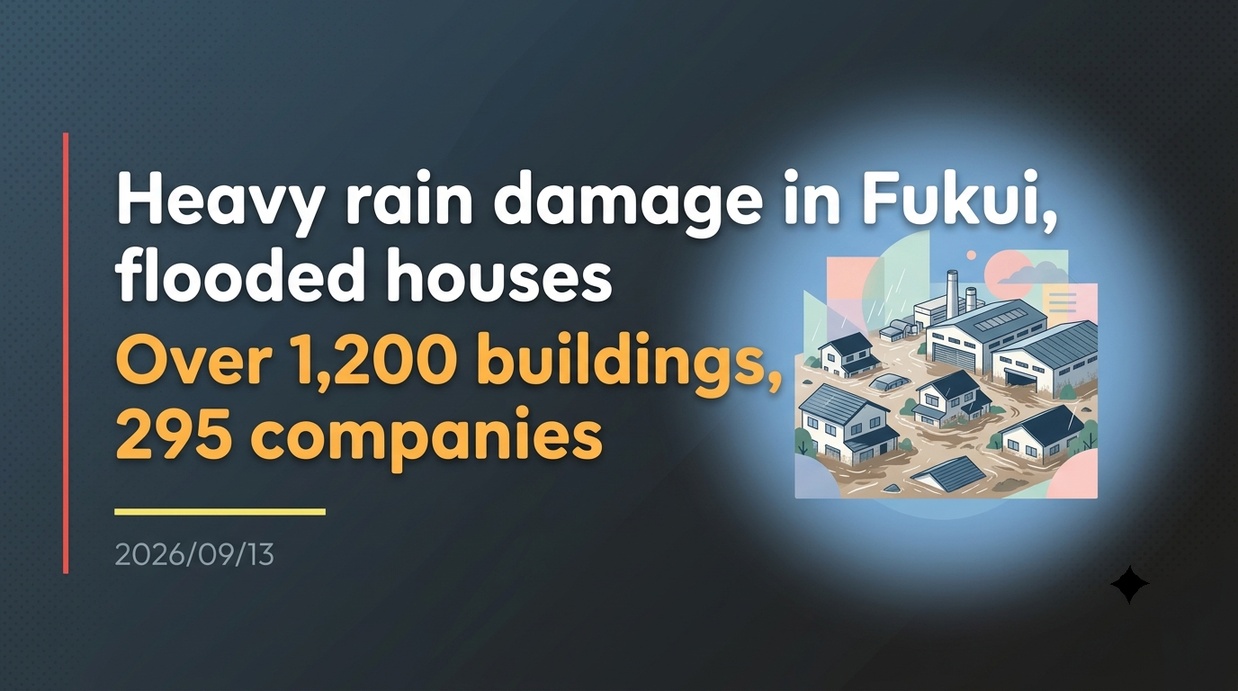
Two weeks after record heavy rainfall devastated the Reihoku region of Fukui Prefecture, official surveys reveal that over 1,200 residential buildings have been flooded and 295 local businesses impacted. With severe disruptions spreading across key regional industries—including textiles, food manufacturing, and agriculture—the national government’s designation of the event as a “Severe Disaster” and swift economic recovery support have become imperative.
- Record Downpours Hit the Reihoku Region: Widespread Housing and Infrastructure Damage
- Direct Hit to Local Industry: 295 Businesses Affected
- Equipment Damage and Operational Losses in Food Manufacturing and Dining
- Devastating Blow to Agriculture and Concerns Over the “Echizen Soba” Brand
- National Government’s “Severe Disaster” Designation and Public Support Frameworks
- Rebuilding Corporate BCPs and Transitioning to “River Basin Disaster Management”
Record Downpours Hit the Reihoku Region: Widespread Housing and Infrastructure Damage
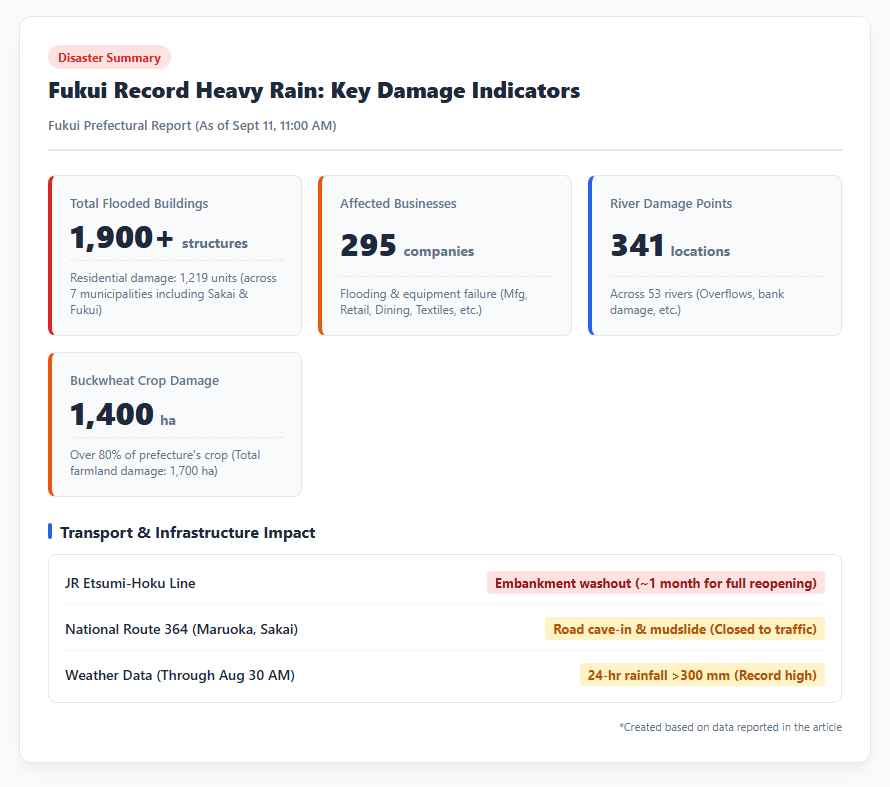
From late August 2026, active atmospheric fronts triggered intense, record-breaking rainfall across Fukui Prefecture, particularly from the night of August 29 through the morning of August 30. The Japan Meteorological Agency issued a Level 5 Emergency Heavy Rainfall Warning, recording historical 24-hour rainfall exceeding 300 millimeters. According to a Fukui Prefectural Government report issued on September 11, two weeks after the torrential rains, the total number of flooded buildings exceeded 1,900. Among these, residential damage reached 1,219 structures across seven municipalities, including Sakai City and Fukui City, forcing numerous residents to engage in grueling mud removal and cleanup operations. Infrastructure suffered major disruptions as well: National Route 364 faced road closures due to cave-ins and mudslides, while the JR Etsumi-Hoku Line experienced embankment washouts that are expected to take about a month to fully repair. River infrastructure was heavily damaged, with overflowing and bank destruction confirmed at 341 locations across 53 rivers in the Reihoku region. As recovery efforts move forward, severed transportation links and damaged public infrastructure remain significant hurdles to regional economic restoration. Please refer to the figure below for an overview of the damage.
Direct Hit to Local Industry: 295 Businesses Affected
The deluge dealt a heavy blow not only to private residences but also to commercial facilities and industrial plants across the region. Prefectural surveys indicate that 295 local businesses suffered flooding, equipment failures, or facility damage. The affected enterprises span a wide range of sectors, including manufacturing, wholesale and retail, and hospitality. Fukui is globally renowned for its textile industry, and in Sakai City’s Maruoka Town—a major hub for woven label manufacturing—the factory of Brancheur was submerged in approximately 10 centimeters of floodwater. Raw thread, finished goods awaiting shipment, and critical electronic circuit boards and components of weaving machinery were inundated, forcing 6 out of 37 machines to stop operating. Direct damages already exceed 10 million yen, with total losses potentially reaching several hundred million yen when accounting for machine repairs and replacements. Visiting the site, Fukui Governor Takahito Ishida emphasized the reality of businesses facing existential threats and pledged swift administrative support. The massive capital required for facility restoration, coupled with opportunity losses from operational downtime, is placing severe financial strain on small and medium-sized enterprises.
Sector-by-Sector Impact and Economic Losses
Equipment Damage and Operational Losses in Food Manufacturing and Dining
Food manufacturers and dining establishments that sustain the local culinary economy are suffering severe operational losses. At Seiyo Kashi Kurabu, a bakery based in Maruoka Town, Sakai City, floodwaters reached approximately 30 centimeters inside the factory during the heavy rains on August 30. Large refrigeration and freezing units essential for confectionery production, along with specialized manufacturing equipment, were completely submerged. As a result, production for all five retail outlets across the prefecture came to a complete standstill. Although employees and volunteers worked tirelessly on cleaning and disinfection, risks of bacterial contamination and equipment malfunctions generated daily operational losses estimated at several million yen. Meanwhile, in Eiheiji Town, the specialty tofu restaurant Koya avoided direct indoor flooding but was forced to suspend operations after an embankment adjacent to its parking lot collapsed. Between handling reservation cancellations, discarding prepared perishable ingredients, and writing off spoiled inventory, estimated losses reached millions of yen. Many business owners continue to face unseen hygiene risks and equipment failure long after the waters have receded, leaving their timelines for reopening uncertain.
Devastating Blow to Agriculture and Concerns Over the “Echizen Soba” Brand
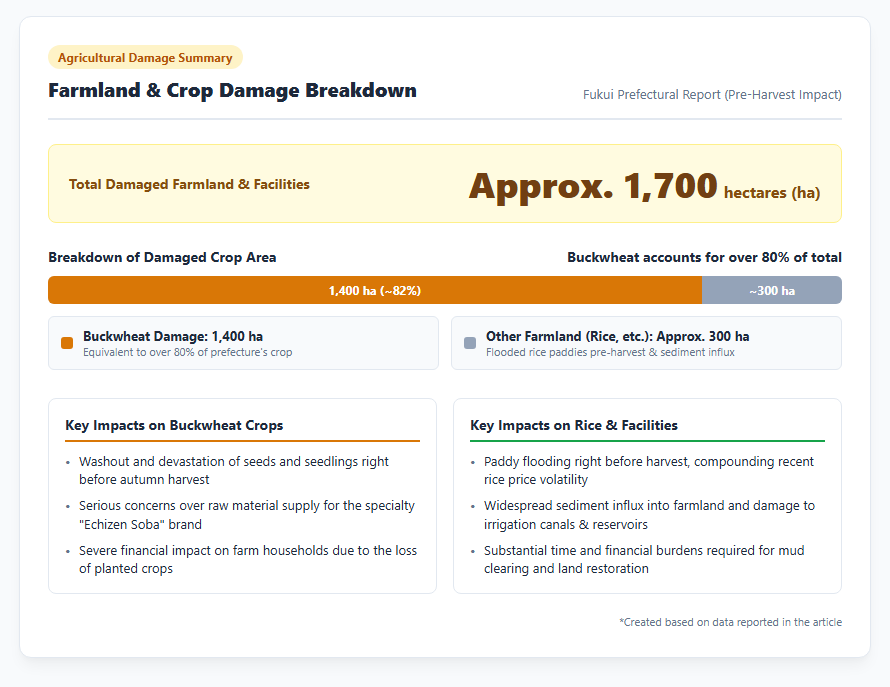
The agricultural sector suffered devastating losses just ahead of the harvest season. Across Fukui, approximately 1,700 hectares of farmland and agricultural facilities were submerged or flooded. Buckwheat—a prized local specialty—bore the brunt of the disaster, accounting for over 80% of total agricultural damage with 1,400 hectares affected. Seedlings and seeds were washed away in key growing areas, raising grave concerns over the supply chain and brand integrity of Fukui’s famous “Echizen Soba.” Paddy rice farmers also faced severe flooding in fields on the verge of harvest, compounding existing financial pressures caused by recent price volatility in the rice market. Additionally, mudslides into farmland and extensive damage to irrigation canals and reservoirs require substantial time and capital to repair. Local agricultural associations have petitioned the prefectural government for price stabilization measures and immediate farmland restoration assistance. Comprehensive policy support combining crop compensation with infrastructure repair is crucial to preventing the decline of regional agriculture. Please refer to the figure below for the status of farmland damage.
Relief Measures and the Outlook for Business Continuity Planning
National Government’s “Severe Disaster” Designation and Public Support Frameworks
In response to the widespread destruction, local and national authorities are expediting relief frameworks. The Fukui Prefectural Government established special consultation desks to assist affected small and medium-sized enterprises with financing and facility restoration. Furthermore, Prime Minister Takaichi announced that the heavy rain damage across the Hokuriku region—including Toyama, Ishikawa, and Fukui prefectures—is expected to be designated as a “Severe Disaster” (Hon-geki) without regional restrictions. This designation raises the national government’s subsidy rate for restoring farmland, forest roads, and public civil engineering facilities, significantly alleviating the financial burden on local municipalities. Additionally, financial support measures—including safety-net guarantees and special emergency loans provided through the Ministry of Economy, Trade, and Industry and financial institutions—are being rolled out to prevent business bankruptcies. Rapid execution of public assistance serves as a vital catalyst for affected business owners to accept support and take steps toward resuming operations.
Rebuilding Corporate BCPs and Transitioning to “River Basin Disaster Management”
This record rainfall leaves critical lessons for corporate Business Continuity Planning (BCP) and regional disaster prevention frameworks. The disaster demonstrated that even businesses in areas traditionally considered safe from flooding face severe risks from sudden, localized downpours. Companies must re-evaluate their hazard maps, secure emergency power supplies, install flood barriers and drainage pumps, and adopt AI-driven crisis management tools for real-time risk assessment. On the public infrastructure side, administrative bodies recognize the limits of traditional engineering controls like river levees and dams, accelerating a transition toward “River Basin Disaster Management” (Ryuiki Chisui). This holistic approach incorporates temporary rainwater retention in public parks, school grounds, and agricultural fields, alongside ring levees protecting residential areas, to mitigate flood risks across entire river basins. Collaborative disaster prevention efforts between businesses and local communities will be key to enhancing long-term regional economic resilience.
References
- [Cabinet Office Disaster Management] Status of Damage Caused by Heavy Rain from August 27, 2026
防災情報のページ - 内閣府内閣府防災情報のページ。災害状況, 被害状況の公表のほか、防災対策情報や内閣府の防災に関する政策等を公開しています。www.bousai.go.jp

【#FukuiTorrentialRain #FloodDamage #SevereDisaster #BusinessContinuityPlanning #RiverBasinDisasterManagement #EconomicSupport】


コメント