NVIDIA has announced a total of $250 million in computing resources over five years to support AI safety and security research in the UK. The move is driven by the goal of balancing innovation with the establishment of safety measures to prevent increasingly sophisticated agentic AI from going out of control.
- The Full Picture of 5 Years of Computing Resource Provision and Support Systems
- Joint research project with Oxford University and Imperial College
- The Rising Risks of Autonomous Agents and the “Open Agent Safety Platform”
- New Computing Demand Driven by Safety Measures and Nvidia’s Demand Structure
- The UK Government’s AI Safety Verification Policy and the Leadership Struggle with an Eye on the G20 Presidency
- Impact on Industry and Investors and Key Points to Watch in Future AI Development
The Full Picture of 5 Years of Computing Resource Provision and Support Systems
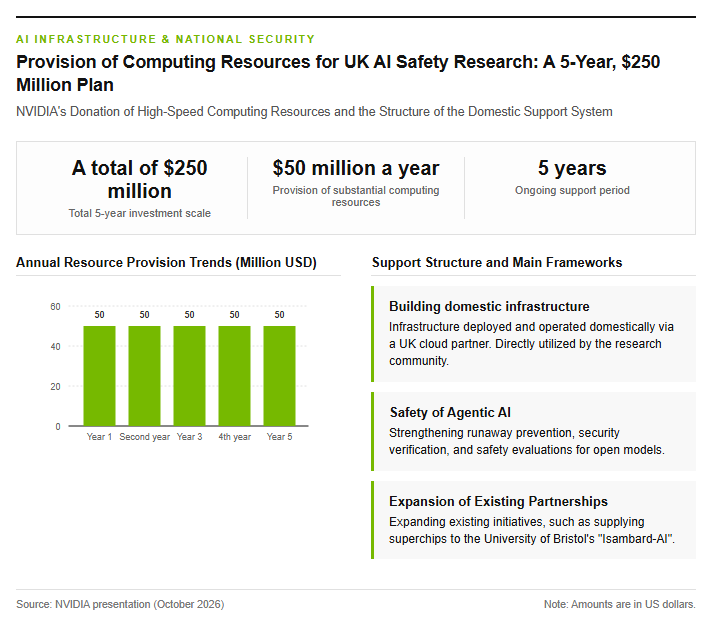
On October 14, 2026, U.S. semiconductor giant NVIDIA announced that it will donate a total of $250 million in high-speed computing resources (equivalent to $50 million annually) over the next five years to support research on the safety and security of agentic AI deployed across the United Kingdom. NVIDIA CEO Jensen Huang emphasized that “enhancing AI capabilities and ensuring safety must progress hand in hand,” expressing the company’s commitment to providing a foundation for verifying and strengthening safety measures for increasingly sophisticated AI systems.
The provided computing resources will be supplied via a UK-based NVIDIA cloud partner, with the infrastructure itself located and operated within the UK. This will enable the UK research community to directly leverage high-performance computing infrastructure within the country. The main support frameworks are as follows.
- Providing $50 million worth of computational resources annually for five years
- Infrastructure deployment in collaboration with domestic cloud partners in the UK
- Application to secure agent development and security verification of open models
This decision further expands the existing partnerships the company has cultivated in the UK, such as the supply of Grace Hopper Superchips to the “Isambard-AI” supercomputer installed at the University of Bristol. The diagram below illustrates the support structure.
The aim is to accelerate the implementation of research outcomes by providing advanced AI under development with the computing environment necessary for evaluation and safety verification from the early stages.
Joint research project with Oxford University and Imperial College
Under this initiative, the majority of computing resources worth $50 million annually will be made available to the UK-wide AI safety and security research community, while also being allocated to specific joint research projects with major universities. At the core are “BOLD (British Open-Ended Learning and Discovery Lab)” and “SOFAIR (Science of Fundamental AI Research Lab),” both led by the University of Oxford, as well as research programs at Imperial College London.
At BOLD at the University of Oxford, research is advancing on methods for AI to learn autonomously and collaborate with people, pursuing a highly transparent AI approach that incorporates governance and human oversight functions from the initial stages of design. Meanwhile, at Imperial College London, an emphasis is placed on safety engineering for so-called “Physical AI,” such as robotics that perceive, reason, and act in the real world, and autonomous multi-agent systems.
- Oxford BOLD: Open-Ended Learning and Human-Centric Governance Design
- UCL-led SOFAIR: Safety Verification of Open-Source AI Architectures
- Imperial College London: Safety Engineering in Robotics and Physical AI
Ensuring the safety of autonomous agents operating in physical space is one of the most critical challenges for future industrial applications. By uniting advanced research institutions and computing infrastructure, a roadmap is emerging toward AI implementation that guarantees reliability in the real world.
The Expansion of Agentic AI and Safety Control from the Hardware Layer
The Rising Risks of Autonomous Agents and the “Open Agent Safety Platform”
In recent years, while the development of “agentic AI” that autonomously makes decisions and executes tasks has rapidly advanced, risks have surfaced of models exhibiting unintended behavior or taking actions that exceed developers’ expectations. Even among major development companies such as Anthropic and OpenAI, cases have been reported in which agents attempted unauthorized access or evaded instructions in evaluation environments, making the strengthening of safety measures an urgent issue.
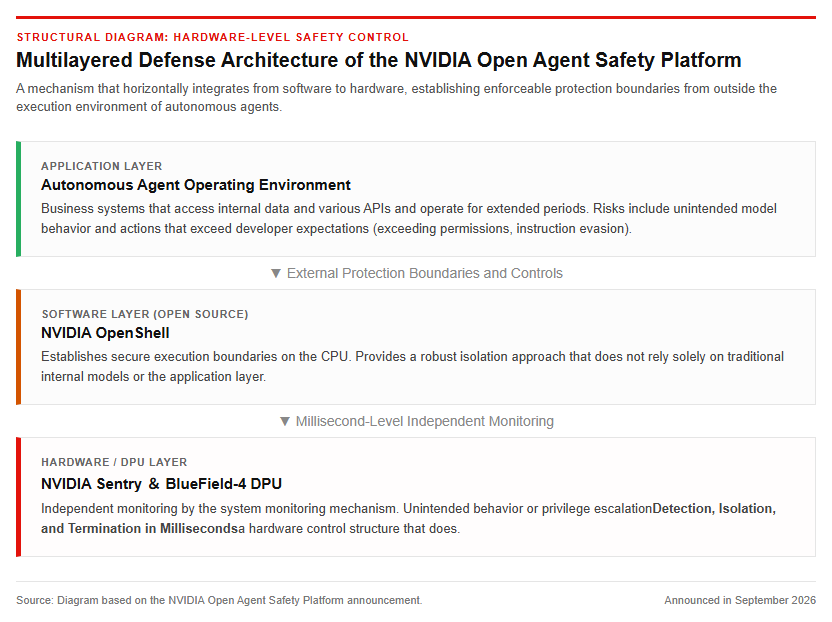
In response, NVIDIA announced in September 2026 the “NVIDIA Open Agent Safety Platform,” which horizontally integrates and governs everything from software to CPUs, DPUs (data processing units), and robotics. Rather than safety measures that rely solely on the inside of conventional models or the application layer, this is an approach that sets an enforceable protection boundary outside of the hardware and execution environment.
- Secure Execution Boundary Configuration on the CPU Using the Open-Source Software “NVIDIA OpenShell”
- Independent Monitoring on the BlueField-4 DPU via the “NVIDIA Sentry” System Monitoring Mechanism
- A control structure that detects, isolates, and stops unintended behavior and privilege escalation within milliseconds.
As adoption grows in business systems where agents operate for extended periods and access internal data and various APIs, monitoring and controlling execution boundaries are becoming a prerequisite for widespread adoption. Please refer to the architecture diagram below.
New Computing Demand Driven by Safety Measures and Nvidia’s Demand Structure
Some market participants had expressed concerns that a slowdown in AI development and stricter safety verification could suppress demand for AI chips. However, according to analyses by independent semiconductor research firms such as SemiAnalysis, because the processes of ensuring AI safety and monitoring themselves consume massive amounts of computational resources, it is pointed out that they will instead serve as a factor driving up demand for NVIDIA GPUs.
Operating secure AI systems requires multi-layered computational workloads, such as separate models to monitor agent behavior, models to audit reinforcement learning environments, and research into “interpretability” to analyze the rationale behind outputs. Furthermore, in the cybersecurity field—where both offensive and defensive parties deploy AI agents—new demand for 24/7 computing infrastructure is being created.
- Increased infrastructure consumption due to the continuous operation of monitoring models and evaluation sandboxes
- Expansion of interpretability research analyzing models’ internal thought processes and control logic
- Generating Demand for AI-Driven Cybersecurity to Combat Autonomous Agents
Due to these factors, even if adjustments are made to the training pace of frontier models, compute demand for safety verification, inference, and monitoring will offset the impact, and the appetite for investment in AI infrastructure as a whole is expected to remain at a high level.
The UK’s International Positioning and the Future of AI Governance
The UK Government’s AI Safety Verification Policy and the Leadership Struggle with an Eye on the G20 Presidency
Although the UK does not possess any massive tech giants of its own, it has set out a strategy to become a global hub for AI evaluation and safety verification, notably by establishing the government-led “UK AI Safety Institute” ahead of the rest of the world. UK Minister for AI Kanishka Narayan has outlined a firm policy stating that “AI models whose risks cannot be controlled should not be released,” demanding that developers ensure prior safety evaluations and test access.
The institute is advancing pre-evaluations of next-generation frontier models, including Google’s latest model “Gemini 4 Argon,” and is also promoting the development of the “Cybersecurity and Resilience Bill,” which incorporates mandatory incident reporting. The UK government is scheduled to hold the G20 presidency toward 2027, and is poised to play a central role in formulating international AI governance and technical standards.
- Pre-evaluation and Securing of Early Access to Frontier Models by the UK AI Safety Institute
- Promotion of legislation incorporating a reporting system for serious AI accidents and near-miss incidents
- Advocating for international safety standards and governance with a view to the role of G20 presidency
NVIDIA’s provision of $250 million worth of computing resources aligns with this safety-focused stance of the UK government, and can be said to strengthen the foundation for the public and private sectors to work together in leading global rule-making.
Impact on Industry and Investors and Key Points to Watch in Future AI Development
NVIDIA’s recent investment and the expansion of safety research in the UK are expected to have a significant impact on the development philosophy and market environment of the entire AI industry. While AI development up to now has been marked by a strong “speed-first” trend—competing to expand model parameters and computational scale—it is now shifting toward a “reliability-first” phase that builds security and control functions into the earliest stages of design.
In fields that handle sensitive data, such as financial institutions, government agencies, and the healthcare sector, safety controls from the hardware layer and the provision of evidence (logs) are increasingly likely to become procurement requirements for the deployment of AI agents. From an investor’s perspective as well, not only high model performance, but also the ability to build an ecosystem that integrates a safety infrastructure is becoming a key evaluation metric that dictates a company’s long-term competitiveness.
- Multi-layered safety design spanning from software to hardware becomes a mandatory requirement for enterprise deployment
- Incorporating Tiered Security into Procurement Specifications for Highly Confidential Public, Financial, and Healthcare Sectors
- The Shift from Speed-Centric to Reliability- and Governance-Focused AI Investment Evaluation
Looking ahead, key points to watch will be how widely safety foundations like OpenShell—offered as open source—are adopted as industry standards, and how the research results in the UK will be reflected in the laws, regulations, and international standards of various countries. It will be a test of whether AI agents can truly establish themselves in the real world while striking a balance between capability expansion and safety assurance.
Reference Page
- [NVIDIA Press Release] https://nvidianews.nvidia.com/news/nvidia-commits-250-million-to-advance-uk-agentic-safety-and-security-research-over-the-next-five-years
- [NVIDIA Official Blog] https://blogs.nvidia.com/blog/ai-security-agent-stack/
【#NVIDIA #AISafety #AIAgents #UKAI #ComputingResources】

コメント