The Ministry of Health, Labour and Welfare has decided on a policy to factor financial income, such as stock dividends and capital gains, into the determination of medical insurance premiums and out-of-pocket medical expenses for elderly individuals aged 75 and over. This is driven by the goal of eliminating inequities in burdens caused by differing reporting methods and enhancing the sustainability of the social security system through ability-to-pay-based contributions.
- Key point of the event: Inclusion of financial income in medical expenses starting from August 2029
- Rectifying Disparities Caused by Tax Return Filing Status and the Background Behind the System Revision
- Online Sharing of Statutory Records and Exclusion from NISA Accounts
- Simulation of Specific Impacts on Insurance Premiums and Out-of-Pocket Costs
- Reducing the burden on the working-generation and the financial structure of medical care for the latter-stage elderly
- Future Outlook and Key Points: Ripple Effects on the Working-Age Generation and Reassessing Asset Management
Key point of the event: Inclusion of financial income in medical expenses starting from August 2029
The Ministry of Health, Labour and Welfare has finalized its policy to launch a new system in August 2029 that will directly reflect financial income, such as dividends and capital gains from listed stocks, in the calculation of medical insurance premiums and the determination of out-of-pocket copayment ratios at medical institutions for late-stage elderly individuals aged 75 and over. A related partial amendment bill to the Health Insurance Act and other laws was enacted on May 29, 2026, and the system will transition to full-scale operation following a period for system modifications and the preparation of statutory records. Specifically, information on financial income generated from January to December 2028 will be collected by the end of January 2029 through statutory statements prepared by financial institutions, and will be utilized to determine insurance premiums and copayment tiers (10%, 20%, or 30%) starting from August of the same year.
Until now, even if individuals had investment gains from stocks or investment trusts, if they selected a designated account with tax withholding and did not file a tax return, local governments were unable to ascertain that income, and it was excluded from the determination of medical expense burdens. Under the new policy, income will be ascertained online via the statutory record database regardless of whether a tax return is filed, meaning individuals will be required to bear a burden commensurate with the profits of their held financial assets. The figure below provides an overview of the new system.
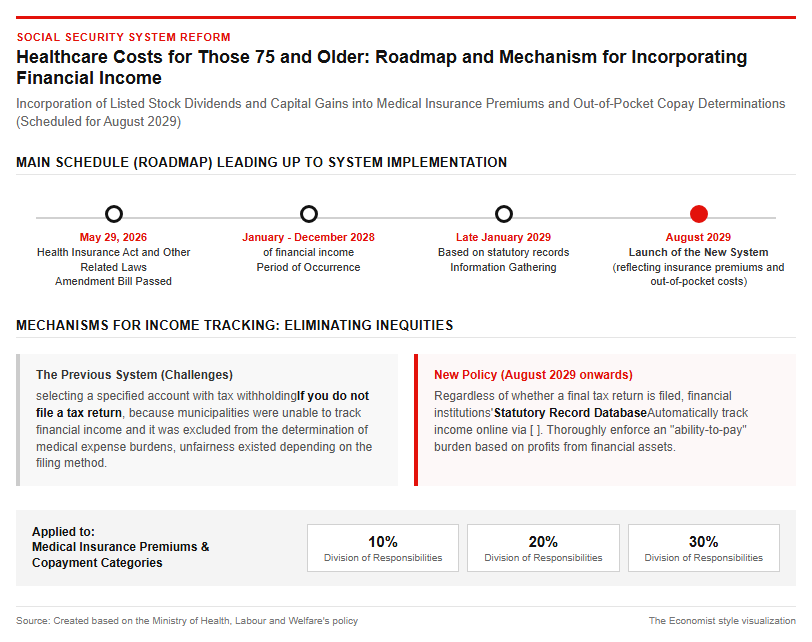
The goal is to ensure practical equity based on an individual’s ability to pay rather than age, in order to sustain healthcare costs that continue to balloon due to the aging population.
Rectifying Disparities Caused by Tax Return Filing Status and the Background Behind the System Revision
The primary reason behind this fundamental review is that under the current tax and social security systems, significant burden disparities have arisen depending on “whether or not a final tax return was filed.” For instance, when receiving dividends from listed stocks, if the assets are managed in a specified account with withholding and a final tax return is not filed, that dividend income is not reflected in the municipality’s tax records. Consequently, no matter how massive the financial income a person earns, their out-of-pocket medical expenses at healthcare facilities remain capped at the standard 10%, and their insurance premiums are also kept at a low level.
On the other hand, in households that voluntarily filed final tax returns for purposes such as offsetting gains and losses on listed stocks or claiming foreign tax credits, their financial income became known to local governments, frequently resulting in cases where their out-of-pocket medical co-payment rates were raised to 20% or 30%, or their annual insurance premiums increased significantly. In fact, it has been pointed out that even among elderly households with the same level of income and 5 million yen in annual dividend income, a gap of about 500,000 yen in insurance premiums occurs solely based on whether or not they filed a final tax return, which has been viewed as a major systemic inequity. The Ministry of Health, Labour and Welfare aims to eliminate such oversights in information capture and discrepancies in treatment caused by procedures, thereby building a fair medical insurance system based on true ability to pay.
The Mechanism for Capturing Financial Income and Its Impact on Households and Asset Management
Online Sharing of Statutory Records and Exclusion from NISA Accounts
To accurately capture individual income information under the new system, the online sharing of statutory records submitted by financial institutions such as securities companies and banks to the National Tax Agency, local governments, and Latter-Stage Elderly Healthcare Wide-Area Unions is being introduced. By digitally linking statutory record data using My Number and other identifiers, an infrastructure will be established that allows each wide-area union to automatically aggregate the financial income of target individuals and use it for determinations, even if the individuals themselves do not file a final tax return. This will enable smooth income tracking without increasing the procedural burden on individuals.
Regarding the treatment of NISA (Tax-Exemption System for Small Investments), which is of particular interest to investors and seniors, it has been explicitly specified as excluded (no impact). Since dividends and capital gains earned through the growth investment quota or accumulation investment quota within a NISA account are tax-free, they will not be captured by statutory reports, nor will they affect the determination of medical insurance premiums or out-of-pocket medical expense ratios. As a result, asset-building strategies such as systematically transferring stocks and mutual funds held in specified accounts to a NISA account will take on critical importance for safeguarding one’s future livelihood.
Simulation of Specific Impacts on Insurance Premiums and Out-of-Pocket Costs
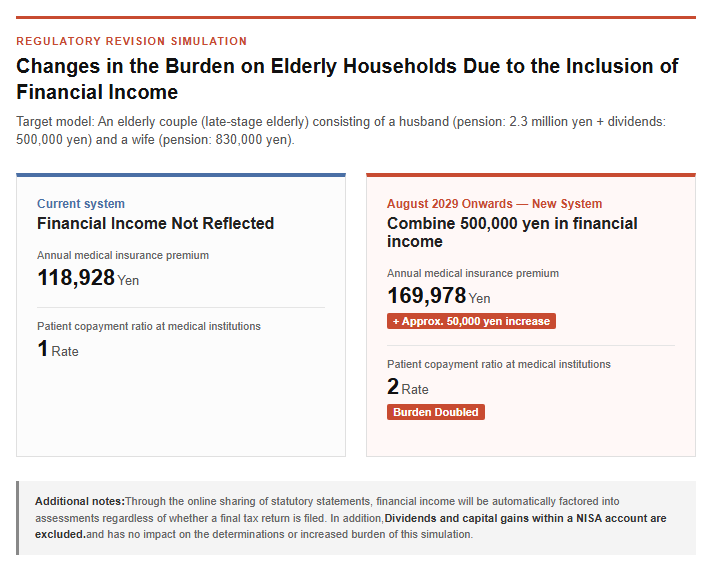
As financial income is reflected in medical insurance assessments, the household financial burden is expected to increase significantly for some elderly households. According to a calculation example presented by the Ministry of Health, Labour and Welfare, in the case of a late-stage elderly couple where the husband has a pension income of 2.3 million yen, dividend income of 500,000 yen, and the wife has a public pension income of 830,000 yen, under the conventional system the husband’s financial income of 500,000 yen was not counted, meaning the annual medical insurance premium was 118,928 yen and the copayment at the counter was limited to 10%.
However, under the new system starting in August 2029, 500,000 yen in financial income will be factored in, increasing the annual medical insurance premium by about 50,000 yen to 169,978 yen, and furthermore, the copayment rate at medical facilities will double from 10% to 20%. For seniors, who frequently visit medical institutions, the impact of their out-of-pocket costs doubling is extremely significant. The figure below illustrates the change in household burden.
As a countermeasure, one option is to switch individual stocks held in a taxable account to mutual funds that do not pay dividends, and then withdraw and use only the necessary amount. Since only the portion representing the increased profit—rather than the entire sale amount—is classified as financial income at the time of withdrawal, an exit strategy that keeps the taxable amount low is effective.
Transition to All-Generation Social Security and Future Outlook
Reducing the burden on the working-generation and the financial structure of medical care for the latter-stage elderly
Behind the ongoing review of medical expenses for the elderly lies a serious intergenerational imbalance within Japan’s social security finances. In fiscal 2021, Japan’s national medical expenditures reached 45 trillion yen, with the generation aged 70 and older consuming over 50% of that amount. In particular, regarding the medical benefits of the Healthcare System for the Late-Stage Elderly (which covers those aged 75 and above), about 40% is covered by support funds from the working generation (contributions from insurance premiums), and about 50% is borne by national and local public funds (taxes), leaving the coverage rate funded by individuals’ out-of-pocket payments and insurance premiums at only around 10%.
With the progression of the declining birthrate and aging population, the social insurance premium burden per working-age person is rising rapidly, putting a severe squeeze on household finances. Monthly social insurance premiums for worker households aged 45 to 54 increased by approximately 24,000 yen from fiscal 2005 to fiscal 2023, reaching levels close to their limit. To alleviate the dissatisfaction of the working-age generation and enhance the sustainability of the system, it is considered essential to shift toward an ability-to-pay burden that requires wealthy elderly individuals who hold financial assets and financial income to bear a fair share of the burden.
Future Outlook and Key Points: Ripple Effects on the Working-Age Generation and Reassessing Asset Management
The inclusion of financial income in the Latter-Stage Elderly Healthcare System starting in August 2029 is positioned not merely as an issue concerning those aged 75 and over, but as a first step toward reform of the entire social security system. At the Ministry of Health, Labour and Welfare and government councils, discussions are also progressing on the creation of a roadmap to raise the out-of-pocket medical copayment for the elderly to 30% in principle, a review of the criteria for determining individuals with incomes comparable to the working generation, and even the incorporation of financial income into the National Health Insurance and Long-Term Care Insurance for those under 75.
Going forward, it is increasingly likely that even for the younger and mid-career generations in their asset-building phase, the traditional assumption that “social security burdens will not increase unless you file a final tax return” will no longer hold true. In preparing funds for old age, it is essential not only to view things from the perspective of simply growing assets, but also to design an exit strategy that minimizes the total lifetime burden, including taxes and social insurance premiums. With the start of income capture slated for 2028, reviewing individual asset management strategies early on—such as maximizing the use of NISA allowances and shifting toward distribution-suppressing investment methods—will be a crucial point moving forward.
Reference page
- [FY 2026 Social Security-Related Budget – House of Councillors] [suspicious link removed]
【#SocialSecurity #LateStageElderlyHealthcareSystem #FinancialIncome #MedicalExpenseBurden #NISA #AllGenerationSocialSecurity】


コメント