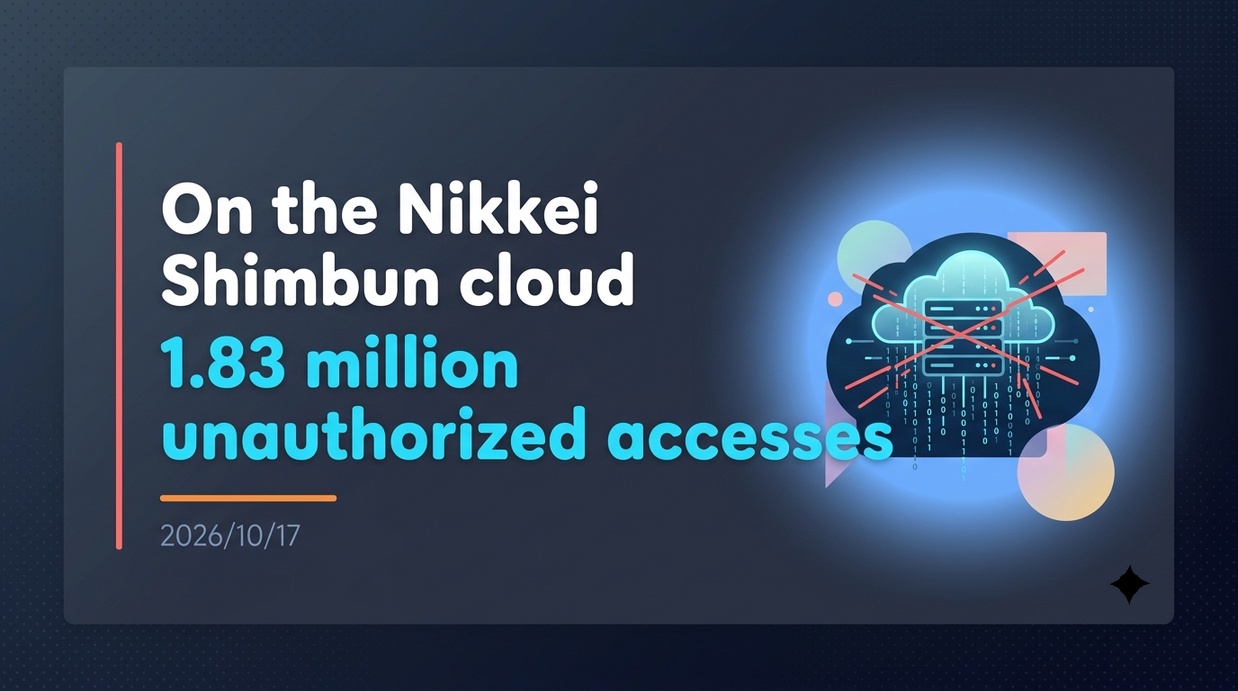
At Nikkei Inc., a major cyber incident occurred in which an external cloud service used for system development suffered unauthorized access, resulting in the leakage of approximately 1.83 million records of personal information. The background to this includes the theft of credentials used to access the cloud service and the presence of account takeover attacks, which have been surging in recent years.
- Credential Theft from the Development Cloud and the Full Scope of the Damage
- Breakdown of Leaked Data and the Risk of Further Damage
- Repeated Unauthorized Access and History of Past Damage
- Main Mechanisms and Threats of Credential Theft
- The Cloud Shared Responsibility Model and the Wall of Identity Management
- Delays in Anomaly Detection and Challenges in Log Monitoring
- Advanced Multi-Factor Authentication and Protection of Development Environments
- Building a Zero Trust Environment and Future Prospects
Credential Theft from the Development Cloud and the Full Scope of the Damage
On October 16, 2026, Nikkei Inc. announced that unauthorized access had occurred to an external cloud service used by the company for system development, raising the possibility that approximately 1.83 million records of personal information may have been leaked. The attack took place between the early hours and morning of October 7, 2026, and it was revealed that a third party infiltrated the cloud environment by masquerading with legitimate access privileges. The cause was that the authentication credentials required to log in to the relevant cloud service were stolen through some means and exploited. Fortunately, as of October 16, 2026, no misuse of the leaked information, secondary damage, suspension of Nikkei’s systems, or data tampering has been confirmed. Furthermore, credit card information was not stored on the target cloud and is not subject to the leak. Following the discovery of the breach, Nikkei immediately invalidated the relevant authentication credentials, reported the incident to the Personal Information Protection Commission, and is proceeding to contact potentially affected individuals directly. The following diagram illustrates a general concept of authentication credential management in a cloud environment.
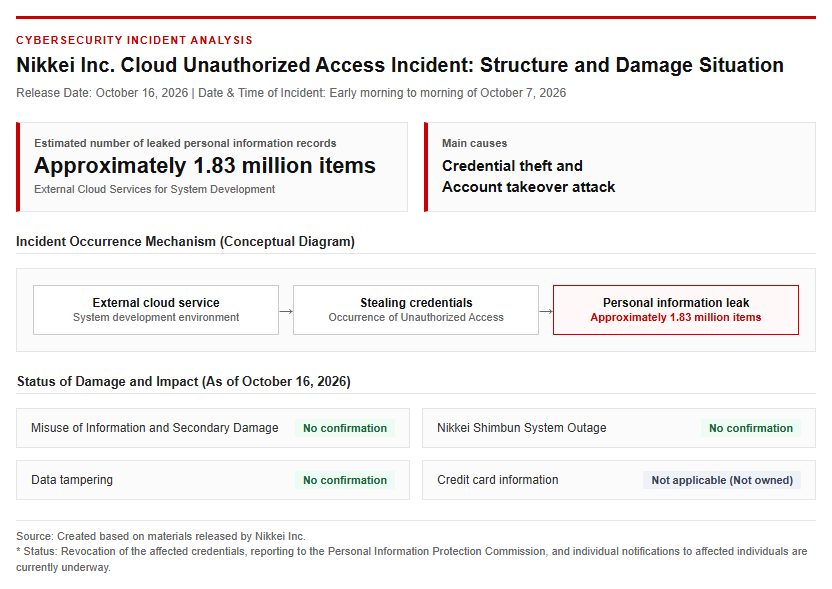
This incident was not merely an attack exploiting a system vulnerability, but rather an attack carried out by hijacking legitimate access privileges, which has once again highlighted the difficulty of key management in cloud operations.
Breakdown of Leaked Data and the Risk of Further Damage
The approximately 1.83 million pieces of information leaked in this unauthorized access are broadly classified into two categories based on their nature. One category is personal information containing any of the following: name, email address, address, phone number, or date of birth, and this accounts for approximately 150,000 cases. Among these 150,000 cases, there are about 120,000 records containing email addresses in particular, which are considered to require the highest level of vigilance from the perspective of preventing secondary damage. This is because if email addresses are leaked, the risk of receiving phishing or spoofing emails disguised as the Nikkei or related organizations increases dramatically. The other category consists of identifier-only data that cannot identify a specific individual on its own, which accounts for approximately 1.68 million cases. Although it is considered difficult to immediately identify individuals using identifiers alone, we cannot rule out the complex risk that they could be cross-referenced or matched with databases and attribute information leaked elsewhere, leading to the identification of individuals. The following image illustrates the structure of the data leak and its risk classification.
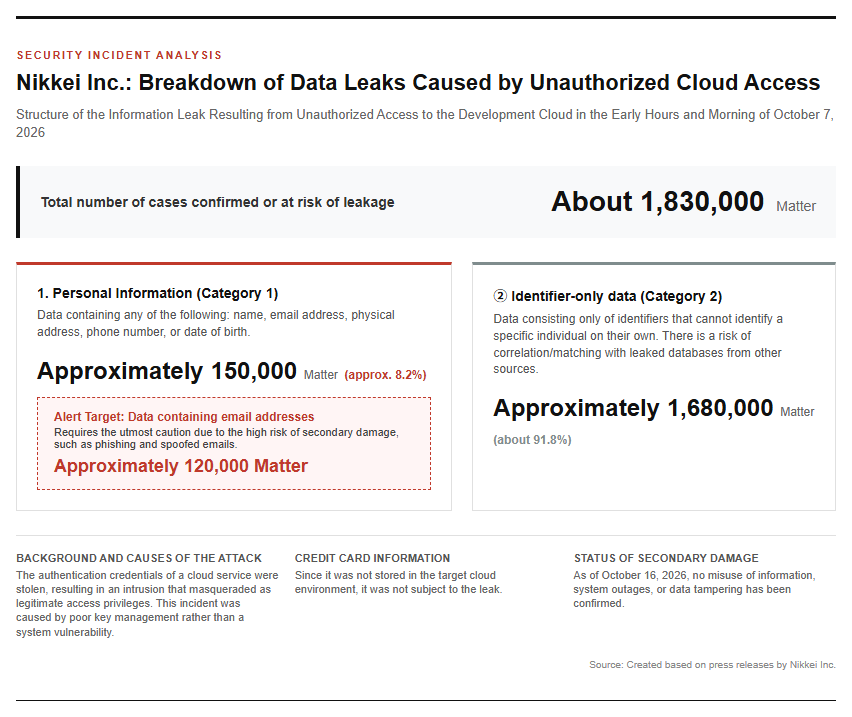
The fact that actual personal information was stored in the test environment for system development has also been cited as an operational issue, and companies are strongly urged to thoroughly manage confidential data.
Repeated Unauthorized Access and History of Past Damage
The cybersecurity incident at Nikkei Inc. is not limited to this latest case involving the leak of 1.83 million records. Just prior to this, on October 4, 2026, the company publicly disclosed two consecutive unauthorized login incidents. In one of them, a Microsoft 365 account used by an employee was compromised, and approximately 9,000 spoofed emails designed to lure recipients to malicious sites were sent to news sources and others. The other incident involved a potential leak of personal information for 1,646 people, including employees and business partners, due to an unauthorized login to a Google Workspace account. Going back even further, in May 2020, a malware infection triggered by a phishing email led to the leak of 12,514 records concerning employees and others, and in November 2025, Slack credentials were leaked via a virus infection on a personally owned PC, resulting in the leakage of information for 17,368 people. Furthermore, in March 2026, a Microsoft 365 account was compromised at Nikkei America, leaking information for 291 people. Given this sequence of events, intrusions into cloud environments originating from device infections and credential theft have occurred intermittently at the company, making the reconstruction of its organizational security infrastructure an urgent issue.
Cloud Account Attack Techniques and Operational Blind Spots
Main Mechanisms and Threats of Credential Theft
In unauthorized access to cloud services, the most powerful weapon used by attackers is not bugs in the system itself, but legitimate users’ credentials (IDs, passwords, and access keys). As methods for stealing credentials, phishing attacks that lure users to authentic-looking login screens to prompt input, and infostealers (information-stealing malware) that lurk on PCs to steal browser-saved passwords and session information have been surging in recent years. Furthermore, in system development environments, mistakes where cloud connection API keys and access keys are mistakenly left written in source code or configuration files and leaked to public repositories continue to happen endlessly. Attackers use automation tools and AI to search for exposed keys and vulnerable credentials in milliseconds, completing system intrusion before humans even realize it. The most critical mechanism of modern cloud threats is that just by having a single key stolen, attackers can slip past robust data center defenses and gain free access to the inside of the cloud as a legitimate user.
The Cloud Shared Responsibility Model and the Wall of Identity Management
When using cloud services, the most fundamental principle that must be understood is the shared responsibility model. In cloud services such as Microsoft 365, Google Workspace, AWS, or Azure, the cloud provider is responsible for the security management of the infrastructure, physical data centers, and hypervisors. On the other hand, the enterprise using the service bears full responsibility for account ID management, access permission settings, multi-factor authentication (MFA) operations, and data classification and protection. In this incident as well, it is believed that the cause was not a breach of the Google or Microsoft infrastructure itself, but rather the compromise of account credentials managed by the user company. Many companies mistakenly assume that security is foolproof simply by adopting the cloud, but in reality, while the burden of server management is reduced, the complexity of identity and permission management has increased exponentially. In the modern era where identity has become the new security perimeter, it is essential to correctly understand the boundaries of the shared responsibility model and implement appropriate permission management and identity protection.
Delays in Anomaly Detection and Challenges in Log Monitoring
A major challenge in cloud security incidents, including this recent case, is the time it takes to detect unauthorized access (dwell time). In past unauthorized logins to Google Workspace, there were numerous instances where organizations could not immediately detect anomalies solely through their own security monitoring systems, learning of the situation for the first time only through notifications from Google. Furthermore, in a case where approximately 9,000 suspicious emails were sent from a compromised legitimate account, it was seen as problematic that the anomalous behavior was not detected or blocked until after the mass mailing occurred. Because attackers log in using legitimate IDs, they easily bypass conventional IP restrictions and simple perimeter defense filters. To prevent this, it is necessary to introduce behavior analytics and log monitoring (UEBA) that can detect anomalous behaviors in real time, such as access from unusual locations or unauthenticated devices, unnatural mass downloads of data in a short period of time, changes to administrator privileges, and the addition of forwarding rules. Since it is difficult to reduce intrusions to zero, there is a strong demand for establishing mechanisms to quickly spot anomalous behavior after an intrusion has occurred.
Future Security Measures and the Transition to Zero Trust
Advanced Multi-Factor Authentication and Protection of Development Environments
The most effective first line of defense against credential theft is the comprehensive implementation and advancement of multi-factor authentication (MFA) that does not rely solely on passwords. However, simply implementing MFA via SMS or authenticator apps is not enough. In recent years, sophisticated methods to bypass MFA have emerged, such as MFA fatigue attacks, which bombard users with MFA approval requests to trick them into accidentally approving them, and Adversary-in-the-Middle (AiTM) attacks, which relay communications to steal session cookies. Therefore, transitioning to phishing-resistant authentication mechanisms using FIDO2-compliant passkeys and hardware security keys is recommended. Furthermore, enforcing rigorous security management in development environments is an urgent priority. It is necessary to prohibit the careless transfer of production data to development environments and to establish operational rules that mandate masking processing or the use of surrogate data (dummy data) during testing. Even in cloud development environments, the principle of least privilege must be strictly enforced, and lifecycle management—such as regularly deleting and updating unnecessary connection keys and accounts—is essential.
Building a Zero Trust Environment and Future Prospects
The idea of perimeter-based security—that the traditional internal network is safe and the outside is dangerous—has completely come to an end with the widespread adoption of the cloud. Moving forward, a complete transition to a Zero Trust architecture, which does not trust any access and constantly verifies it, is essential. In a Zero Trust environment, even if valid IDs and passwords are entered, real-time evaluations are performed for each access to determine whether the originating device meets security requirements, whether the connection is from a suspicious location, and whether it holds the appropriate permissions for the data being accessed. Even if credentials for a single account are stolen, device authentication and context verification can stop intrusions and minimize the lateral spread of damage (lateral movement). To ensure sustainable cyber resilience for enterprises, it is necessary to continuously and company-wide develop integrated authentication platforms that respond to the latest threat trends and to periodically review security policies.
Reference page
- [Official Announcement by Nikkei Inc. (October 16, 2026)] https://www.nikkei.com/article/DGXZQOUD159VX0V11C26A0000000/
[#Cybersecurity #CloudSecurity #DataBreach #UnauthorizedAccess #PrivacyProtection #MultiFactorAuthentication #ZeroTrust #Nikkei]
コメント