On October 16, 2026, ASUS JAPAN INC. released four products in the “ASUS UGen” series of edge AI accelerators capable of executing AI inference locally without the need for the cloud. This release comes against the backdrop of a rapidly growing demand for on-device AI, which shifts AI processing from the cloud to the device side to ensure data privacy and eliminate communication latency.
- Key Points of the UGen Series Launch and Product Lineup
- Ease of implementation via external USB and internal M.2 interfaces
- High processing performance and ultra-low power consumption powered by the Hailo chipset
- Local Processing of Generative AI Workloads and Main Memory Protection
- Cross-platform compatibility and a robust development ecosystem
- Background of the Edge AI Processor Market Shifting from the Cloud to the Edge
- The Future Shaped by the Evolution of Edge AI Technology and Key Areas to Watch
Key Points of the UGen Series Launch and Product Lineup
On October 15, 2026, ASUS JAPAN Inc. announced three models in the “ASUS UGen300” series edge AI accelerators—which support generative AI processing such as large language models in addition to traditional vision AI—and one entry-level “ASUS UGen200” model, with sales beginning on October 16, 2026. This product lineup is hardware developed to accelerate AI inference processing in local environments on PCs and embedded devices, without relying on expensive cloud services or large servers.
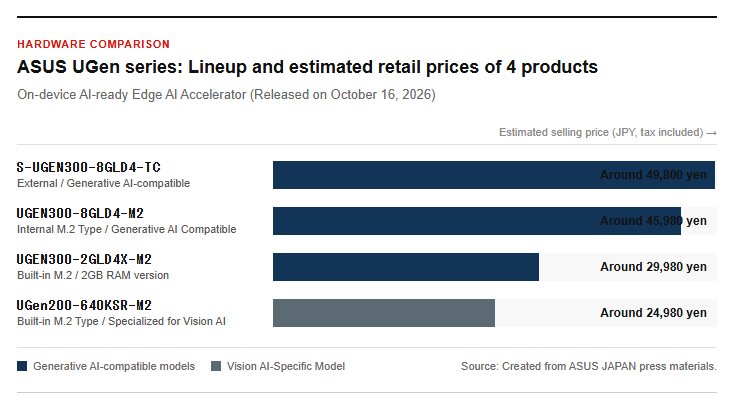
The lineup consists of a total of four models: the external type “S-UGEN300-8GLD4-TC” (expected retail price of around 49,800 yen), the internal M.2 board type “UGEN300-8GLD4-M2” (expected retail price of around 45,980 yen), the 2GB memory version “UGEN300-2GLD4X-M2” (expected retail price of around 29,980 yen), and the vision AI-specialized “UGen200-640KSR-M2” (expected retail price of around 24,980 yen). Flexible options are available according to your application, system configuration, and budget. Please refer to the product images below.
Ease of implementation via external USB and internal M.2 interfaces
A major feature of the UGen series lies in its diverse interface design, which significantly lowers the barrier to entry. The flagship model, the “S-UGEN300-8GLD4-TC,” supports plug-and-play via a versatile USB 3.2 Gen 2 (Type-C) port. This makes it possible to instantly expand the local AI processing capabilities of existing laptops or small desktop PCs without the need to disassemble the PC internals or install additional expansion slots.
Meanwhile, the “UGEN300-8GLD4-M2”, “UGEN300-2GLD4X-M2”, and “UGen200-640KSR-M2”, which are designed to be embedded inside systems, feature standard M.2 2280 slots (Key-M or Key B+M) and a PCIe 3.0 interface. Because they require no extra wiring and offer a compact form factor, they enable the creation of space-saving embedded AI environments inside industrial PCs (IPCs), custom PCs, and compact single-board computers without obstructing internal space or chassis airflow. They are designed for smooth deployment even in environments with limited installation space, such as sensing equipment in development sites and factories.
High processing performance and ultra-low power consumption powered by the Hailo chipset
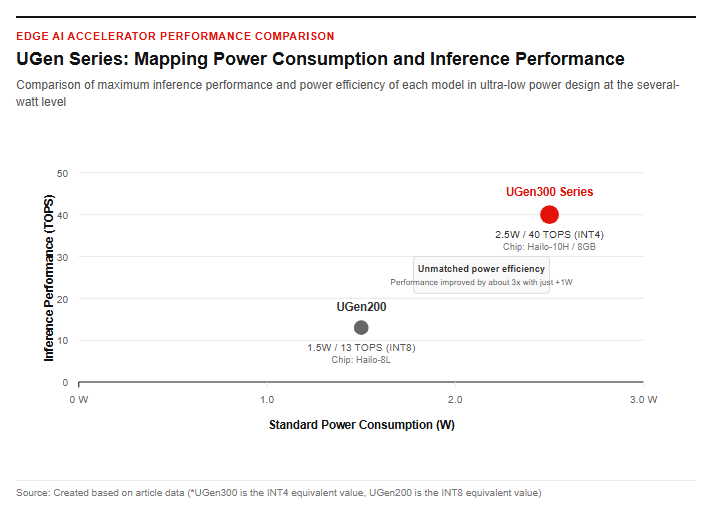
The UGen300 series is equipped with the “Hailo-10H” AI processor, delivering an inference performance of up to 40 TOPS (INT4) while maintaining exceptional power efficiency with a standard power consumption of just 2.5W. By integrating dedicated LPDDR4/4X memory directly onto the accelerator itself, it enables stable AI processing without placing a burden on the host PC’s main RAM space or computational resources.
Meanwhile, the “Hailo-8L” processor featured in the entry-level UGen200 model delivers up to 13 TOPS (INT8) of processing performance with a typical power consumption of just 1.5W. By specializing in conventional vision AI tasks such as image classification, object detection, and person tracking, it achieves operation at a low cost and with extremely low power consumption. Because of this ultra-low power consumption design on the scale of a few watts, stable continuous operation is possible even in fanless enclosures where heat generation is strictly limited, edge environments requiring 24-hour continuous operation, and battery-powered portable devices.
The Technical Advantages and Scalability Brought by Local AI Inference
Local Processing of Generative AI Workloads and Main Memory Protection
Conventional cloud-dependent AI services have faced issues such as communication latency when transmitting data over the internet, ongoing usage costs for cloud infrastructure, and security risks related to information leakage. Equipped with dedicated 8GB or 2GB memory, the UGen300 series enables high-speed local processing of the latest generative AI workloads, including large language models (LLMs), vision-language models (VLMs), and speech recognition via Whisper.
Since inference processing is completed entirely within the device, confidential information and personal data that you do not want to send outside the company can be safely utilized while remaining in the local environment. Furthermore, thanks to the architecture where computations are performed independently on the AI accelerator side, a major advantage is that it does not increase the load on the PC’s main memory or CPU, allowing other business applications and multitasking processes to run smoothly in parallel. This realizes a smart working environment where data collected on-site is converted into text, analyzed, and evaluated in real time on the spot. Please refer to the operational configuration diagram below.
Cross-platform compatibility and a robust development ecosystem
The ASUS UGen series features extensive platform compatibility and a robust software environment to accelerate post-deployment application development and validation tasks. In addition to Windows and Linux, the operating system supports Android for B2B use cases, and the hardware architecture accommodates both x86 and ARM environments. This enables the deployment of identical system configurations across a wide range of systems, from standard Windows PCs to embedded Linux terminals.
Furthermore, through the dedicated tool “UGen Utility” and GitHub, over 150 pre-trained AI models (Model Zoo) and sample code are provided. Developers can leverage industry-standard frameworks such as TensorFlow, PyTorch, and ONNX to embark on proof-of-concept (PoC) or proprietary app development immediately after purchase, without having to build models from scratch. This comprehensive development ecosystem significantly reduces the time and cost required for companies to implement AI.
Rapid Growth of the Edge AI Market and Future Industrial Expansion
Background of the Edge AI Processor Market Shifting from the Cloud to the Edge
With the global spread of AI technology, the trend of shifting data processing hubs from centralized clouds to the edge—the source of data generation—is accelerating. According to market research, the edge AI processor market is projected to grow from $3.6 billion in 2025 to $15.66 billion by 2035, expanding at a compound annual growth rate (CAGR) of 15.83%. Furthermore, data from sources such as the Ministry of Internal Affairs and Communications indicate that the domestic edge computing market is expected to expand from a scale of 1.9 trillion yen in 2025 to 2.6 trillion yen in 2028.
Behind this rapid growth are the pressure on network bandwidth caused by the explosive increase in IoT devices and the demand for millisecond-level real-time response performance required in factories, autonomous driving, and medical settings. In environments such as industrial equipment that cannot tolerate communication latency and settings where confidential data cannot be sent outside, edge AI—which makes decisions on the device itself—is evolving into an indispensable foundational technology.
The Future Shaped by the Evolution of Edge AI Technology and Key Areas to Watch
Looking ahead, in the edge AI sector, attention is focused on the evolution from passive AI that simply recognizes and classifies data to “Physical AI” and “Agentic AI,” which assess on-site conditions and take autonomous actions. Industrial robots, Automated Guided Vehicles (AGVs), and smart cameras are detecting environmental changes in real time at the edge, realizing advanced on-site intelligence that instantly determines optimal operations. Furthermore, the convergence of lightweight technologies for Small Language Models (SLMs) with NPUs and dedicated accelerators is making multimodal processing on mobile devices and compact embedded systems a reality.
The emergence of accessible, low-power accelerators like the “UGen” series introduced by ASUS significantly lowers the barrier to entry for utilizing AI in small and medium-sized enterprises (SMEs) and manufacturing floors. Moving forward, determining how to optimally combine and operate cloud AI and edge AI in alignment with a company’s specific operational challenges will likely become a crucial key that dictates corporate digital transformation and competitiveness.
Reference page
- 【ASUS Unveils Full-Spectrum AI and Always Incredible Innovations at CES 2026】https://press.asus.com/news/press-releases/asus-ces-2026-ai-innovations/
- [ASUS UGen300 USB AI Accelerator 8GB LPDDR4 Product Page] https://www.asus.com/JP/motherboards-components/ai-accelerator/ugen/ugen300-usb-8g/
- 【ASUS UGen300 M2 AI Module 8GB LPDDR4 Product Page】https://www.asus.com/jp/motherboards-components/ai-accelerator/ugen/ugen300-m2-8g/
- [ASUS UGen300 M2 AI Module 2GB LPDDR4X Product Page] https://www.asus.com/JP/motherboards-components/ai-accelerator/ugen/ugen300-m2-2g/
- [ASUS UGen200 M2(B+M) AI Module Product Page] https://www.asus.com/jp/motherboards-components/ai-accelerator/ugen/ugen200-640ksr-m2/
- [Ministry of Internal Affairs and Communications, 2025 Information and Communications White Paper, Part II, Chapter 1, Section 8: Edge Computing] https://www.soumu.go.jp/johotsusintokei/whitepaper/ja/r07/html/nd218300.html
[#EdgeAI #ASUS #UGen300 #Hailo #GenerativeAI #OnDeviceAI #LocalAI]
コメント