On October 15, 2026, U.S.-based ServiceNow announced “AI Passport,” a new solution that controls AI agent execution permissions in real time. This comes amid a serious challenge: while the adoption of AI agents within enterprises is rapidly expanding, the establishment of governance and permission management frameworks is failing to keep pace.
- The Mechanism of “AI Passport” Credentials Using Cryptographic Signatures and Real-Time Control
- Technical collaboration with NVIDIA and ecosystem formation through open specifications
- Expansion of Shadow AI Detection and Comprehensive Cost and Value Governance Features
- The Urgent Need for Governance in Financial Institutions and Highly Regulated Industries and the Technology Separation Model
- The Future of AI Agent Operations and Key Considerations for the Enterprise Market
The Mechanism of “AI Passport” Credentials Using Cryptographic Signatures and Real-Time Control
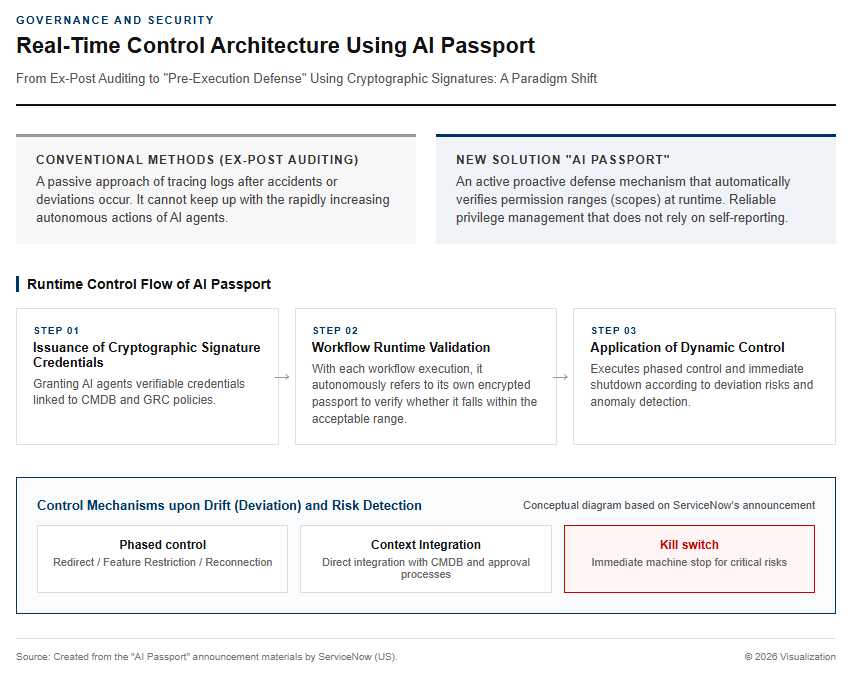
On October 15, 2026, U.S.-based ServiceNow announced “AI Passport,” a solution that controls and verifies runtime permissions for AI agents and Model Context Protocol (MCP) servers in real time. While traditional governance methods have centered on post-incident audits—tracing logs after accidents or deviations occur—AI Passport provides a proactive defense mechanism that automatically verifies permitted scopes at runtime. Cryptographically signed credentials are issued to each AI agent, and with every workflow execution, the agent refers to its encrypted passport to autonomously check whether it remains within the allowable range. These credentials are directly tied to business contexts such as the enterprise’s Configuration Management Database (CMDB), Governance, Risk, and Compliance (GRC) policies, and workflow approval processes. If an AI agent is about to deviate (drift) from its pre-assigned permitted scope, the system applies tiered controls such as redirection, feature restrictions, and reconnection. Furthermore, if a critical malfunction or security risk is detected, operations can be halted by a machine-speed instant stop function (kill switch). This enables reliable operations based on objectively verifiable permission records, even for third-party external AI agents, without blindly trusting self-proclaimed authority claims.
Technical collaboration with NVIDIA and ecosystem formation through open specifications
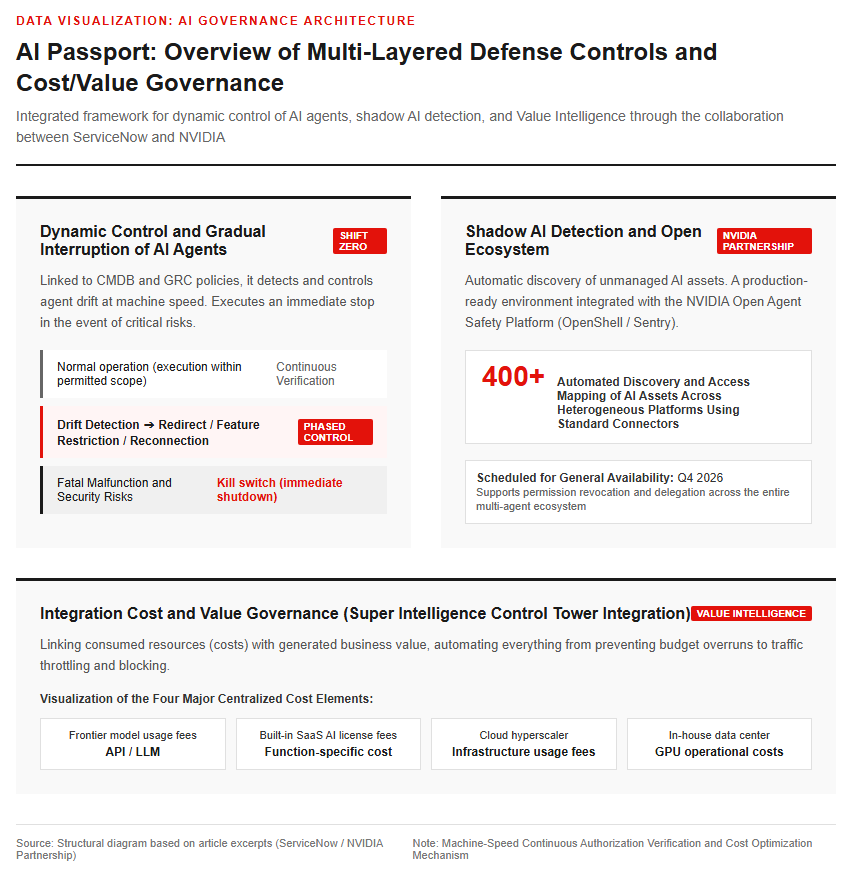
AI Passport is designed based on an open specification that does not depend on any specific vendor, enabling interoperability with a variety of governance products, identity providers, and execution platforms. To ensure the robust execution capability of this system, ServiceNow welcomed US-based NVIDIA as a design and launch partner. Leveraging the “NVIDIA Open Agent Safety Platform,” the two companies are jointly developing a production-ready control environment that integrates “NVIDIA OpenShell,” an open-source software providing a secure execution environment, and the “NVIDIA Sentry” security framework. This establishes a system that performs continuous authorization verification at machine speed for every action executed by AI agents deep within the enterprise infrastructure. This technological foundation embodies the company’s “Shift Zero” concept, which embeds security and governance from the initial product design stage. A major strength is its ability to achieve high-precision privilege revocation and granular delegation of authority not only for proprietary AI agents, but across a diverse multi-agent ecosystem. The official general availability of AI Passport is scheduled for the fourth quarter of 2026.
Expansion of Shadow AI Detection and Comprehensive Cost and Value Governance Features
Along with the introduction of AI Passport, ServiceNow has significantly expanded its comprehensive governance capabilities covering all AI operations within enterprises. It is equipped with a function to early detect “shadow AI”—unmanaged AI operating without organizational approval on the internal network—and automatically discovers AI assets scattered across heterogeneous platforms via more than 400 standard connectors. Additionally, it offers access mapping that links access privileges with actual credentials, as well as continuous AI visibility functions that track and monitor the behavior of AI agents. Furthermore, to prevent discrepancies between costs and effects associated with AI adoption, it introduced a cost governance tool integrated with IT asset management (ITAM) and the “Super Intelligence Control Tower.” This enables the centralized visualization and analysis of frontier model usage fees, licensing costs for AI features embedded in SaaS, cloud hyperscaler usage fees, and GPU operation costs in the company’s own data centers. By utilizing “Value Intelligence,” which links consumed resources with generated business value, companies can establish a system to automatically execute phased responses ranging from budget overrun prevention and alert notifications to traffic throttling and ultimate blocking.
The Necessity and Future Outlook of AI Agent Governance in Enterprises
The Urgent Need for Governance in Financial Institutions and Highly Regulated Industries and the Technology Separation Model
Controlling AI agents has become an urgent challenge, particularly in financial institutions and highly regulated industries where strict compliance is required. According to the survey results from the “2026 Banking AI Maturity Index” published by ServiceNow, while 100% of surveyed banks reported utilizing AI in some form, only 24% stated that they have adequately established a governance framework commensurate with that usage. The presence of unmanaged service accounts, unregistered devices, and shadow AI agents represents an immense management risk in today’s world, where regulatory incident notification deadlines are increasingly being shortened. From an academic perspective as well, as pointed out in the paper “Separating Capability from Permission: A Governance Framework for Agentic AI Autonomy Levels,” the importance of a framework that clearly distinguishes between the “Autonomous Capability Level (ACL),” which an AI system can technically execute, and the “Allowed Autonomy Level (AAL),” which is actually permitted depending on organizational context and risk, has been advocated. Even if an AI agent possesses high processing capabilities, the principle of the “separation of capability and permission”—operating it while limiting it to a human-intervened monitoring level in consideration of operational risks and irreversibility—is deeply aligned with the design philosophy of this AI Passport.
The Future of AI Agent Operations and Key Considerations for the Enterprise Market
In the field of corporate AI adoption, we have already entered a phase where thousands of AI agents are being integrated into daily operations. For example, pioneering company LTM Limited has deployed over 1,500 AI agents internally, assigning a uniform employee ID and supervisor to each agent to ensure strict accountability and governance. In such large-scale environments, the ServiceNow platform serves as a System of Record that records and integrates the activity of all AI assets. Meanwhile, the competitive landscape in the market is also intensifying. Rival US-based Workday has signed an agreement to acquire C1.ai, a company with identity governance technology, instantly accelerating the battle for supremacy over access control and security in enterprise-grade AI infrastructure. Moving forward, for companies to safely enjoy the benefits of automation through AI agents, it is essential to fundamentally shift their security approach from conventional retrospective log reviews to real-time scope limitation and automatic halting during execution. Toward the launch of AI Passport in the fourth quarter of 2026, corporate IT departments and risk managers are required to promptly advance the authorization design and phased guardrails for autonomous AI.
Reference page
- [ServiceNow Press Release] https://newsroom.servicenow.com/
- [arXiv Research Paper] [suspicious link removed]
【#AIPassport #ServiceNow #AIGovernance #AIAgents #NVIDIA #Security #ShadowAI #EnterpriseAI】
コメント