A total of 44 companies, including Mitsui Sumitomo Insurance under the umbrella of MS&AD Insurance Group Holdings, have invested in “Noetra,” a SoftBank-led domestic AI development company. This comes as they aim to build “Physical AI” as an industrial foundation while receiving public-private support on a scale of 1 trillion yen, in response to the US- and China-led AI development race.
- Pooling Efforts for Domestic AI Development and the Background Behind the Participation of 44 Companies Including MS&AD
- “Physical AI” Beyond Conventional Generative AI and the 2027 and 2031 Roadmaps
- Company-wide AI Platform “AI Ribbon” Supporting Business Transformation and Strengthening the Implementation Structure
- The Advancement of Insurance Operations Expanding from Claims Assessment and Underwriting to Prevention
- Financial Services Agency’s AI Guidelines and Governance Systems Required for Financial Institutions
- Future Focus Areas and Industry Impact in Aiming to Be an “Insurance Company Chosen by AI”
Pooling Efforts for Domestic AI Development and the Background Behind the Participation of 44 Companies Including MS&AD
In Japan’s industrial sector, an “All-Japan” movement is accelerating to break away from dependence on U.S. and Chinese technology and build independent large-scale foundational AI models. At Noetra, a new AI development company established by SoftBank, a total of 35 new companies—consisting of 23 manufacturing firms and 12 non-manufacturing firms—have joined in addition to the initial 9 companies, which included SoftBank, Honda, Sony Group, NEC, and three megabanks, bringing the total number of investing companies to 44. From the non-manufacturing sector, major financial and insurance institutions such as Mitsui Sumitomo Insurance of the MS&AD Group, Nippon Life Insurance, and Sumitomo Life Insurance, as well as JERA, Rakuten Group, and Sakana AI, have come together. On June 30, 2026, the project was officially selected for NEDO’s (New Energy and Industrial Technology Development Organization) domestic foundational AI model development project. The government plans a total public-private investment scale of approximately 1 trillion yen over the five-year period leading up to fiscal year 2030, including allocating about 300 billion yen in the fiscal year 2026 budget proposal. The aim is to prevent concerns over the outflow of on-site data and technical know-how to overseas entities and to establish a system to safely utilize industrial data, which is one of Japan’s strengths.
“Physical AI” Beyond Conventional Generative AI and the 2027 and 2031 Roadmaps
The most defining characteristic of this national-scale project is that it goes beyond conventional generative AI centered on text and image generation, aiming instead to realize “Physical AI” that exerts advanced control over real-world machinery and equipment. From factory production line automation and anomaly detection to the autonomous operation of construction machinery, automated transport in logistics, and even advanced risk prediction and social infrastructure management, it establishes an environment where AI directly processes and makes decisions based on real-world data. As shown in the figure below, the vision is to build a new international competitive advantage by fusing sophisticated data from Japan’s manufacturing and service frontlines.
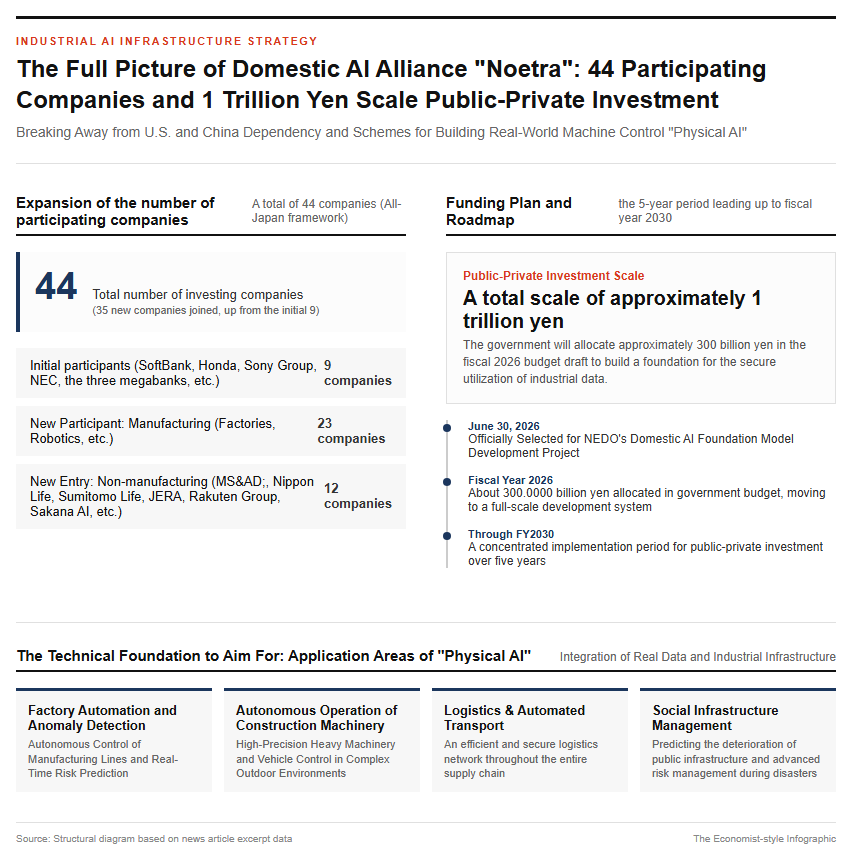
Noetra is advancing plans to complete what will become one of Japan’s largest large-scale AI foundation models around 2027. Furthermore, by 2031, the company has set a policy to evolve it into an industrial infrastructure that integratively processes multi-dimensional real-world data—such as sensor information, images, and audio—and to widely open it not only to participating companies, but to Japanese businesses as a whole. This is expected to foster cross-industry technological innovation that goes beyond individual company-level initiatives.
AI Innovation in the Insurance Industry and MS&AD’s Unique Strategy
Company-wide AI Platform “AI Ribbon” Supporting Business Transformation and Strengthening the Implementation Structure
MS&AD Insurance Group positions AI and DX not merely as methods for operational efficiency, but as a core foundation to dramatically enhance customer experience and drive business model transformation. Within the group, it has introduced a proprietary generative AI add-in called “AI Ribbon,” establishing an environment available to all approximately 39,000 group employees. It is utilized approximately 45,000 times per day on average, with about 26,000 monthly unique users, enabling daily improvements in work productivity and the rapid implementation of ideas into initiatives. The company is also strengthening its driving force in terms of organizational structure, having established “MS&AD AX Co., Ltd.,” a joint venture with ExaWizards Inc., in June 2026. Furthermore, in October 2026, it newly established the “AI Promotion Department” within the holding company, centrally managing AI utilization as a critical management agenda for the entire group. Toward sustainable growth, it places emphasis on developing three foundational pillars—”human resources,” “data,” and “governance”—and has built a structure to consistently drive everything from PoC (proof of concept) to operational improvements.
The Advancement of Insurance Operations Expanding from Claims Assessment and Underwriting to Prevention
In the frontline of the insurance business, concrete business process transformations leveraging AI technology are progressing. In the area of underwriting, AI analyzes past customer information and various risk data, achieving refined risk assessment and advanced calculation of appropriate premiums. In insurance sales and agency support, it is widely introduced as tools for assisting operators with telephone reception, automatic FAQ responses, customer acquisition analysis, and educational support. Furthermore, in the area of claims services, AI is introduced for determining liability in accidents and automatically calculating damage amounts based on image and text information at the time of the accident, achieving both speed and improved accuracy in payment operations. The role played by insurance companies goes beyond simply paying out insurance claims after an accident or disaster occurs. By utilizing AI-based data analysis, they are expanding their domain into the prevention of accidents and disasters, damage mitigation, and early recovery support, aiming to evolve their business model from post-event compensation to the provision of risk-mitigation solutions.
Policy Background, Governance, and Future Outlook
Financial Services Agency’s AI Guidelines and Governance Systems Required for Financial Institutions
As the application of AI rapidly expands from internal operations to customer touchpoints, the importance of governance and risk management in financial institutions is growing. The “AI Discussion Paper Version 1.1” published by the Financial Services Agency in March 2026 outlines the ideal approach to appropriate risk management in response to the advancement of AI utilization in financial institutions. There are strong demands for measures against potential risks such as factually incorrect information (hallucinations) output by AI models, unfair judgments caused by bias, leakage of training data, and cyberattacks. Financial institutions are required to build internal rules covering both conventional AI and generative AI under the proactive involvement of management, and to practice “agile governance” that responds promptly to environmental changes. As the following figure shows, establishing an appropriate management structure ranging from frontline primary control to independent internal audits has become essential.
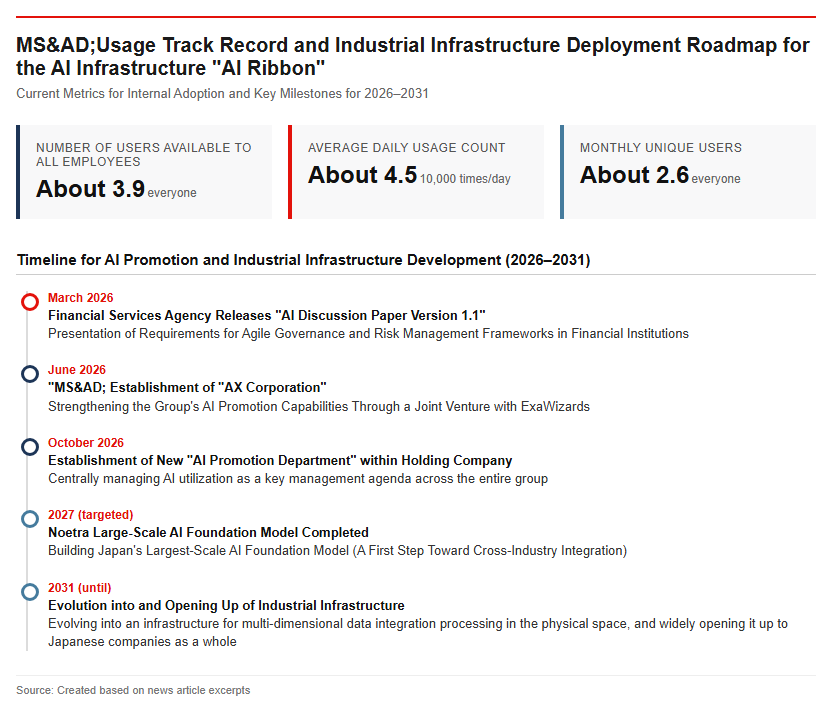
Efforts are underway to maximize the value of AI while ensuring safety by deterring unauthorized “shadow IT” and thoroughly implementing model risk management.
Future Focus Areas and Industry Impact in Aiming to Be an “Insurance Company Chosen by AI”
A major turning point in future insurance distribution will be not only product comparisons made by customers themselves, but also the arrival of an era where AI agents used by customers propose and select the optimal insurance products. Anticipating future changes in insurance distribution, the MS&AD Insurance Group has set forth a strategy aiming not only to be chosen by customers, but also to be “an insurance company that is fairly evaluated and chosen by AI as well.” To this end, the company is structuring its data so that AI can appropriately interpret information such as product features, service quality, and satisfaction data, while advancing the development of technical foundations such as APIs that allow AI to connect smoothly. In the global market, tech giants such as OpenAI and Google are continuing to make massive investments, and the competition in AI development is extremely fierce. Amidst this, the biggest focus moving forward will be whether Japanese companies can integrate their strengths—financial and insurance expertise as well as actual data from manufacturing sites—with domestic AI infrastructure to build highly practical physical AI. The challenge of the public-private domestic AI alliance is drawing attention as a catalyst that will accelerate the digital transformation of the entire insurance industry.
Reference Page
【#MSAD #DomesticAI #PhysicalAI #Noetra #InsuranceDX #GenerativeAI #PublicPrivatePartnership】
コメント