Araki Gumi, a general construction company based in Okayama City, has installed stairs fabricated using a construction 3D printer for the Asahi River embankment maintenance project commissioned by the Ministry of Land, Infrastructure, Transport and Tourism, dramatically reducing the construction period from the conventional 12 days to 2 days. This initiative is driven by a severe labor shortage in the construction industry and a strong demand to promote automation and labor-saving at construction sites.
- Events and the Reality of Schedule Reduction in Levee Staircase Construction by Arakigumi
- Comparison with conventional methods and significant efficiency improvements in on-site work
- The Severe Labor Shortage and Changes in the Labor Structure in the Construction Industry
- Advantages and Ripple Effects of 3D Printing in Civil Engineering and Infrastructure
- Challenges of Construction Costs, Legal Regulations, and a Shortage of Specialized Talent
- Future Developments and Key Focus Areas for New Construction Models Brought by Construction DX
Events and the Reality of Schedule Reduction in Levee Staircase Construction by Arakigumi
Araki-gumi Co., Ltd., a general construction company headquartered in Kita-ku, Okayama City, has carried out construction using concrete stair components fabricated with a construction 3D printer in the “FY2025 Asahigawa Uchiyamashita Embankment Maintenance Work” ordered by the Okayama River Office of the Chugoku Regional Development Bureau, Ministry of Land, Infrastructure, Transport and Tourism. This project is being conducted on the Asahigawa embankment in Kyobashicho, Kita-ku, Okayama City, and in October 2026, the stair components pre-fabricated by the 3D printer were delivered to the actual construction site and installation work was carried out.
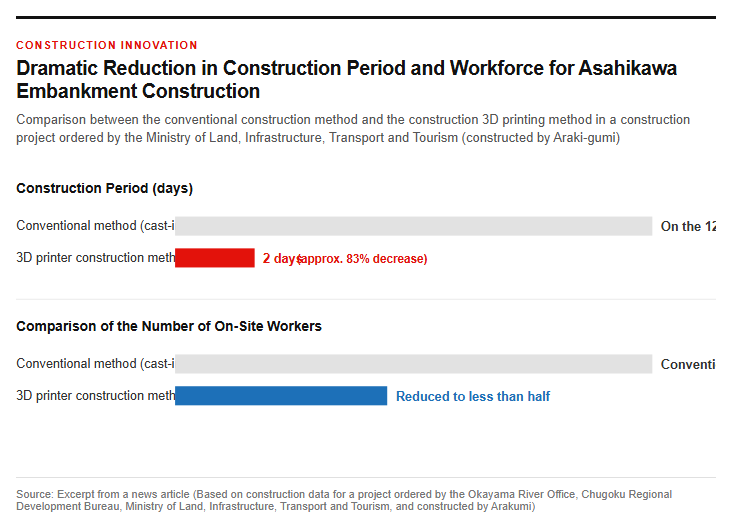
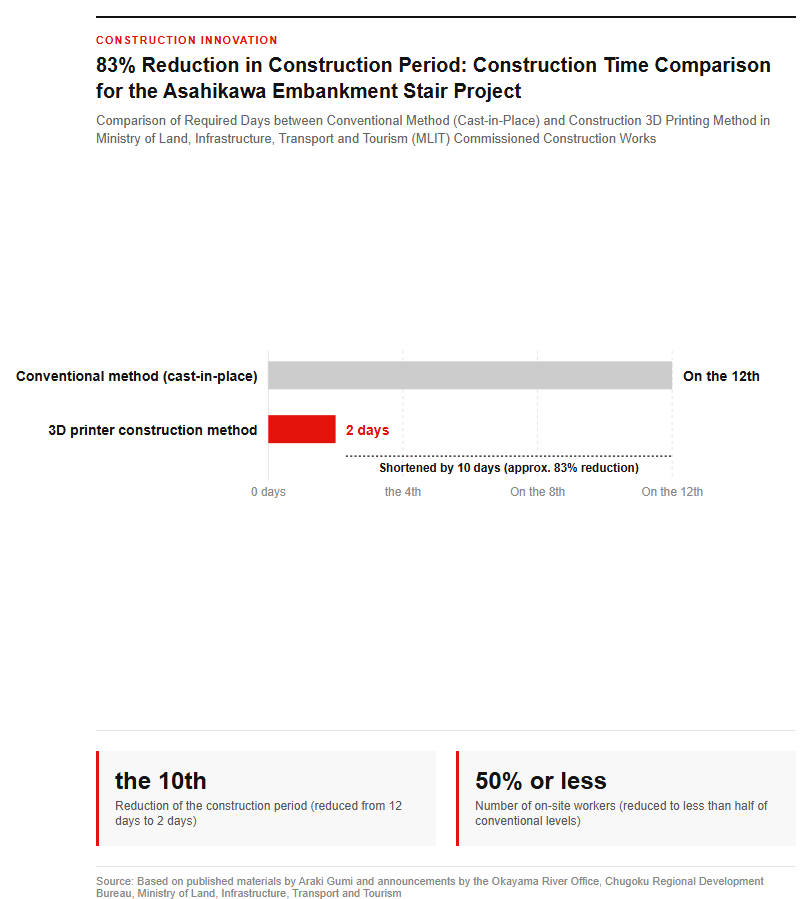
When constructing stairs using the conventional cast-in-place concrete method, multiple steps are required: assembling wooden formwork on-site to match complex shapes, pouring ready-mixed concrete, curing it until it reaches the specified strength, and then removing the formwork. Therefore, the conventional method accounted for a total construction period of 12 days until completion. However, the construction 3D printing method adopted this time employs an approach in which stair components are precisely fabricated off-site or near-site based on pre-created 3D data, and the completed components are transported to the site by truck or other means and installed using a crane.
As a result, the on-site construction period was shortened to just 2 days, achieving a significant 10-day reduction in construction time (a reduction rate of approximately 83%). Furthermore, along with the simplification of on-site work, the number of on-site workers required for construction was successfully reduced to less than half of conventional levels. This case has been attracting considerable attention within the construction industry as an example of simultaneously achieving labor-saving and shorter construction periods at a high level.
Comparison with conventional methods and significant efficiency improvements in on-site work
When constructing concrete structures at construction sites, three-dimensional shapes featuring continuous treads and risers—such as stairs—in particular involve extremely complicated formwork assembly compared to flat walls or floors, thus requiring the skills of skilled craftsmen and a significant amount of working time. Conventional construction methods involve a continuous sequence of multi-stage manual tasks, ranging from the creation, transportation, and on-site installation of formwork to concrete pouring, curing, formwork removal, and waste material disposal.
In contrast, the construction 3D printing method newly introduced by Arakigumi (with technical cooperation from Polyuse Co., Ltd. and others) automatically forms structures by extruding and layering special mortar material from a nozzle based on digital 3D model data. By adopting a precast method in which pre-formed stair components are assembled on-site, it is possible to completely skip processes associated with cast-in-place construction, such as formwork assembly and disassembly, and prolonged on-site curing.
Since on-site work is consolidated into only finishing processes such as transport, installation, and joint treatment, waiting time and work burdens on-site are dramatically reduced. Furthermore, it is important that construction efficiency is enhanced while securely meeting necessary quality standards such as structural strength and durability. Rather than merely testing new technologies, Arakigumi comprehensively compares and evaluates quality, workability, and economic efficiency according to the conditions of each site, and has selected the 3D printer construction method as a practical option, representing a major step forward in the digitalization of civil engineering construction.
The Labor Shortage Facing the Construction Industry and the Background Behind the Adoption of 3D Printers
The Severe Labor Shortage and Changes in the Labor Structure in the Construction Industry
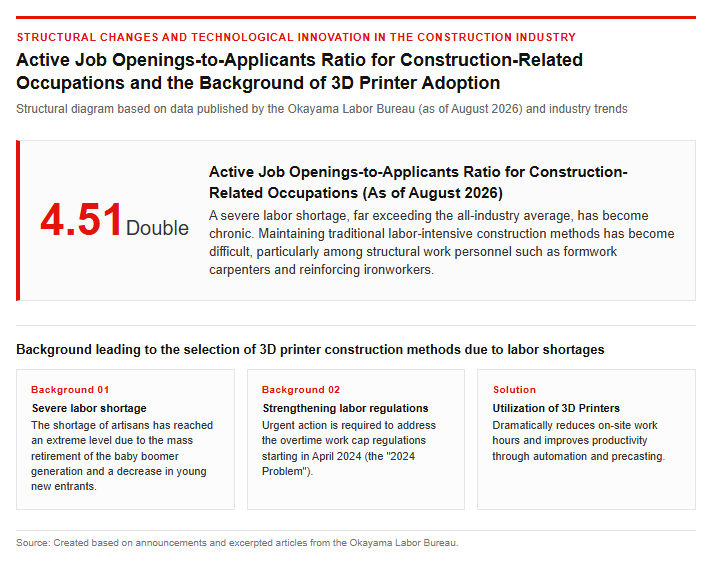
The chronic labor shortage and aging workforce in the construction industry have become critical issues nationwide. According to the active job openings-to-applicants ratio for August 2026 released by the Okayama Labor Bureau, the ratio for construction-related occupations reached 4.51, representing a severe and habitual labor shortage that significantly exceeds the all-industry average. Furthermore, due to the caps on overtime work enforced from April 2024 (the so-called “2024 problem” in the construction industry), there is an urgent demand to maintain or exceed conventional construction capacity within limited working hours.
Especially structural framing workers, such as formwork carpenters and reinforcing ironworkers who are essential to concrete construction, represent one of the areas experiencing the most severe shortage of skilled workers due to the mass retirement of the baby boomer generation and a decrease in young new recruits. If conventional labor-intensive construction methods continue as they are, there are concerns about delays in public infrastructure maintenance and disaster recovery work.
In response to this critical situation, the Ministry of Land, Infrastructure, Transport and Tourism has introduced “i-Construction 2.0,” which aims to drastically improve productivity at construction sites by promoting the automation of outdoor construction and the use of robot technology. Because construction 3D printers automatically build structures based on programs, they enable construction that does not rely excessively on the experience of skilled technicians. This severe background of labor shortages is precisely the biggest factor rapidly driving the adoption of 3D printers at construction sites.
Advantages and Ripple Effects of 3D Printing in Civil Engineering and Infrastructure
The use of construction 3D printers is rapidly advancing toward practical application not only in the architectural field for housing and other buildings, but also in the field of public civil engineering infrastructure such as roads, rivers, and breakwaters. In civil engineering work, there are many structures—such as retaining walls, catch basins, curbs, wave-dissipating blocks, and stairs—that must be individually manufactured to match the terrain and plans of the site. This has resulted in a heavy burden of cost and time associated with the custom production of wooden formwork.
By utilizing 3D printers, components can be produced directly from digital data, eliminating the need for conventionally disposable wooden formwork and offering environmental advantages (GX and Green Digital Transformation) by significantly reducing construction waste generation. Furthermore, it has been demonstrated that reducing on-site working time in hazardous environments—such as high places, sloped terrain, and slopes—mitigates the risk of personal accidents and enhances safety.
Domestically, major general contractors and civil engineering operators across the country—such as Takenaka Doboku constructing stairs at a land development site, Obayashi Corporation manufacturing precast members for retaining walls at the New Maruyama Dam project, and Kohjigumi constructing stairs on the Ota Riverbed—have been achieving tangible construction results utilizing 3D printer technology such as Polyuse. This latest achievement by Araki Gumi in the Asahikawa embankment construction serves as an important case that once again demonstrates the effectiveness of utilizing 3D printers in public civil engineering structures.
Challenges and Future Outlook for the Adoption of Construction 3D Printers
Challenges of Construction Costs, Legal Regulations, and a Shortage of Specialized Talent
For construction 3D printers to become even more widely adopted on future construction sites, there are several major challenges that must be overcome. First is the issue of construction costs. In addition to the equipment acquisition costs for the 3D printer itself, the cost of special mortar materials used to ensure extrudability from the nozzle and shape retention after layering is higher than that of general-purpose concrete. Consequently, material and machinery costs currently tend to be higher than conventional construction methods. Although there is an effect of reducing labor costs, it is necessary to evaluate overall economic efficiency, including the reduction of site management costs and traffic guidance costs resulting from shorter construction periods.
Secondly, the establishment of legal regulations and technical standards. In the architectural field, new structural method standards regarding “additive manufacturing formwork-integrated wall-type RC construction” were enacted by the Ministry of Land, Infrastructure, Transport and Tourism in June 2026, leading to clearer procedures for single-story buildings of 200 square meters or less. Meanwhile, in the civil engineering field, although construction guidelines are being formulated by organizations such as the Japan Society of Civil Engineers, the standardization of long-term durability evaluations and quality control standards for structural members is still in development.
Third, there is a shortage of specialized technical personnel who can handle 3D CAD and BIM/CIM data, and appropriately manage 3D printer operations and material quality control. Although human resource development is underway at various general contractors and educational institutions, it is expected to take time to permeate construction sites as a whole.
Future Developments and Key Focus Areas for New Construction Models Brought by Construction DX
Araki-gumi’s recent construction of embankment stairs symbolizes that 3D printing has moved beyond the realm of special demonstration experiments and is beginning to take root as an “everyday on-site option” for regional general contractors. Moving forward, as the mass production of 3D printer equipment and the development of highly versatile deposition materials progress, the currently concerning costs of materials and equipment are expected to decrease, leading to expectations of adoption in an even wider range of construction work.
In the future, the introduction of systems is anticipated that will automatically analyze 3D design models such as BIM/CIM and instantly simulate whether conventional construction methods, 3D printing methods, or factory-produced precast products are the most optimal in terms of construction schedule, cost, and constructability. Furthermore, attention is also being focused on the selective use of on-site (direct on-site fabrication) and near-site (near-site fabrication) methods, as well as the evolution toward a fully automated overall construction process through data integration with drone surveying and ICT construction machinery.
Amid Japan’s accelerating labor shortage, 3D construction printers are garnering expectations not merely as labor-saving tools, but as foundational technologies for sustainable infrastructure development and regional safety. Initiatives by progressive construction companies, including Arakigumi, are expected to significantly drive the digital transformation (construction DX) of the entire construction industry moving forward.
Reference Page
- [Araki Gumi Co., Ltd. Press Release] https://prtimes.jp/main/html/rd/p/000000017.000163331.html
- [Araki Gumi Co., Ltd. Corporate Website] https://www.arakigumi.com/
[#Construction3DPrinter #ArakiGumi #ReducedConstructionPeriod #LaborSaving #ConstructionDX #iConstruction #CivilEngineeringWork #LaborShortage]

コメント