On October 15, 2026, the Japan Actors Union released the “Guidelines for the Use of Generative AI Regarding Voice.” It is expected to serve as a voluntary, unified set of rules to fill the legal vacuum regarding unauthorized training and rights infringement caused by rapidly evolving AI voice-cloning technology.
- Background of the Guideline’s Announcement and the Sense of Crisis in the Voice Acting Industry
- Challenges Regarding “Voice Rights” in Japan’s Legal System
- Prior consent at each stage and the 1-year renewal rule
- Standardization of Compensation, Multilingual Support, and Credit Display
- Ethical Standards for the AI Reproduction of Voices of the Deceased
- Building a Healthy “Voice Economy” and Technical Measures
- Developments in International Legal Regulations and Future Points of Focus
Background of the Guideline’s Announcement and the Sense of Crisis in the Voice Acting Industry
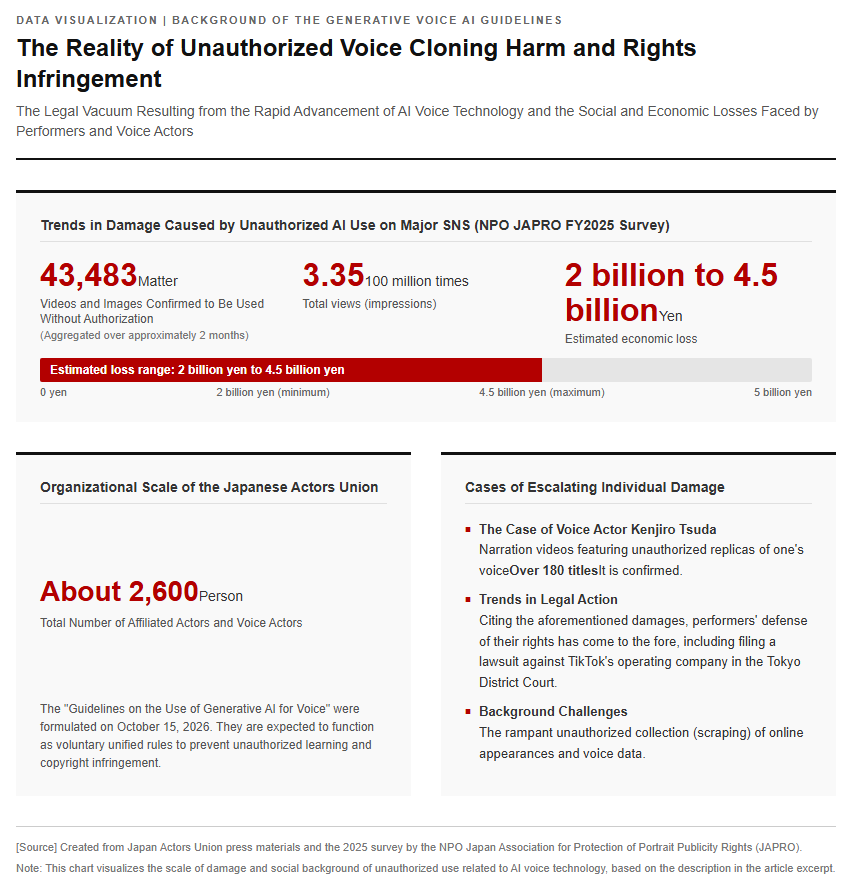
On October 15, 2026, the Japan Actors Union (Nihon Haiyu Rengo, representing approximately 2,600 member actors and voice actors) held a press conference at Geino Kadensha in Shinjuku Ward, Tokyo, to formulate and announce the “Generative AI Guidelines for Voice.” This move comes amid the rapid spread of AI voice-cloning technology—which can reproduce human vocal characteristics with high accuracy using only text input—and the increasingly serious issue of unauthorized use. Currently, there is a rampant rise in cases where online performances and audio data are collected (scraped) without permission and used to train AI models without consent.
As an actual case of damage, a widely reported incident involved voice actor Kenjiro Tsuda filing a lawsuit in the Tokyo District Court against the operating company of TikTok over more than 180 narration videos that imitated his voice without authorization. Furthermore, according to a fiscal 2025 survey by the Japan Portrait Publicity Rights Protection and Monitoring Organization (JAPRO), 43,483 AI-generated videos and images unauthorizedly using the faces and voices of celebrities were identified on major social media platforms over a period of about two months, with total views reaching 335 million and estimated economic losses calculated at between 2 billion and 4.5 billion yen. For performers whose voices are their stock-in-trade, a critical situation continues in which their identities and economic foundations are threatened. Please refer to the figure below.
Challenges Regarding “Voice Rights” in Japan’s Legal System
The biggest reason why the Japan Actors Union stepped in to formulate voluntary guidelines lies in the “legal vacuum” where no explicit law exists under current Japanese law to directly and comprehensively protect an individual’s “voice” itself. Under the Copyright Act, voice quality and tone themselves are not protected as copyrighted works, and the neighboring rights granted to performers are also limited to specific past performance recordings, meaning there have been limits to regulating the act of having AI read aloud new text.
To address this issue, on July 27, 2026, the Ministry of Justice’s “Working Group on the Civil Liability Framework for the Unauthorized Use of Portraits, Voices, etc.” largely approved a draft interpretive guideline stipulating that “portraits, etc.” in Supreme Court precedent (the Pink Lady case ruling) also include voices, and that voices are likewise subject to protection under the right of publicity and personality rights. While this guideline clarifies through interpretation that the unauthorized use of voices for “profit-making purposes” can constitute a tort, it has not led to the enactment of a law with direct statutory binding force. Because waiting solely for national legislation cannot deter damages, common standards to ensure transparency and fairness among production companies and AI developers were deemed necessary.
Four Major Challenges in the “Guidelines for the Use of Generative AI Concerning Voice”
Prior consent at each stage and the 1-year renewal rule
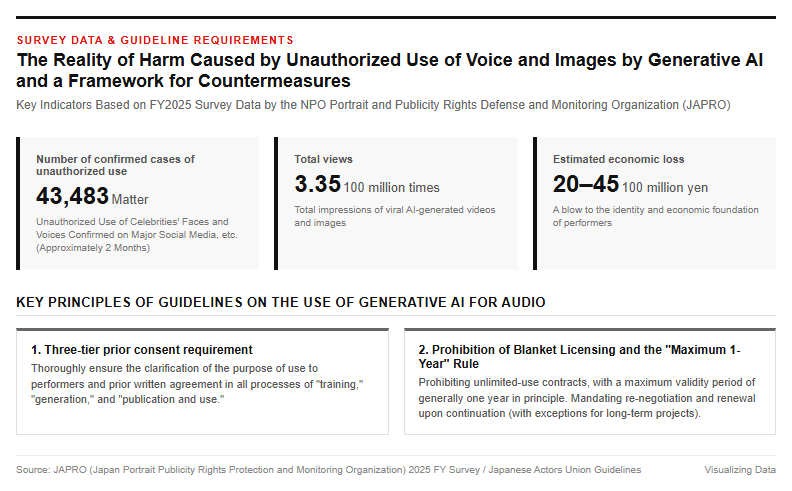
The “Guidelines on the Use of Generative AI for Voice” strictly stipulate “prior consent” and “limitations on the consent period” to guarantee the self-determination rights of performers. The utilization process in AI technology is classified into three stages: “learning (input),” “generation,” and “publication/use (output).” At any of these stages, it is mandatory to clearly indicate the purpose of use to the performer, who is the owner of the voice, and to obtain prior written agreement.
Furthermore, it explicitly prohibits “comprehensive licensing”—which allows unlimited use for future separate works or series under a single contract—and so-called “all-you-can-use” contract formats. In principle, the validity period of the consent and contract is stipulated as “a maximum of one year,” and in the case of continued use after the period expires, it is necessary to undergo renewal procedures after re-negotiating the terms of use and compensation. However, exception clauses have also been established to allow contracts exceeding one year only when justifiable reasons exist, such as for anime productions or large-scale video games with long development and production periods. For business operators, going through a clear contracting process also has the effect of preventing litigation risks and enhancing ethical brand value. Please refer to the figure below.
Standardization of Compensation, Multilingual Support, and Credit Display
These guidelines define the use of AI-generated voices as a new form of “performance provision” by performers and call for appropriate compensation. They prohibit including AI usage compensation in standard performance fees and stipulate that contracts must establish separate fee items, such as AI training and development fees, generative AI usage fees, additional usage fees for advertising and promotion, and multilingualization usage fees.
Regarding multilingual localization, it is stipulated that when Japanese performances are automatically converted and dubbed into other languages—such as English, Chinese, and Spanish—using AI technology, individual prior consent and the receipt of compensation are required for each language translated. At the same time, it demands consideration for the “preservation of performance integrity” to ensure that the emotional expressions, nuances, and cultural contexts of the original performance are not compromised by the language conversion. Furthermore, when AI-generated voices are used in a work, it is mandatory to credit the use of AI, the names of the AI service and model used, and the name of the performer who provided the original voice. Note that performers may also choose to be credited anonymously or under a pseudonym upon request.
Ethical Standards for the AI Reproduction of Voices of the Deceased
Regarding “AI clones,” which use AI technology to recreate and restore the vocal profiles of deceased voice actors and performers, strict ethical standards have been established that prohibit them in principle. The AI reproduction of a deceased person’s voice in new works or entirely different projects in which the individual was not involved during their lifetime is not permitted under any circumstances.
Exceptional cases are strictly limited to the following two scenarios. First, when the project is one to which the individual had agreed to appear during their lifetime. Second, in cases where, within a sequel to an existing series in which the individual appeared during their lifetime—where production had concretely begun at the time of the individual’s death—it is necessary to complete unfinished portions that are difficult to replace or take over by another performer. Even when these exceptional conditions are met, written consent must be obtained in advance from the bereaved family (legal heirs) and the talent agency or similar entities from the individual’s lifetime, and appropriate compensation equal to or greater than that from their lifetime must be paid to the bereaved family. This establishes a safety net to prevent situations where the dignity or historical brand of the deceased is commercially exploited.
Future Outlook and International Regulatory Trends
Building a Healthy “Voice Economy” and Technical Measures
The purpose of the guidelines is not to eliminate or prohibit AI technology, but to healthily expand the “Voice Economy” while ensuring that rights are properly protected. Rather than hindering the adoption of technology, the initiative aims to build a sustainable business model where performers, production companies, and AI developers can mutually benefit by standardizing fair licensing agreements and compensation returns.
Efforts to establish technical tracking and security systems are also accelerating. The Japan Actors Union has partnered with Itochu Corporation and Itochu Techno-Solutions (CTC) to announce the launch of “J-VOX-PRO” (tentative name), an official database for securely storing and managing the voice data of voice actors and actors. It will encourage registration among its approximately 2,500 members, applying invisible digital watermarks and voiceprint registration technologies to prevent and detect unauthorized synthesis and misuse. Furthermore, ensuring reliability through technical approaches is being promoted, including certification systems by the non-profit Audio AI Training Data Authentication Service Organization (AILAS) and provenance management based on the international “C2PA” standard.
Developments in International Legal Regulations and Future Points of Focus
Legal regulations surrounding AI-based voice replication have become a global trend. In 2024, the U.S. state of Tennessee enacted the so-called “ELVIS Act,” becoming the first in the nation to explicitly designate the “voice” as a protected property right in statute. Furthermore, at the federal level, deliberations are underway on the “NO FAKES Act,” which would prohibit the unauthorized creation of digital replicas.
In the European Union (EU), Article 50 of the EU AI Act mandates the disclosure and attachment of machine-readable identifiers for audio content generated or edited by AI. Judicial and legislative bodies in various countries are moving toward strict legal regulations, such as in China, where the Beijing Internet Court handed down a ruling recognizing the infringement of personality rights by AI-generated voices. Within Japan, it is expected that the new Japan Actors Union guidelines will become established as industry-standard autonomous rules, alongside efforts to urge the government to enact legislation and the accumulation of judicial precedents through trials such as the one involving Kenjiro Tsuda.
Reference page
- [Japan Actors Union] Guidelines Released on the Use of Generative AI for Voice https://www.nippairen.com/about/jau_guideline.html
- [Ministry of Justice] Study Group on Civil Liability for Unauthorized Use of Likenesses, Voices, etc. https://www.moj.go.jp/MINJI/minji07_00400.html
[#GenerativeAI #VoiceRights #JapanCouncilofPerformers #AIVoice #RightOfPublicity #Guidelines #VoiceActors]

コメント