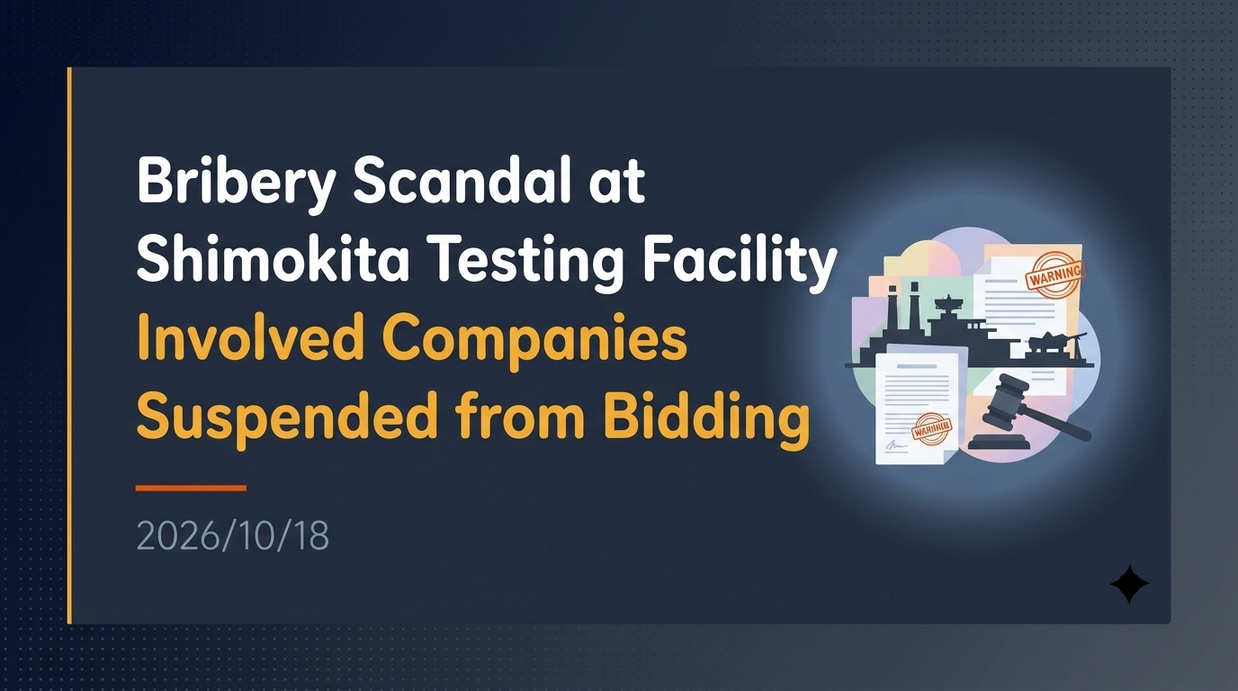
Following the arrest of three individuals, including a Ground Self-Defense Force officer, by the Aomori Prefectural Police on suspicion of bribery surrounding the Acquisition, Technology & Logistics Agency’s Shimokita Test Center, Aomori Prefecture has decided to implement a suspension from bidding against the involved construction company. Behind the lax procurement ethics of the Self-Defense Forces and the misconduct at closed regional facilities, there lie structural issues that have been repeated over many years.
- [Key Points of the Incident] The Structure of Bribery and the Full Picture of Corrupt Entertainment at the Shimokita Test Center
- Legal Status of Ground Self-Defense Force Personnel and Penal Provisions as Special-Position National Public Employees
- The Administrative Mechanism of Suspension from Bidding and Exclusion from Public Procurement by Aomori Prefecture
- Point Deductions in Comprehensive Evaluations Due to Bidding Suspension and Penalty Impacts on Corporate Management
- The Historical Vulnerabilities Facing Defense Procurement and the Structural Challenges of Its Increasingly Opaque Operations
- [Future Outlook and Key Focus Areas] Reconstruction of the internal control system and ensuring the effectiveness of the whistleblowing system
[Key Points of the Incident] The Structure of Bribery and the Full Picture of Corrupt Entertainment at the Shimokita Test Center
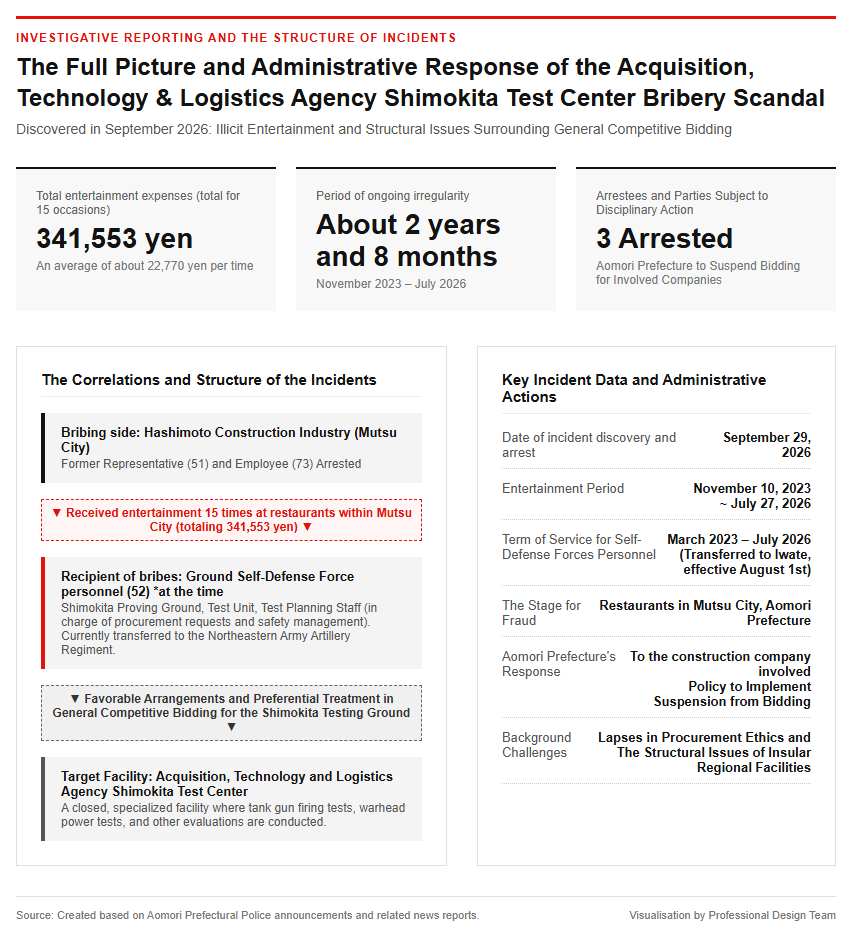
On September 29, 2026, the Aomori Prefectural Police arrested three men in connection with a bribery case surrounding bidding at the Acquisition, Technology & Logistics Agency (ATLA) Shimokita Test Center: a 52-year-old Ground Self-Defense Force (GSDF) officer on suspicion of accepting bribes, and a 51-year-old former representative of Hashimoto Kensetsu Kogyo, a construction company based in Mutsu City, along with a 73-year-old employee of the same company, on suspicion of offering bribes. According to the arrest allegations, between November 10, 2023, and July 27, 2026, the GSDF officer is suspected of receiving entertainment and meals worth a total of 341,553 yen over 15 occasions at restaurants in Mutsu City, as a reward for receiving favorable treatment regarding general competitive bidding for various services ordered by the Shimokita Test Center and for the purpose of future favors. This works out to an average of slightly over 20,000 yen per visit, repeated over a period of about two years and eight months. At the time, the GSDF officer served as a test planning staff member in the testing unit and was in charge of procurement request operations and safety management from March 2023 to July 2026. The Shimokita Test Center is a facility that conducts tank gun firing tests and warhead lethality tests for surface-to-air guided missiles, and this wrongdoing exploited his position of verifying the performance of defense equipment. Additionally, because the GSDF officer had been transferred to the GSDF Northeastern Army Artillery Regiment in Iwate Prefecture on August 1, 2026, just prior to his arrest, media reports referred to him as a former employee of the Shimokita Test Center. The diagram below illustrates the structure and relationships of the incident.
Legal Status of Ground Self-Defense Force Personnel and Penal Provisions as Special-Position National Public Employees
The arrested Self-Defense Force (SDF) member is not only personnel under the Self-Defense Forces Act but also holds a special-service position under the National Public Service Act. Because they directly fall under the definition of a public servant stipulated by the Penal Code, they are in a position where accepting bribes in connection with their duties subjects them to bribery charges. The statutory penalty for simple bribery is imprisonment for up to 5 years, while aggravated bribery for providing favors in response to a request is set at imprisonment for up to 7 years. There are past precedents of SDF personnel being prosecuted for accepting money and valuables by exploiting their positions in equipment procurement or construction projects. For example, records show that in 1968, during renovation work at the SDF Central Hospital, a major in charge of supervision and inspection was exposed for accepting over 1.5 million yen in cash from a contractor. The responsibilities of a special-service national public servant are extremely heavy, and for actions that severely undermine public servants’ integrity and official fairness, not only criminal penalties but also strict disciplinary dismissal and disqualification procedures by the Ministry of Defense and the SDF will be applied. Furthermore, heavy consequences that bring definitive ruin to an individual’s life—such as the forfeiture of retirement allowances and the loss of social trust—are imposed.
Municipal Bidding Suspension Systems and the Blow to Corporate Management
The Administrative Mechanism of Suspension from Bidding and Exclusion from Public Procurement by Aomori Prefecture
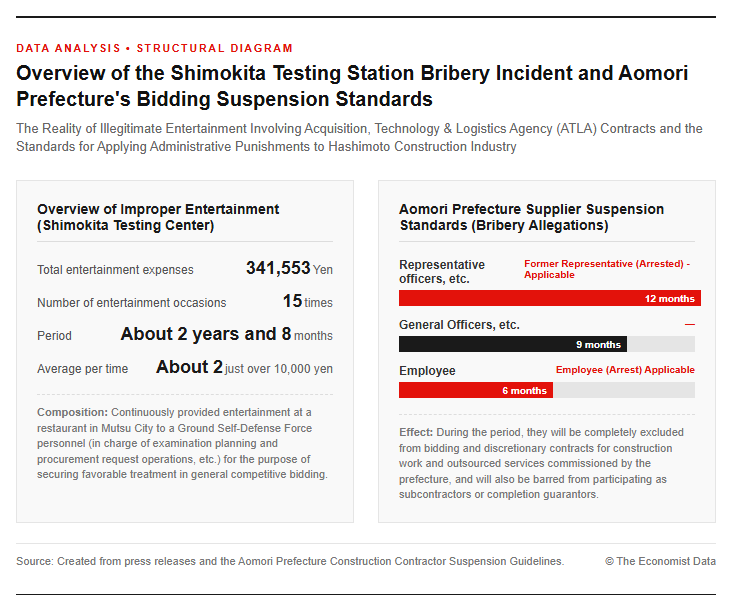
Aomori Prefecture has decided to impose a designation suspension (suspension from bidding) for prefectural-ordered construction work and other projects on Hashimoto Construction Industry in Mutsu City, whose former representative and employees were arrested in a bribery case involving the Shimokita Test Site. Based on the Aomori Prefecture Guidelines for Suspension of Designated Construction Contractors, etc., if a representative executive, officer, or employee of a qualified construction company is arrested or prosecuted on suspicion of bid-rigging, collusive bidding, bribery, etc., the prefecture is required to impose a designation suspension for a period determined based on the circumstances. The standard suspension periods from the date of learning of an arrest on suspicion of bribery are set at 12 months for representative executives, etc., 9 months for general officers, etc., and 6 months for employees. Business operators subjected to a designation suspension are excluded from designated competitive bidding and discretionary contracts for construction work and service outsourcing ordered by Aomori Prefecture during this period, and are also prohibited from becoming subcontractors or completion guarantors for prefectural projects. The flow of the administrative disposition procedure is as follows.
Point Deductions in Comprehensive Evaluations Due to Bidding Suspension and Penalty Impacts on Corporate Management
A suspension from bidding not only results in the temporary loss of eligibility to participate in tenders, but also imposes severe penalties on a company’s evaluation of past construction performance and overall credibility. According to Aomori Prefecture’s performance evaluation scoring criteria, if an accident or inappropriate incident caused by the contractor occurs during the execution of work, leading to measures such as a suspension from bidding, points will be deducted from the comprehensive evaluation score for that project. If the suspension period exceeds one month, it is subject to a maximum deduction of 15 points. Furthermore, if contract non-conformity or violations of relevant laws and regulations due to intentional acts or gross negligence are identified, an additional deduction of up to 20 points will be applied. Consequently, even after the suspension period has expired, the technical evaluation score in comprehensive evaluation-method bidding significantly declines, severely impairing the competitiveness in winning contracts. For local construction companies that depend on public works, this represents an extremely heavy administrative disposition that directly affects their business continuity.
Structural Challenges in Defense Procurement and Future Prevention Measures
The Historical Vulnerabilities Facing Defense Procurement and the Structural Challenges of Its Increasingly Opaque Operations
Fraudulent structures surrounding procurement and bidding within the Ministry of Defense and the Self-Defense Forces have become serious problems in the past as well. In 2006, a systematic government-led bid-rigging scandal was uncovered in construction work ordered by the Defense Facilities Administration Agency (DFAA). Following the arrest of senior agency officials and demands for over 2.2 billion yen in penalties, the situation ultimately led to the abolition of the DFAA and its integration into the Ministry of Defense. Furthermore, in fiscal 2008, a defense inspection revealed government-led bid-rigging involving the procurement of office furniture and other items at the Japan Air Self-Defense Force’s 1st Supply Depot, where SDF personnel had disclosed the preferences of the planned supplier prior to bidding, leading to massive disciplinary action against 50 related personnel. Regional specialized facilities such as the Shimokita Test Ground, which conducts equipment testing, tend to become closed environments, creating a structural vulnerability where external checks on the ordering authority of personnel in charge fail to function properly. A long-standing in-group mentality and inappropriate relationships with local contractors hollowed out compliance, serving as fertile ground for fraudulent practices.
[Future Outlook and Key Focus Areas] Reconstruction of the internal control system and ensuring the effectiveness of the whistleblowing system
To restore trust in future defense procurement, rebuilding internal check-and-balance systems for individual procurement personnel is deemed an urgent necessity. Under the crime of obstruction of bids, etc., by officials stipulated in Article 8 of the Act on Prevention of Involvement in Bidding Collusion, etc., severe criminal penalties of up to 5 years of imprisonment or a fine of up to 2.5 million yen are imposed for acts such as disclosing bidding-related secrets or compromising fairness. The Ministry of Defense and the Acquisition, Technology & Logistics Agency (ATLA) are continuously advancing the thorough separation and mutual checks between procurement request departments and contracting departments, expanding the application of electronic bidding, and strengthening statistical verification of unnatural winning-bid statuses. Furthermore, to enable the reporting of misconduct even when consulting supervisors is difficult, active use of helplines routed through external attorneys and whistleblower systems is being encouraged. Maintaining high ethical standards in defense operations and ensuring a thoroughly transparent procurement process are indispensable keys to preventing recurrence.
Reference Page
- [Guidelines for Measures such as Suspension from Bidding Concerning Construction Contracts, etc. (Directive) – Ministry of Defense] https://www.mod.go.jp/atla/
- [Compliance Guidance [For Managers] – Ministry of Defense Inspector General’s Office] https://www.mod.go.jp/igo/compliance/guidance/pdf/cg7kanri-full.pdf
- [ATLA Shimokita Test Center] https://www.mod.go.jp/atla/shimokita.html
【#ATLA #ShimokitaTestCenter #BriberyScandal #AomoriPrefecture #SuspensionFromBidding #Compliance #PublicProcurement】
コメント