The world’s largest women in tech event, the “Grace Hopper Celebration (GHC) 2026,” was abruptly canceled just before its opening. Behind the scenes are corporate sponsor withdrawals, a severe shortage of funding, and social and political headwinds surrounding DEI (Diversity, Equity, and Inclusion).
- Abrupt Cancellation Two Weeks Before Opening and Chaos at the Venue
- A .6 million deficit and sharply reduced sponsor funding
- The Wave of DEI Retreat and Corporate Capital Reallocation to AI
- Inflated Operating Scale and the Limits of Event Cancellation Insurance
- Stagnation in Hiring Female Engineers and the Blow to Young Job Seekers
- The Restructuring of Diversity Promotion and the Future of Conferences
Abrupt Cancellation Two Weeks Before Opening and Chaos at the Venue
The “Grace Hopper Celebration (GHC) 2026,” one of the world’s largest conferences for women in IT scheduled to be held at the Anaheim Convention Center in California, USA, from October 27 to 30, 2026, was suddenly canceled just two weeks before its opening. The organizer, the non-profit organization AnitaB.org, announced that sluggish individual registration and corporate sponsorships falling significantly short of projections left them unable to cover massive operating costs. This abrupt decision, coming right before venue setup and speaker coordination were set to proceed, has sent shockwaves through prospective attendees and industry insiders. The collapse of this massive event—which typically attracts over 700 companies annually, featuring major tech giants and financial institutions such as Google, Meta, Amazon, Disney, and Goldman Sachs—has caused severe chaos for those involved. More than 500 scheduled speakers and numerous young engineers who had prepared for on-site interviews and networking have voiced confusion over the last-minute notice. In many cases, flight and hotel reservations had already passed their non-refundable deadlines, making the economic blow to individual participants a serious issue as well. The following chart illustrates the timeline of the event cancellation and an overview of the confusion.
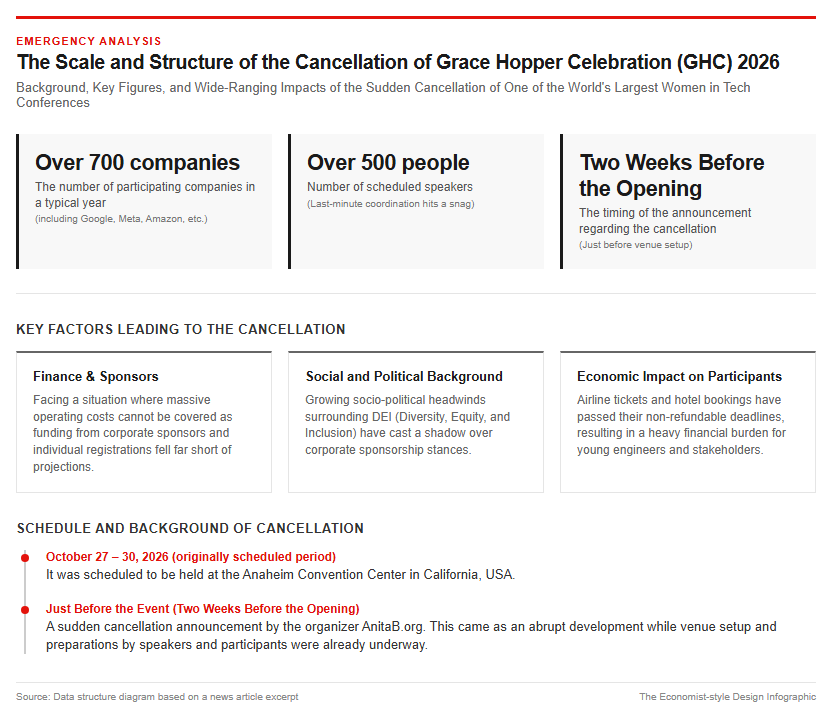
AnitaB.org is urging attendees to follow refund procedures for registration fees and to continue interacting online with corporate recruiters, but this has not yet resolved the confusion caused by the sudden decision.
A .6 million deficit and sharply reduced sponsor funding
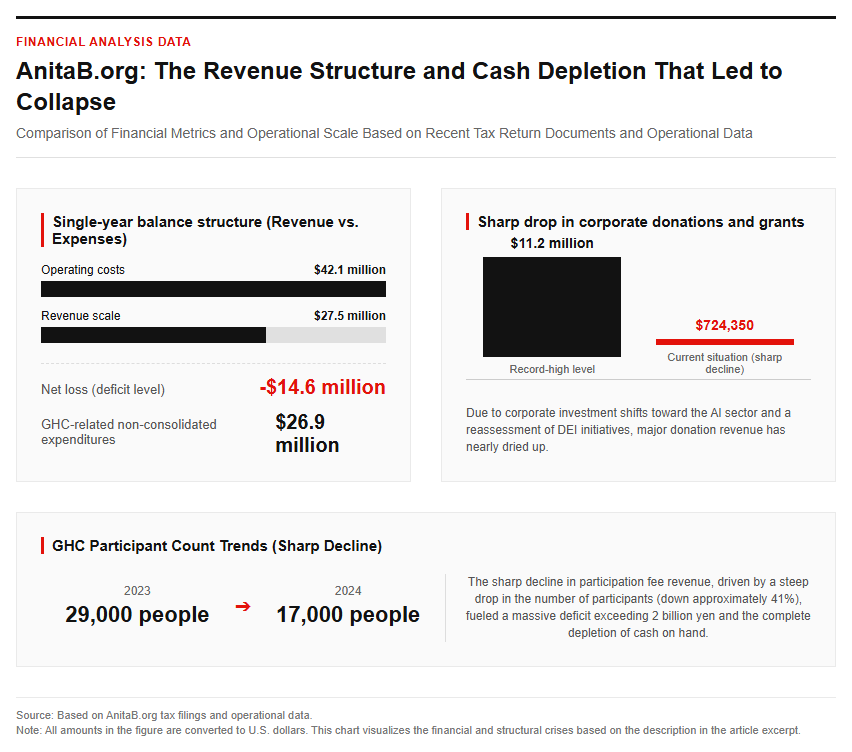
At the root of this cancellation drama lies a severe structural financial deficit that AnitaB.org was facing. According to recent tax filings and operational data, the organization had operating expenses of $42.1 million against annual revenues of $27.5 million, posting a massive net loss of $14.6 million (over 2 billion yen) in a single fiscal year. GHC-related expenditures alone amounted to $26.9 million, resulting in an operational structure where securing funds in advance was extremely critical. The number of attendees plummeted from 29,000 in 2023 to 17,000 in 2024, and the decline in registration fee revenue weighed heavily on the organization. Furthermore, the final blow was the dramatic drop in corporate donations and grants. Donation revenue, which had previously reached $11.2 million, plummeted to a mere $724,350, leading to a situation where cash on hand to cover upfront preparation costs was completely depleted.
- Revenue: $27.5 million (down significantly year-over-year)
- Operating expenses: $42.1 million (excessive relative to the scale of the business)
- Net loss: $14.6 million (an unsustainable level of loss)
- Donations and Grants: Plummeted from $11.2 million to $724,350
In the midst of such a critical financial situation, AnitaB.org attempted to secure new sponsors and raise the necessary funds right up until the very last minute, but those efforts fell through, ultimately forcing the organization to discontinue its operations due to a cash shortage.
The Social and Structural Factors That Led to the Collapse of Events
The Wave of DEI Retreat and Corporate Capital Reallocation to AI
The rapid slowdown of massive events is heavily influenced by shifting budget priorities across the entire IT industry and changes in the socio-political environment. In recent years, major semiconductor vendors and large cloud providers have made unprecedented capital investments in developing infrastructure for generative AI (artificial intelligence), optical interconnect technology, and advanced computing platforms. Affected by this ripple effect, recruitment and awareness budgets related to diversity, equity, and inclusion (DEI), as well as sponsorships for external events, have been significantly reduced and re-evaluated. Additionally, increasing political headwinds and legal risks surrounding DEI initiatives, particularly in the United States, are making companies more cautious. Corporate legal departments, concerned that programs targeting specific demographics or the creation of excessive diversity quotas could pose discrimination lawsuit risks, have intensified efforts to distance themselves from title sponsorships of major events.
- Budget pressure caused by intensive investment in generative AI infrastructure and semiconductor technology
- Corporate conservatism avoiding litigation risks and political criticism regarding DEI initiatives
- A shift from reliance on single, large-scale events to decentralized recruitment on a university and regional level
As the industry moves away from excessive, PR-driven DEI initiatives toward a culture that emphasizes substantive skills and research outcomes, the massive conference format itself is entering a transitional phase.
Inflated Operating Scale and the Limits of Event Cancellation Insurance
This situation has highlighted the limitations of operational methods and risk management for large-scale business events. In recent years, ticket prices for GHC have soared to a minimum of over $600, and the per-person operating costs—including venue fees, audiovisual equipment costs, and food and beverage expenses—have ballooned to the scale of $1,000 to $2,000. In addition, there were growing concerns about declining quality and overcrowding due to an excessive shift from a venue for genuine technical discussion to a corporate recruiting fair. Meanwhile, the administration of event cancellation insurance is becoming increasingly difficult. Since the COVID-19 pandemic, the application of infectious disease exclusions and the tightening of conditions for holding events in high-risk areas have progressed, restricting the scope of revenue compensation by insurance. The following diagram illustrates the structure of event operation risks and insurance coverage.
Even the force majeure clauses that many organizing bodies rely on, while effective for venue contract exemptions, do not compensate for lost registration revenue or expected profits. Event models that depend on revenue from upfront registration fees and sponsorships are extremely vulnerable to unexpected capital withdrawals, making the redesign of sustainable financial plans essential.
The IT Industry’s Talent Pipeline and Future Outlook
Stagnation in Hiring Female Engineers and the Blow to Young Job Seekers
The cancellation of GHC is creating a severe fissure in the hiring pipeline for female talent in the IT and semiconductor industries. According to 2025 data from the U.S. Bureau of Labor Statistics (BLS), the percentage of women in computer and mathematical occupations stands at 27.5%, while in IT management it remains at 25.1%, deviating significantly from the overall workforce level of 47.1%. Furthermore, according to Stanford University’s 2026 AI Index Report, the gender gap in AI research and development remains unclosed, with no major country having achieved an equal ratio. Amid this situation, the loss of centralized interview and recruiting venues like GHC results in a disadvantage regarding valuable career opportunities, especially for students and early-career job seekers from non-target schools.
- Percentage of Women in US IT-Related Roles in 2025: 27.5%
- Women in US IT Management Roles in 2025: 25.1%
- Widening Disparity in In-Person Interviews and Scouting Opportunities for Early-Career Professionals
Decentralized hiring methods tend to increase individual application management costs and informal job offer decline rates, presenting companies with the challenge of finding it difficult to efficiently discover diverse talent.
The Restructuring of Diversity Promotion and the Future of Conferences
Going forward, the transition is expected to progress from a framework overly reliant on a single massive event to a new, sustainable, and highly accessible approach to gatherings. Among researchers and practitioners, there is a growing re-evaluation of the effectiveness of online (virtual) events, which eliminate the need for long-distance travel and expensive accommodation, as well as hybrid events that connect regional hubs. The virtual format has the advantage of dramatically lowering participation barriers for students and early-career researchers who face constraints regarding travel budgets and visa acquisition, thereby promoting the engagement of diverse communities.
- Utilizing online events to reduce physical travel costs and carbon dioxide emissions
- Revitalizing Regional Communities Through a Hybrid Event Linking Regional Hubs
- Moving beyond temporary recruitment PR to university partnerships and long-term development schemes
Diversity promotion within organizations is required to evolve from superficial event hosting and slogans into practical approaches directly integrated into business processes and evaluation systems. Following the painful lesson of the cancellation of GHC, the IT industry is moving forward to rebuild a truly inclusive and sustainable talent development foundation.
Reference page
- 【Report on the Future of Conferences – arXiv】[suspicious link removed]
- 【[Suspicious link removed] Official Press Release】https://anitab.org/press-release
【#GraceHopperCelebration #GHC2026 #AnitaBOrg #DEI #ITIndustry #EventCancellation #WomenEngineers】

コメント