US President Trump has decided to hold off on imposing large-scale additional sanctions against Russia, with Secretary of State Marco Rubio stating that this is a 60-day “pause” to analyze the impact on the global economy. Behind this decision lies a strong intent by the US administration to curb soaring prices of crude oil and diesel fuel ahead of the US midterm elections in November 2026, thereby alleviating inflation within the United States.
- Postponement of Sanctions Against Russia and Secretary of State Rubio’s Explanation
- Overview of the Lindsey Graham Sanctions Act and Invocation of the Waiver Provision
- Soaring Fuel Prices and Measures to Curb Inflation Ahead of the November Midterm Elections
- The Contradiction Between the Gasoil Supply Agreement with President Putin and Sanctions
- Ukraine and European Backlash, and the Impact on Primary Energy Markets
- Economic Uncertainties and Future Outlook/Key Points to Watch
Postponement of Sanctions Against Russia and Secretary of State Rubio’s Explanation
On the night of Friday, October 16, 2026, U.S. President Trump signed an executive order halting the implementation of the majority of the Russia sanctions legislation he had signed into law the previous month. In response, U.S. Secretary of State Marco Rubio explained that the exemptions from these sanctions and additional tariffs were a “60-day illusory pause” to analyze their impact on the U.S. and global economies. Secretary of State Rubio cited the soaring global energy prices and the deteriorating situation surrounding Iran as background, emphasizing that a 60-day analysis period was necessary to carefully assess the economic blow that the enforcement of sanctions would bring. He also dismissed concerns that the White House had ordered a slowdown in Ukraine’s access to the satellite communications network (Starshield) to restrict drone operations in connection with military aid to Ukraine. This decision has delivered a major shock to the U.S. Congress and allies who wish to maintain pressure on Russia as it continues its invasion of Ukraine. Please refer to the diagram below for the specific background and impact of this policy decision.
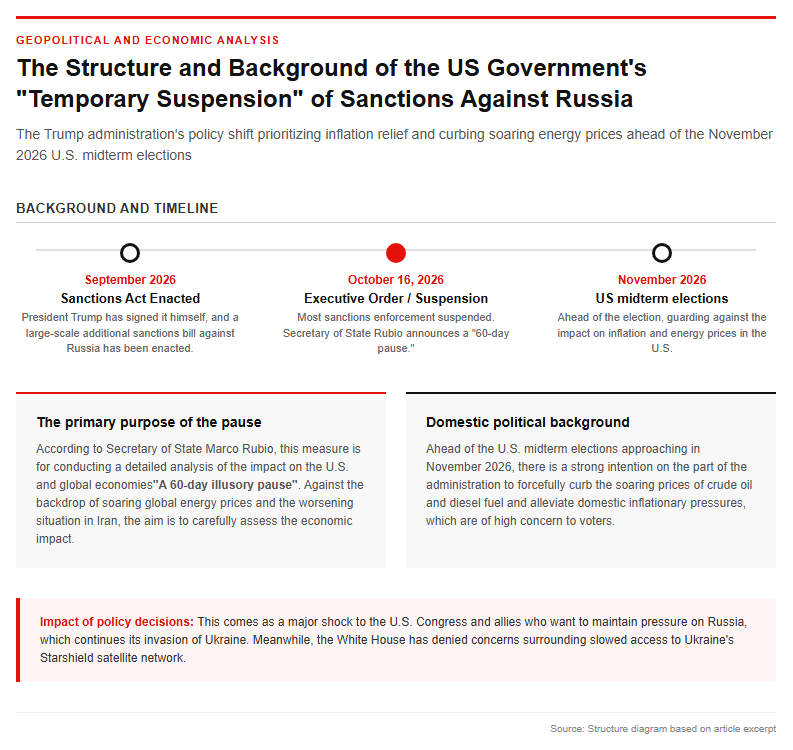
The ruling administration cites the “national interest” as the reason, but the unusual postponement of the implementation right before it was due to take effect has sent massive ripples through the international community, becoming a factor that undermines the future credibility of U.S. foreign policy.
Overview of the Lindsey Graham Sanctions Act and Invocation of the Waiver Provision
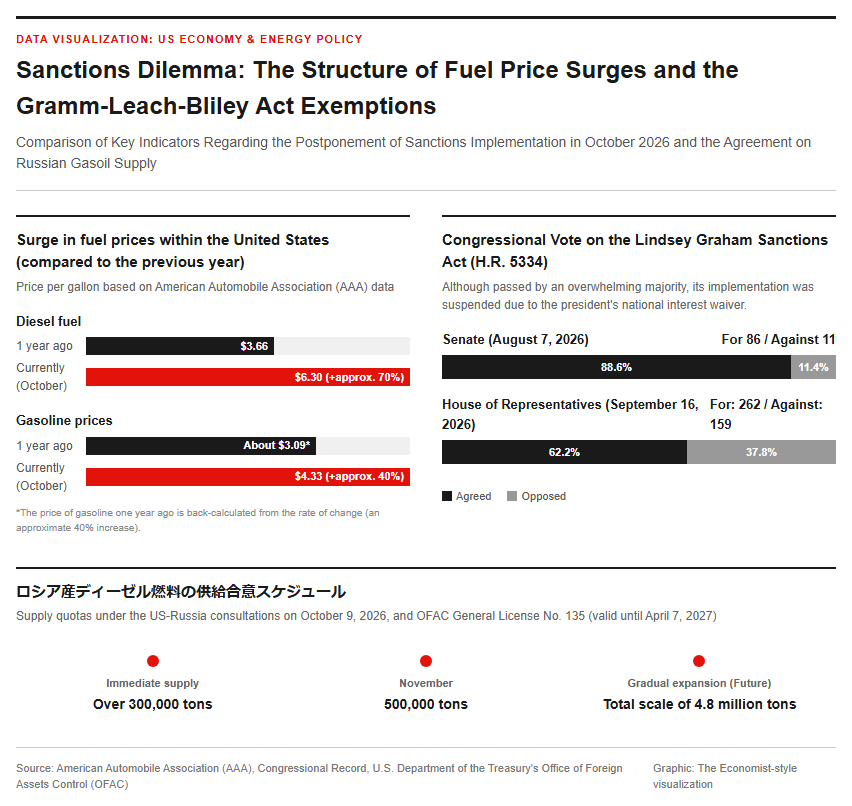
The law exempt from application this time is the “Lindsey O. Graham Russia-Iran Sanctions Act of 2026” (H.R. 5334), named after the prominent Republican Senator Lindsey Graham, who passed away in July 2026. The bill was passed by the Senate on August 7, 2026, by a vote of 86 to 11, and by the House of Representatives on September 16 of the same year by 262 to 159, and was signed into law by President Trump on September 18 of that year. The pillars of the law include a 500% tariff on Russian products, secondary tariffs of up to 100% on major purchasers of Russian crude oil and gas as well as countries evading sanctions, and transaction restrictions on Russian government bonds and financial institutions. These major measures were scheduled to take effect on October 18, 2026, but were halted by executive order on October 16, just two days before implementation. President Trump exercised the “national interest waiver authority” stipulated in Section 115 of the Act, exempting the implementation of the majority of the law by submitting a written certification of national interest to Congress. However, this measure did not repeal the law itself, leaving a structure that allows room for the president or the secretary of state to re-impose the sanctions in the future based on their judgment.
Domestic Economic and Political Background Behind the U.S. Decision to Forgo Sanctions
Soaring Fuel Prices and Measures to Curb Inflation Ahead of the November Midterm Elections
Behind the decision to forgo sanctions lie the upcoming U.S. midterm elections on November 3, 2026, and a dramatic surge in fuel prices within the United States. According to data from the American Automobile Association (AAA), the national price of diesel fuel in the U.S. in mid-October 2026 reached approximately $6.30 per gallon, surging by about 70% from $3.66 a year earlier. Gasoline prices also stand at about $4.33 per gallon, a year-over-year increase of roughly 40%. Diesel fuel is an infrastructure fuel that supports industries across the board, including trucking, agriculture, construction, and rail, and its soaring price directly leads to higher prices for daily necessities and food, acting as a factor that exacerbates inflation in the U.S. Amid compounding disruptions in crude oil supply due to escalating tensions in the Middle East, had secondary tariffs of up to 100% been imposed on India and China—major buyers of Russian crude oil—under the Graham Act, global crude oil supply and demand would have tightened further, and U.S. gasoline and diesel prices would likely have jumped even higher. It can be said that the Trump administration prioritized curbing domestic prices over pressure on Russia to avoid struggles for the ruling Republican Party in the midterm elections.
The Contradiction Between the Gasoil Supply Agreement with President Putin and Sanctions
Just prior to waiving the sanctions, on October 9, 2026, President Trump held a telephone conversation with Russian President Vladimir Putin and suddenly announced that an agreement had been reached to supply Russian diesel fuel to the global market. The details of the agreement are to immediately supply over 300,000 tons of diesel fuel to the market, followed by 500,000 tons in November, and subsequently expand the supply step-by-step to secure a total scale of 4.8 million tons. On the same day, the U.S. Department of the Treasury’s Office of Foreign Assets Control (OFAC) also issued General License 135, authorizing the import and offshore trading of Russian diesel fuel for a period until April 7, 2027. However, if the Graham Act—which imposes penalties of up to 100% on third countries purchasing Russian energy—were to be invoked as is, it would directly contradict the self-promoted procurement and market supply of Russian diesel. Therefore, in order to make this gasoil trade happen and alleviate market supply concerns, waiving the enactment of the Graham Act was an essential prerequisite. Please refer to the figure below for the interrelationship between the gasoil trade and the sanctions waiver, as well as the market structure.
Ripple Effects on International Affairs and Future Outlook
Ukraine and European Backlash, and the Impact on Primary Energy Markets
Strong backlash has erupted from Ukraine, Europe, and even a bipartisan group in the US Congress against the Trump administration’s suspension of sanctions. On October 17, 2026, Ukrainian President Volodymyr Zelenskyy sharply condemned the US measures as an economic bailout for Russia, stating that “it is a mistaken decision that encourages Russian attacks and slaughter.” In fact, immediately after the announcement, the Russian military carried out large-scale airstrikes on more than 15 energy facilities across Ukraine. Within the US Congress, Republican Senators such as Darrin Graham—carrying on the legacy of the late Senator Graham—and Ted Cruz criticized the move as “a mistake that benefits Putin,” while Democratic lawmakers also expressed strong dissatisfaction, calling it “surrender to the aggressor.” Meanwhile, the European Union (EU) is maintaining its own independent sanctions network, having approved additional designations on October 15, 2026, to close sanctions loopholes. This highlights a growing misalignment in security and economic cooperation between the US and Europe caused by unilateral US action.
Economic Uncertainties and Future Outlook/Key Points to Watch
The decision to forgo sanctions this time temporarily averted tariff risks for major importers of Russian crude oil—such as India, which purchases approximately 1.8 million barrels per day, and China, which purchases about 1.2 million barrels per day—and had the effect of curbing sudden volatility in the global energy market in the short term. However, this does not mean that long-term uncertainties have been dispelled. This is because no clear expiration date has been set for the exemption measures, and sanctions or tariffs could be re-imposed at any time at the sole discretion of the president. Looking ahead, three key points warrant attention: first, what reviews or legislative amendments the U.S. Congress will demand regarding the exemption report following the November 2026 midterm elections; second, whether the Trump administration will revoke the exemptions if Russia continues its attacks on energy facilities; and third, how global corporations will restructure their supply chains amid the double standard of unilateral U.S. easing and continued European sanctions. The international business community, including Japanese companies, must establish long-term risk management systems predicated on the opaque policy risks of the United States.
Reference Page
- [White House Executive Order (October 16, 2026)] https://www.whitehouse.gov/presidential-actions/2026/10/implementing-the-lindsey-o-graham-sanctioning-russia-and-iran-act-of-2026/
- 【US Congress H.R. 5334 Bill Information (Lindsey O. Graham Act)】https://www.congress.gov/bill/119th-congress/house-bill/5334
- [US Department of the Treasury OFAC General License 135] https://ofac.treasury.gov/media/937216/download?inline=
- [US Energy Information Administration (EIA) Short-Term Energy Outlook] https://www.eia.gov/outlooks/steo/report/petro_prod.php
【#PresidentTrump #RussiaSanctions #SecretaryRubio #DieselPrices #USMidtermElections #EnergySecurity #GeopoliticalRisks】


コメント