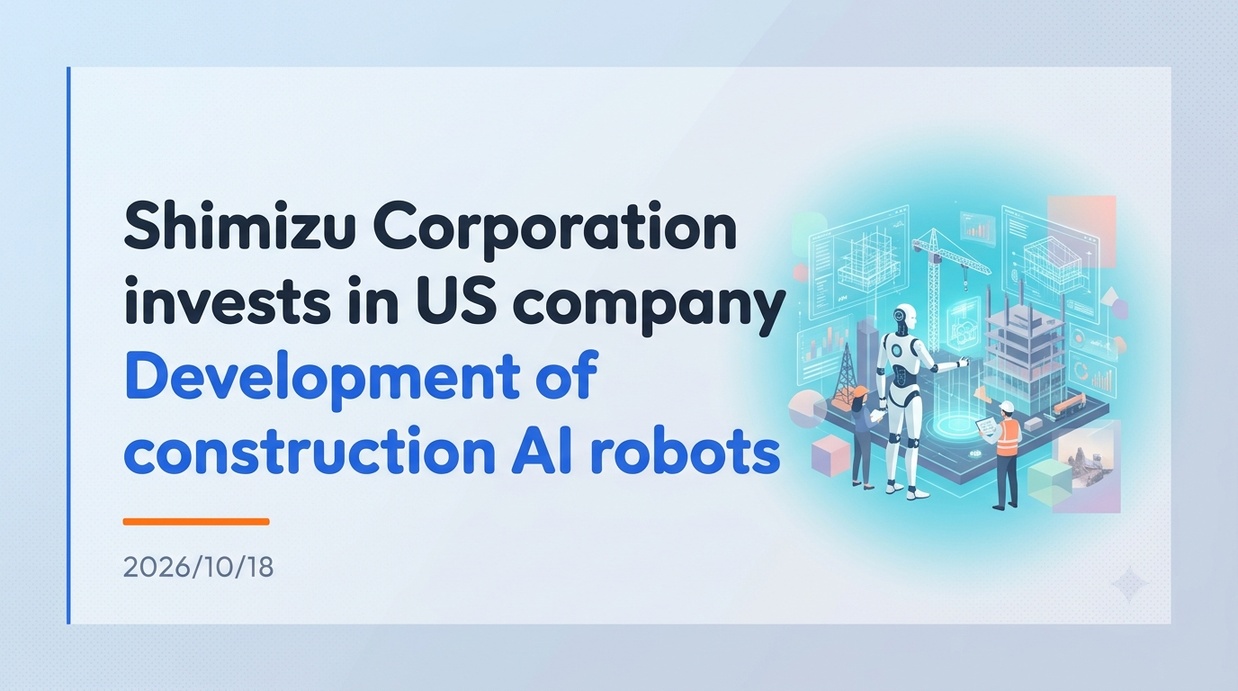
Shimizu Corporation has invested in a U.S. AI startup and started joint development of humanoid AI robots for construction sites. The background to this includes the severe labor shortage and aging workforce in the construction industry, as well as the urgent need to reduce manpower associated with the “2024 problem.”
- Shimizu Corporation’s Investment in US-based Noble Machines and Its Objectives
- Timeline from Virtual Space Simulation to Field Verification
- The serious labor shortage caused by the aging of skilled artisans and the 2024 problem
- The Impact of Physical AI That Surpasses Dedicated Machines to Handle General-Purpose Tasks
- The barrier of implementation costs and the development of safety standards and data infrastructure
- The Future of Construction DX and Changes in Industry Structure Toward 2030
Shimizu Corporation’s Investment in US-based Noble Machines and Its Objectives
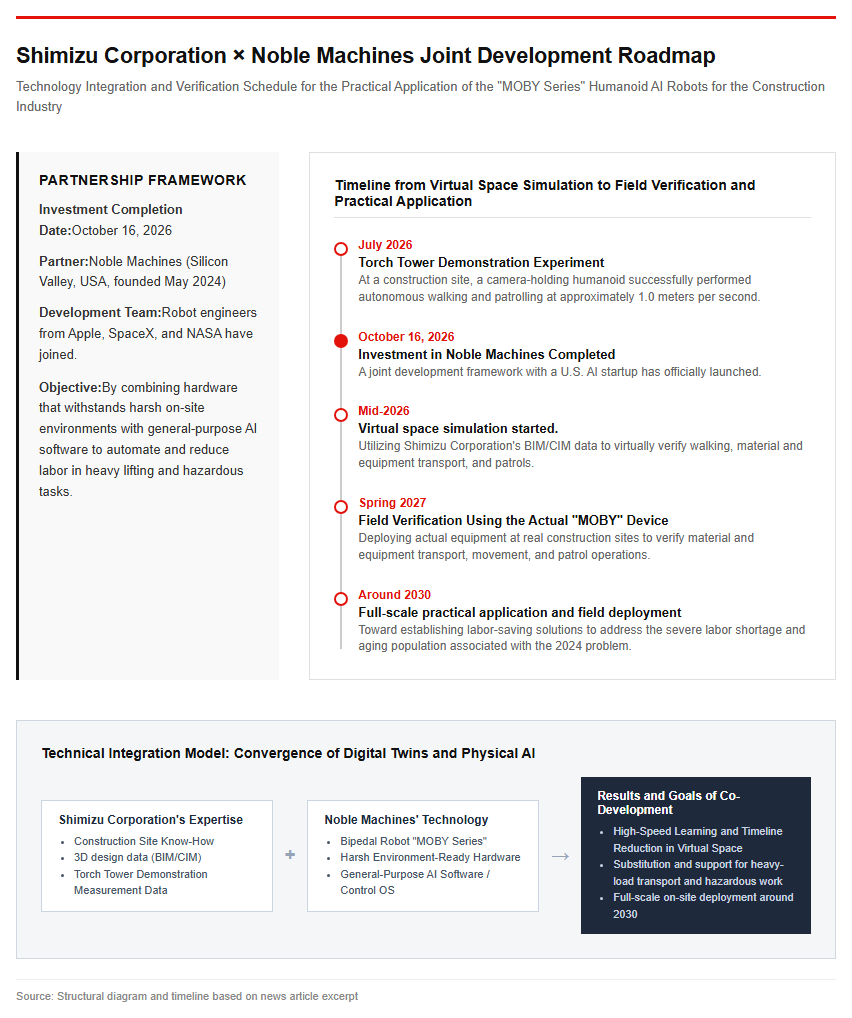
On October 16, 2026, Shimizu Corporation announced that it has completed its investment in Noble Machines, a Silicon Valley startup developing AI humanoid robots for the construction industry. Founded in May 2024, Noble Machines is an emerging company that includes engineers who have been involved in humanoid robot development at Apple, SpaceX, and NASA. It boasts high technological capabilities in both aspects: a hardware structure that can withstand harsh job-site environments and general-purpose AI software capable of handling diverse tasks.
In this collaboration, Shimizu Corporation will integrate its longstanding construction site know-how and insights, as well as BIM/CIM data (which is 3D design data), into the control OS and operation applications of the MOBY series of bipedal robots developed by Noble Machines. The initiative aims to establish a system that supports or replaces heavy lifting and hazardous work involving high physical strain—which have traditionally relied on manual labor at construction sites—with physical AI-equipped robots.
Timeline from Virtual Space Simulation to Field Verification
The joint development between the two companies will proceed in a phased approach utilizing digital twin technology. Aiming for 2026, the project will utilize BIM/CIM data held by Shimizu Corporation to begin motion simulations in a virtual space for activities such as walking, material and equipment transport, and site patrols. By rapidly conducting learning and improvements in the virtual space, the plan is to significantly shorten the development period for the actual machines.
Next, starting in the spring of 2027, actual MOBY units will be deployed to real construction sites to transition into a verification phase for specific tasks, such as transporting and moving equipment and materials, and conducting site patrols. Shimizu Corporation has already been advancing the verification of physical AI, and in July 2026, at the Torch Tower construction site currently under construction, it successfully demonstrated a humanoid robot holding a camera autonomously patrolling while walking at a speed of approximately 1.0 meters per second. Bringing together these insights, the company is looking ahead to full-scale practical application and on-site introduction around 2030. The figure below shows a conceptual image of verification that links the virtual space with the actual site.
Challenges Facing the Construction Industry and Why They Dared to Go Humanoid
The serious labor shortage caused by the aging of skilled artisans and the 2024 problem
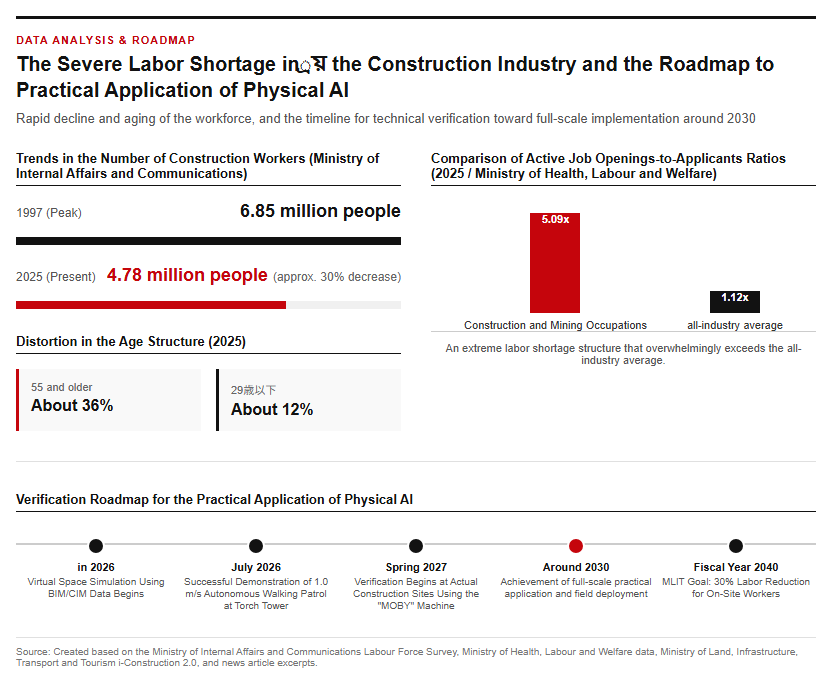
In the construction industry, a sharp decline in the workforce and an aging population have become extremely serious issues. According to the Labour Force Survey by the Ministry of Internal Affairs and Communications, the number of construction workers in 2025 stood at approximately 4.78 million, representing a roughly 30% drop from the peak of about 6.85 million in 1997. Additionally, the active job openings-to-applicants ratio for 2025 announced by the Ministry of Health, Labour and Welfare shows that construction and mining occupations have reached 5.09, reflecting a severe labor shortage that far exceeds the all-industry average of 1.12.
Furthermore, looking at the age distribution of the workforce, workers aged 55 and older account for approximately 36%, while the younger demographic aged 29 and under remains at only around 12%, raising concerns about the mass retirement of skilled technicians and delays in generational succession. In addition, the upper limits on overtime work enforced from April 2024 (such as a cap of 720 hours or less per year) have made it impossible to maintain construction systems that rely on conventional working hours. The Ministry of Land, Infrastructure, Transport and Tourism (MLIT) has also outlined a goal in i-Construction 2.0 to reduce on-site labor by 30% by fiscal 2040, making drastic on-site reforms imperative.
The Impact of Physical AI That Surpasses Dedicated Machines to Handle General-Purpose Tasks
Physical AI is an artificial intelligence technology that perceives the physical world’s environment through cameras and sensors, and autonomously makes decisions and acts according to the situation. Conventionally, robots introduced at construction sites have been predominantly dedicated machines (single-function machines), such as rebar-tying machines and automated guided vehicles, that only perform pre-programmed movements. However, at construction sites where the environment changes daily depending on work progress, the hassle of setting up jigs and securing traffic routes for each dedicated machine has created a challenge where labor-saving effects remain limited.
In contrast, the reason for deliberately adopting a bipedal humanoid form is that construction sites themselves are designed with temporary stairs, scaffolding, and passageways to facilitate human work. Humanoid robots can enter these sites directly without the need to modify existing infrastructure, and can also share the power tools and workspaces used by human workers. Their ability to function as a versatile machine that can handle multiple tasks with a single unit—from transporting materials and equipment to conducting night patrols and simple labor—is the greatest strength of physical AI robots. The photo below illustrates the concept of them working alongside humans.
Hurdles to Practical Application and Future Outlook
The barrier of implementation costs and the development of safety standards and data infrastructure
The greatest barriers to the widespread adoption of physical AI robots on construction sites are implementation costs and the challenge of clarifying cost-effectiveness. Advanced robots equipped with physical AI tend to be expensive per unit, and a survey of private enterprises similarly reveals that “the difficulty in estimating cost-effectiveness relative to implementation costs” is most frequently cited as a barrier to adoption. To advance their general-purpose use, reducing prices through the establishment of mass-production systems by equipment manufacturers and the standardization of key components is essential.
In addition, establishing safety standards for when humans and humanoid robots work side by side on the same site, as well as formulating fail-safe mechanisms to prevent unforeseen accidents, are urgent priorities. Concurrently, building a “construction-specific AI ecosystem” that digitalizes motion data from skilled workers and trains AI on it will enhance robot operational accuracy while serving as a foundation for passing down Japan’s advanced construction skills to the next generation.
The Future of Construction DX and Changes in Industry Structure Toward 2030
The collaboration between Shimizu Corporation and Noble Machines holds the potential to go beyond mere labor-saving tools and fundamentally revolutionize the concept of construction DX (Digital Transformation). By expanding BIM/CIM data—traditionally used for building design and estimation—into a “geographic information infrastructure for controlling and operating robots” through digital twins, the entire process from design to construction and maintenance is unified.
If humanoid AI robots come to handle the transportation of heavy equipment and hazardous tasks, humans will be able to concentrate on advanced specialized skills such as formwork construction and interior finishing, as well as overall management. This will reduce the physical burden on on-site workers and also help boost the motivation of younger generations and women to join the workforce. Following demonstration experiments in the spring of 2027, the establishment of a robot-human collaborative system aimed at 2030 is expected to drive the entire construction industry toward a sustainable industrial structure.
Reference page
- [Completed Investment in US AI and Robotics Company Noble Machines] https://www.shimz.co.jp/company/about/news-release/2026/2026044.html
【#ShimizuCorporation #PhysicalAI #ConstructionRobots #Humanoids #ConstructionDX #LaborShortage #2024Problem #BIM】


コメント