Amid rising U.S. interest rates and debt concerns among AI infrastructure companies, major Asian semiconductor and tech stocks plummeted. Behind this are the worsening funding environment for massive, debt-reliant investments and the market’s reassessment of profitability.
- Key event highlights: CoreWeave bond plunge and 8th consecutive day of decline for US semiconductor stocks
- Spillover to Major Asian Markets and Sharp Corrections in Stocks and Currencies
- Surging Financing Costs Due to US Rate Hikes and “Reverse Crowding-Out”
- Credit Uncertainty and Shipment/Inventory Disruptions Triggered by Circular Trading and Excessive Debt Dependency
- US-Dependent Hyperscaler Investment and the Risk of Emerging Competitors
- Future Outlook and Points to Watch: Increasingly Selective AI Investments and Market Survival Strategies
Key event highlights: CoreWeave bond plunge and 8th consecutive day of decline for US semiconductor stocks
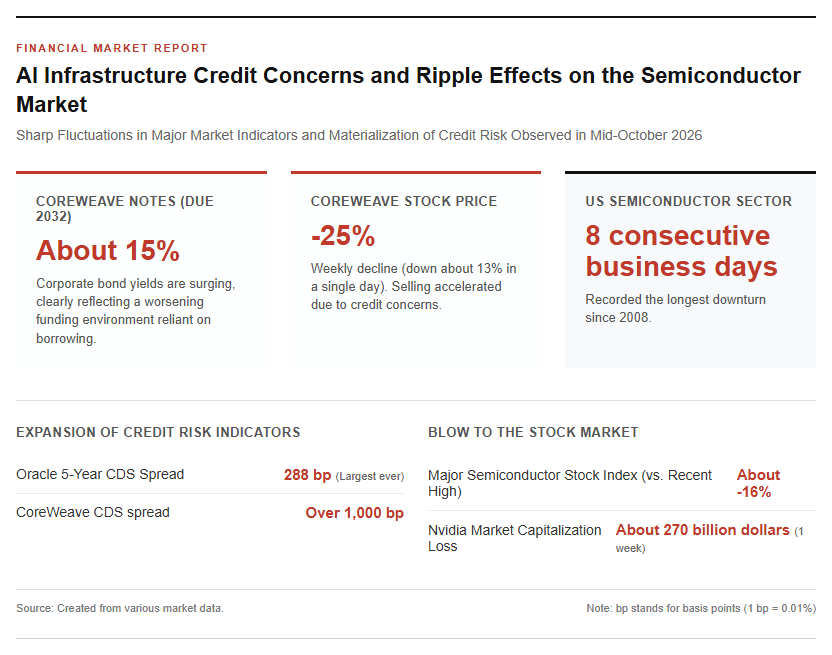
In mid-October 2026, a financial shock that shook global markets originated from the U.S. credit market. The yield on 2032-maturity corporate bonds issued by CoreWeave, a neo-cloud company providing cloud infrastructure for AI, surged to nearly 15%, while its stock price plummeted by about 13% in a single day and 25% for the week. At the same time, Oracle’s 5-year CDS spread widened to a record high of 288 bps, and CoreWeave’s CDS also exceeded 1,000 bps, as concerns over debt expansion erupted all at once.
This AI-related credit anxiety immediately spread to the stock market. The U.S. semiconductor sector recorded eight consecutive sessions of declines, entering its longest losing streak since 2008. The major semiconductor index fell by a cumulative approximately 16% from its recent peak, and NVIDIA lost about $270 billion in market capitalization in a week. This was driven by a sudden surge in concerns that soaring financing costs would stall the capital expenditure plans that have thus far expanded the market. Please refer to the figure below.
Spillover to Major Asian Markets and Sharp Corrections in Stocks and Currencies
AI debt concerns originating in the US dealt a direct blow to the stock markets of various Asian countries and regions that support the semiconductor supply chain. In the Tokyo market, on October 15, 2026, the Nikkei Stock Average plummeted by more than 3,300 yen from the previous day, recording the third-largest drop in history. In particular, the Nikkei Semiconductor Stock Index suffered a devastating blow, plunging 10.1% from the previous day.
The correction in the South Korean market was even more severe. The Korea Composite Stock Price Index (KOSPI) fell for seven consecutive trading days through October 15, triggering a circuit breaker as the drop exceeded 9% during trading. Memory chip giants Samsung Electronics plummeted 9.48% and SK Hynix plunged 11.06% from the previous day, with their stock prices dropping by more than 40% from their June 2026 peaks. The Asian AI hardware stock basket compiled by Goldman Sachs also fell 11% for the week. Despite TSMC announcing a bullish sales outlook, selling pressure did not subside due to concerns across the entire supply chain, and financing bottlenecks shook the broader Asian high-tech industry.
Distortions in the Financial Structure and Clogging of the “Circular Global Capital Flows”
Surging Financing Costs Due to US Rate Hikes and “Reverse Crowding-Out”
The biggest factor cooling down the AI market is the monetary tightening and persistently high interest rates by the US Federal Reserve (FRB). At the FOMC meeting in September 2026, the Fed raised its policy rate by 0.25 percentage points to 3.75–4.00%. This is a territory exceeding the neutral rate envisioned by the Fed (3.25–3.50%), representing a level that suppresses the real economy and investment. In the US Treasury market as well, the 2-year yield approached 5%, and the 10-year yield also rose to the 5.3% range.
Amid this rising interest rate environment, hyperscalers (major cloud service providers) have successively issued massive amounts of corporate bonds. Corporate bond issuances by Alphabet, Amazon, Meta, and Oracle through October 2026 exceeded $228 billion, more than double the total for the previous year. While investment capital has been flowing from government bonds into AI-related corporate bonds, bond spreads for AI issuers widened to approximately 115 bps in late September. A “reverse crowding-out” phenomenon is occurring, with investors purchasing “non-AI corporate bonds” to avoid concentration risk in corporate debt, and constraints are beginning to emerge on both the volume and pricing of capital supply.
Credit Uncertainty and Shipment/Inventory Disruptions Triggered by Circular Trading and Excessive Debt Dependency
In the AI infrastructure market, “round-trip transactions”—whereby major tech companies and VCs invest in AI startups and use those funds to have the startups purchase their own cloud services and GPUs—have become commonplace. Such a structure carries the risk of overstating actual demand, creating a systemic risk where the deterioration of a single company’s financial health could simultaneously trigger the impairment of investments and the loss of future revenue.
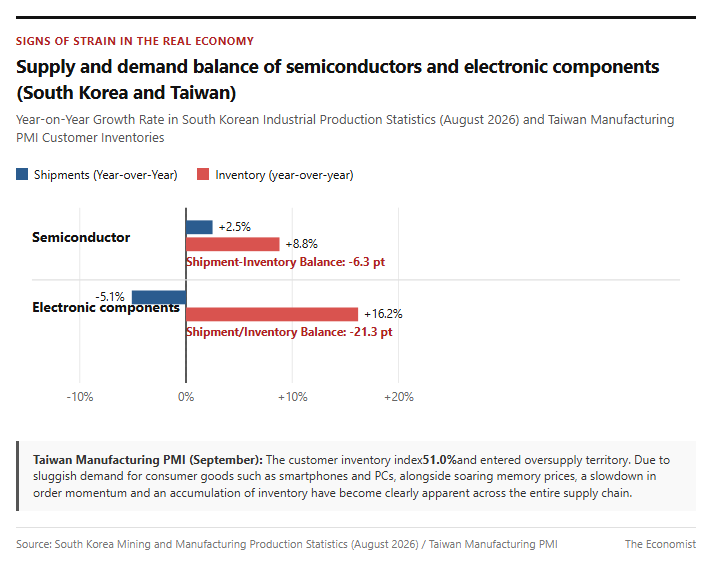
Signs of a shift are also emerging in the supply and demand of the real economy. According to South Korea’s industrial production statistics for August 2026, semiconductor shipments rose by a mere 2.5% year-on-year, while inventories grew by 8.8%, worsening the shipment-inventory balance to minus 6.3 points. In the electronic components sector, shipments decreased by 5.1% and inventories increased by 16.2%, with the balance deteriorating to minus 21.3 points. In Taiwan as well, the September manufacturing PMI showed the customer inventory index entering excess territory at 51.0%. Sluggish consumer demand for smartphones and PCs, combined with the heavy cost burden of soaring memory prices, has made the slowdown in order momentum and the increase in inventories increasingly pronounced. Please refer to the figure below.
Structural Risks and Future Outlook of the Asian Semiconductor Industry
US-Dependent Hyperscaler Investment and the Risk of Emerging Competitors
Asian semiconductor companies have increasingly developed a structure of reliance on massive capital expenditures by major U.S. tech companies. Total capital expenditures (CAPEX) by the top five major companies—Amazon, Alphabet, Meta, Microsoft, and Oracle—are estimated to reach approximately $800 billion in 2026 and exceed $1.1 trillion in 2027. TSMC, Samsung Electronics, and SK Hynix together account for about one-third of the weight of the MSCI Asia ex-Japan Index, meaning that a slowdown in U.S. investment is directly linked to the broader Asian economy.
Furthermore, the pursuit by Chinese semiconductor manufacturers has emerged as a new risk factor. ChangXin Memory Technologies (CXMT), a major Chinese DRAM maker, has announced plans to roll out server DRAM adopting the 4F² architecture within the year. Despite facing US export restrictions on EUV lithography equipment, the company has rapidly expanded its market share in the Chinese market, posing a threat to existing major Asian manufacturers in terms of a price collapse and the seizure of future demand in the commodity memory market. With memory accounting for 90% of South Korea’s semiconductor exports, there are growing concerns over oversupply and price drops in areas other than advanced AI chips.
Future Outlook and Points to Watch: Increasingly Selective AI Investments and Market Survival Strategies
The future AI market is transitioning from a phase of euphoria where “anything AI-related is bought unconditionally” to a phase where stocks are strictly “selected” based on financial health and actual supply and demand. According to Gartner’s estimates, while over $3.5 trillion in AI infrastructure investment will be made by 2030, it is warned that a substantial portion of it will face the risk of impairment due to insufficient revenue.
Key focal points to watch are U.S. interest rate trends and the operating cash flows of major hyperscalers. Major companies’ AI capital expenditures are projected to exceed their operating cash flows between 2027 and 2028, and if interest rates remain high amid an increasing reliance on external funding, a series of delayed data center construction starts and plan revisions could occur. Meanwhile, ultra-large companies with substantial cash reserves, as well as the cutting-edge logic and HBM sectors, which continue to experience severe supply shortages, are expected to remain resilient. Companies are being urged to pivot away from a mere performance competition toward establishing financing structures that are sustainable even under high interest rates and building systems capable of fulfilling legal and regulatory responsibilities.
Reference Page
- https://www.bloomberg.com/news/articles/2026-10-15/stock-market-today-dow-s-p-live-updates
【#AIFundingRisk #SemiconductorStockPlunge #CoreWeave #RisingInterestRates #AsianEconomy #KOSPI #ReverseCrowdingOut】
コメント