Central General Development has unexpectedly revised its consolidated net profit/loss for the cumulative second quarter of the fiscal year ending March 2027 downward into the red. In the background are rising selling prices for condominiums due to soaring construction costs, alongside a shortfall in the number of units delivered caused by increasingly cautious housing purchase sentiment.
- Summary of Revisions for the Cumulative Second Quarter of the Fiscal Year Ending March 31, 2027, and the Reality of Slipping into the Red
- Delays in sales progress and cost factors in the core condominium business
- Stock price trends and changes in valuation metrics before and after the announcement
- Equity Ratio and Cash Flow Trends in Financial Statements
- Nationwide Surge in Condominium Prices and Polarization of the Buyer Demographic
- Conditions for Achieving the Maintained Full-Year Earnings Forecast and Key Points of the Business Strategy
Summary of Revisions for the Cumulative Second Quarter of the Fiscal Year Ending March 31, 2027, and the Reality of Slipping into the Red
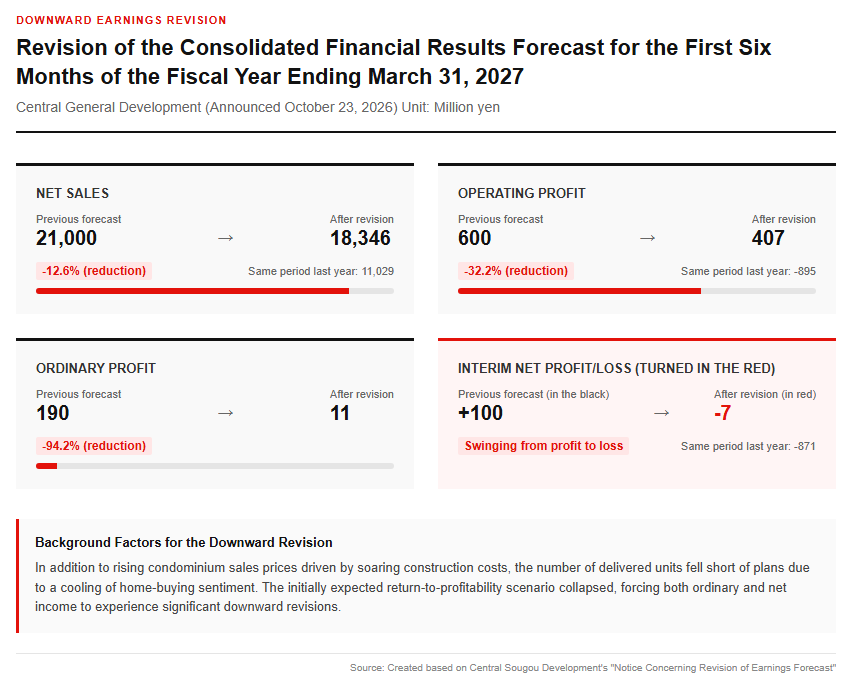
Central General Development Co., Ltd. (Securities Code: 3238), a real estate developer listed on the Tokyo Stock Exchange Standard Market, disclosed a revision to its financial forecasts at 15:30 on October 23, 2026. In this announcement, the company significantly lowered its consolidated financial forecasts for the cumulative second quarter of the fiscal year ending March 31, 2027 (from April 1, 2026, to September 30, 2026). Net sales were revised from the previous forecast of 21,000 million yen to 18,346 million yen, a decrease of approximately 12.6 percent. Profits experienced even more significant downward deviations, with operating income dropping by approximately 32.2 percent from the previous forecast of 600 million yen to 407 million yen, and ordinary income plunging by approximately 94.2 percent from the previous forecast of 190 million yen to 11 million yen. The most market-shocking revision was to the interim net income/loss attributable to owners of the parent, which was revised downward from a previously forecasted surplus of 100 million yen to a deficit of 7 million yen, causing interim net income per share to fall from 10.40 yen to minus 0.73 yen. Since the results for the same period of the previous year (cumulative second quarter of the fiscal year ended March 31, 2026) were net sales of 11,029 million yen, an operating loss of 895 million yen, and an interim net loss of 871 million yen, the company technically maintains an increase in revenue and a narrowing of the deficit year-on-year, but its initial scenario of returning to profitability has collapsed. Please refer to the figure below summarizing the figures for the financial forecast revision.
Delays in sales progress and cost factors in the core condominium business
Regarding the direct factors leading to this downward revision of financial results, the company cited that the number of condominium units sold in its core real estate sales business fell below initial projections. Central Sougou Development has been developing the “CLAIR” series of new condominium units for families in major cities and regional core cities nationwide, but the progress of contracts and unit deliveries planned at the beginning of the fiscal year was delayed. Behind this is the ongoing rise in condominium prices driven by soaring building material prices and labor costs, leading to a situation where customers facing persistent inflation have shifted their housing purchase mindset in an even more cautious direction. In particular, as the passing on of rising construction costs to prices became necessary not only in major metropolitan areas but also in regional core cities, prospective buyers’ selectivity intensified, increasing the number of cases requiring more time to reach a contract. As a result, net sales fell short of the plan by approximately 2.654 billion yen, and the decrease in gross profit coupled with the burden of fixed costs caused operating income and ordinary income to contract sharply, leading to the final profit and loss falling into the red.
Stock Market Reaction and Verification of Financial Health
Stock price trends and changes in valuation metrics before and after the announcement
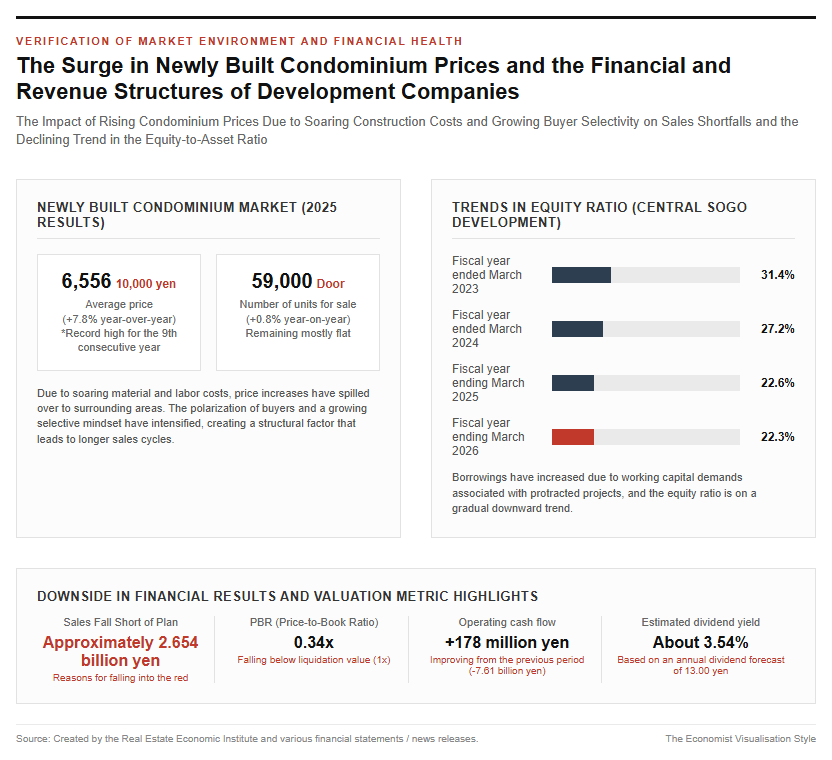
On the Tokyo Stock Exchange on October 23, 2026, following the announcement of a downward revision, the closing share price of Central Sogo Development finished down 6.0 yen (down 1.61 percent) from the previous day at 367.0 yen. During the day’s trading, volume reached 17,400 shares, with a market capitalization of approximately 3.553 billion yen. Looking at the valuation at the current share price level, the PBR (Price-to-Book Ratio) remains at around 0.34x, entrenching a low PBR state well below the 1x level considered to be the liquidation value. Furthermore, the PER (Price-to-Earnings Ratio) based on the latest earnings is approximately 23.89x. The company previously experienced a sharp drop in its share price when it announced a substantial downward revision and dividend cut in March 2026, just before the end of the fiscal year ending March 2026, recording a year-to-date low of 337.0 yen on March 23, 2026. Compared to its year-to-date high of 440.0 yen (February 16, 2026), trading continues to face heavy resistance on the upside, but assuming the company’s projected annual dividend of 13.00 yen for the fiscal year ending March 2027, the projected dividend yield reaches about 3.54 percent, with the sense of undervaluation and yield levels providing a certain floor for the downside.
Equity Ratio and Cash Flow Trends in Financial Statements
When considering the recent downward revision in the company’s business performance, reviewing its balance sheet and financing structure is essential. As of the end of the fiscal year ended March 31, 2026, which marks its most recent full-year financial closing, the company’s total assets stood at 46,101 million yen, net assets were 10,302 million yen, and its equity ratio was 22.3 percent. The equity ratio has continued on a gradual downward trend, falling from 31.4 percent in the fiscal year ended March 31, 2023, to 27.2 percent in the fiscal year ended March 31, 2024, and 22.6 percent in the fiscal year ended March 31, 2025. In terms of cash flow, operating cash flow for the fiscal year ended March 31, 2026 secured a surplus of 178 million yen, but it remains at a level still recovering from the negative 7,610 million yen of the previous fiscal year (ended March 31, 2025). Driven by the acquisition of business sites for rental condominiums and an increase in construction-in-progress accounts, the company’s borrowings are tending to increase year-on-year. In the condominium sales business, funds are tied up for long periods from site acquisition to completion and handover; consequently, a stagnation in sales contracts is structurally prone to directly affect working capital efficiency and borrowing interest burdens, making strict credit management and the optimization of inventory turnover imperative.
Environmental Changes in the Real Estate Industry and Future Prospects
Nationwide Surge in Condominium Prices and Polarization of the Buyer Demographic
Behind Central General Development’s business performance lies a structural change in the macroeconomic environment surrounding the domestic real estate industry as a whole. According to a survey by the Real Estate Economic Institute, the average price of newly built condominiums put on the market nationwide from January to December 2025 rose 7.8 percent year-on-year to 65.56 million yen, updating record highs for the ninth consecutive year. Meanwhile, the number of units launched nationwide remained virtually flat, increasing by 0.8 percent year-on-year to 59,940 units. The surge in construction costs driven by rising material prices and higher labor rates has been prolonged, with the wave of price increases spreading not only to central urban areas but also to surrounding residential areas. Please refer to the figure below, which shows the trends and price movements of the newly built condominium market.
Due to such price surges, and driven by concerns over sluggish real wage growth and future interest rate hikes, purchasing sentiment among typical families—centered primarily around first-time homebuyers—has rapidly turned cautious. While high-value urban properties are being bought by the affluent, a polarization of buyers has become pronounced, with suburban and regional properties seeing noticeably prolonged sales periods.
Conditions for Achieving the Maintained Full-Year Earnings Forecast and Key Points of the Business Strategy
While the previous period’s results were unexpectedly revised downward into a loss, the company has left its full-year consolidated earnings forecast for the fiscal year ending March 31, 2027, unchanged from its previous outlook. The full-year plan expects net sales of 45,000 million yen (a 17.0% increase year-on-year), operating profit of 1,350 million yen (a 50.2% increase), ordinary profit of 650 million yen (a 113.8% increase), and net income attributable to owners of the parent of 400 million yen (a 171.0% increase). To achieve these full-year targets, the company will need to post net sales of 26,654 million yen and an operating profit of 943 million yen in the second half (October 1, 2026, to March 31, 2027), resulting in an extremely strong second-half-weighted earnings structure. The company plans to complete and deliver a total of 15 properties during the fiscal year ending March 31, 2027—13 in regional areas and 2 in the Tokyo metropolitan area—and aims to recover profitability by developing high-value-added properties with superior environmental performance, such as ZEH (Net Zero Energy Houses) and low-carbon buildings. Future focuses will include the progress of contract acquisitions and the reliable execution of property deliveries in the second half, as well as the feasibility of the year-end dividend forecast of an annual 13.00 yen per share (an increase from the previous period’s actual 5.00 yen).
Reference page
- [Central General Development Co., Ltd. Official Corporate Information Site] https://www.central-gd.co.jp/
[#CentralSogoDevelopment #DownwardRevision #RealEstateIndustry #Condominiums #EarningsFlash #StockInvesting #FinancialAnalysis]


コメント