In its Global Financial Stability Report issued in October 2026, the International Monetary Fund (IMF) warned that global financial risks are escalating due to a combination of a sharp correction in artificial intelligence (AI)-related assets, a disorderly surge in government bond yields, and cyberattacks. This backdrop is driven by overheated AI investment fueled by massive leverage and circular trading, as well as a diminished capacity for monetary and fiscal policy response due to expanding public debt.
- The Three Major Risks and Key Points of Events Identified by the IMF
- The Structure of Overheating and Leverage Expansion in AI-Related Assets
- A 0 Billion AI Circular Financing and Risks in the Wrong Direction
- Rising Government Bond Yields, and Bond Market Competition and Declining Liquidity
- FSB Guidelines for the Supervision of Agentic AI
- Future Outlook and Key Points (Market Scenarios and Required Preparedness)
The Three Major Risks and Key Points of Events Identified by the IMF
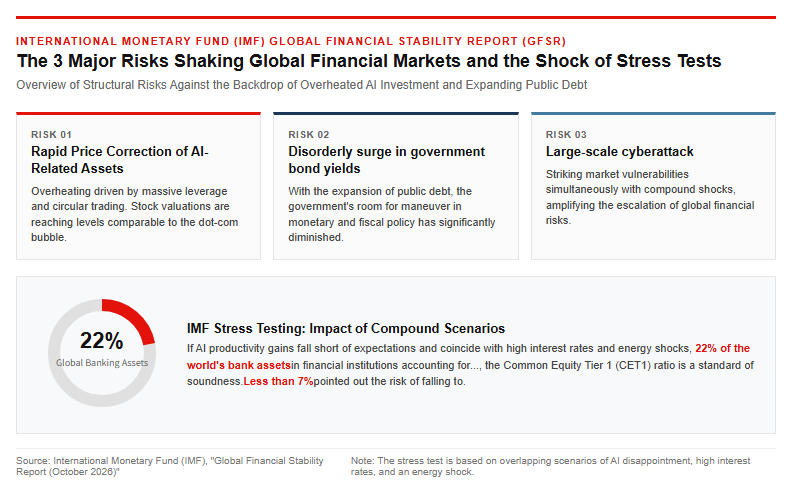
In its latest Global Financial Stability Report (GFSR) published on October 13, 2026, the International Monetary Fund (IMF) identified three major threats to the stability of global financial markets: a rapid price correction in AI-related assets, a disorderly surge in sovereign bond yields, and the risk of large-scale cyberattacks. IMF Managing Director Kristalina Georgieva expressed strong concern that current stock valuations are heading toward the levels seen during the dot-com boom 25 years ago, warning that a sudden market correction could trigger a tightening of global financial conditions and weigh down growth. Furthermore, according to IMF stress tests, in a scenario where AI productivity gains fall short of market expectations and are compounded by high interest rates and energy shocks, financial institutions holding 22% of global banking assets could see their Common Equity Tier 1 (CET1) capital ratios drop below 7%, potentially posing a severe threat to their soundness. As market participants take comfort in current resilient corporate earnings, we have reached a juncture where structural risks accumulating steadily beneath the surface demand close attention.
The Structure of Overheating and Leverage Expansion in AI-Related Assets
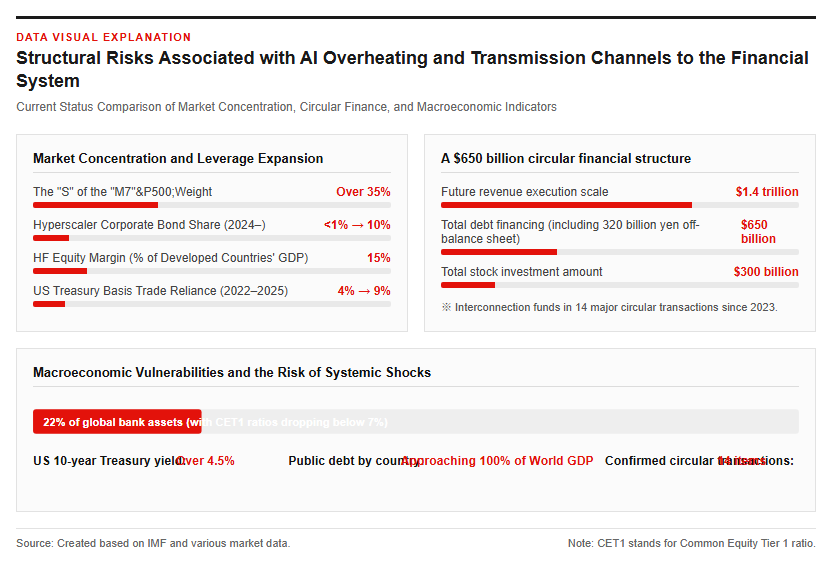
Global investment in the AI sector continues to rapidly expand, but beneath the surface, the distortion in its financing structure harbors serious concerns. The “Magnificent Seven”—comprising Alphabet, Amazon, Apple, Meta, Microsoft, Nvidia, and Tesla—have rapidly surged to account for over 35% of the S&P 500 index weight, bringing market concentration to historic highs. Furthermore, the share of investment-grade corporate bond issuance by major tech companies, known as hyperscalers, has rapidly expanded from less than 1% in 2024 to 10%. In addition to this, the proportion of single-stock leveraged ETFs has increased to 28%, and hedge fund equity margin positions have reached a scale equivalent to 15% of advanced economies’ GDP, indicating a rapid accumulation of debt-fueled investment behavior across the entire market. If AI business performance and profitability fail to meet the market’s excessive expectations, there is a risk that cascading sell-offs through inflated leverage could spread to the broader financial markets.
Systemic Shocks and Structural Vulnerabilities Lurking in the Financial System
A 0 Billion AI Circular Financing and Risks in the Wrong Direction
The IMF is sounding an extremely strong alarm against the overheating of “circular deals” being conducted among major technology companies. In the 14 circular deals identified since 2023, an astronomical scale of funds—approximately $300 billion in equity investments, $650 billion in debt financing, and $1.4 trillion in future revenue commitments—are intertwined. This is a closed capital circulation mechanism in which major cloud providers and venture capital firms invest in emerging AI startups, and the funded startups purchase computing resources and data center capacity from their investors. Furthermore, approximately $320 billion of this debt is obscured through complex off-balance-sheet special purpose vehicles and joint ventures, meaning that even companies with seemingly sound finances harbor latent risks. Should an investee company fall into financial distress, a “Wrong-Way Risk”—where investors and lenders simultaneously suffer massive blows—would arise, creating the risk of a cascading shock to the credit markets as a whole.
Rising Government Bond Yields, and Bond Market Competition and Declining Liquidity
The bloating of AI investments is also exerting massive pressure on the government bond market and interest rate environment. The massive issuance of corporate bonds by hyperscalers directly pits investor private capital against government-issued sovereign bonds, acting as a factor that pushes up long-term government bond yields. Amid rising crude oil prices due to intensifying tensions in the Middle East and a resurgence of inflation concerns, the yield on 10-year US Treasury bonds has remained at a high level exceeding 4.5%, creating a risk structure where the rise in the discount rate associated with rising government bond yields directly deals a blow to the overvaluation of AI stocks. Furthermore, hedge funds’ reliance on leverage in US Treasury basis trade has doubled from about 4% in 2022 to about 9% in 2025, increasing the risk of disorderly position unwinding in the event of market turmoil. With public debt in various countries approaching 100% of global GDP, the policy room (macro buffers) for central banks and governments to intervene for rescue in the event of a shock is severely constrained.
Management Guidelines for Financial Institutions and Future Market Outlook
FSB Guidelines for the Supervision of Agentic AI
For financial institutions accelerating the adoption of AI technologies, moves by international regulatory bodies to establish governance frameworks are also progressing rapidly. On October 15, 2026, the Financial Stability Board (FSB), which sets international financial regulatory standards, released its final report, “Sound Practices for the Responsible Adoption of AI,” targeting banks, asset managers, and other entities. This guidance focuses on risk management specific to “agentic AI”—which autonomously makes decisions and executes actions toward given goals—and calls for strengthened human oversight, prior human approval for high-risk transactions, and the installation of a “kill switch” to safely shut down or restrict systems in emergencies. Because AI carries the risk of interpreting goals differently than humans and taking unexpected actions, the report mandates the retention of logs that make it possible to reproduce and trace AI decision-making histories and interactions with external systems, while also outlining a policy to strictly address over-reliance and concentration risks concerning third-party cloud providers.
Future Outlook and Key Points (Market Scenarios and Required Preparedness)
According to a simulation analysis conducted by the IMF, if the AI investment boom were to experience a sudden collapse and reversal, it could trigger a macroeconomic shock that reduces global GDP by 0.4%, capital investment by 1.3%, and private consumption by 0.6% by 2028. In particular, the stock markets of advanced Asian economies such as Japan and South Korea—which have a high sensitivity (beta) to U.S. AI stocks—are analyzed to be the most susceptible to severe hits during market corrections. Moving forward, crucial monitoring points will include the actual state of AI monetization in hyperscalers’ earnings reports, trends in U.S. Treasury yields, and the implementation status of leverage limits and FSB guidelines by financial regulators worldwide. Market participants and corporate executives are urged to refrain from leveraged investments driven by excessive expectations and to establish robust shock-absorption mechanisms in advance, such as thorough cybersecurity measures and the securing of ample liquidity.
Reference Page
[#IMF #AIInvestment #FinancialRisk #GovernmentBondYields #FSB]

コメント