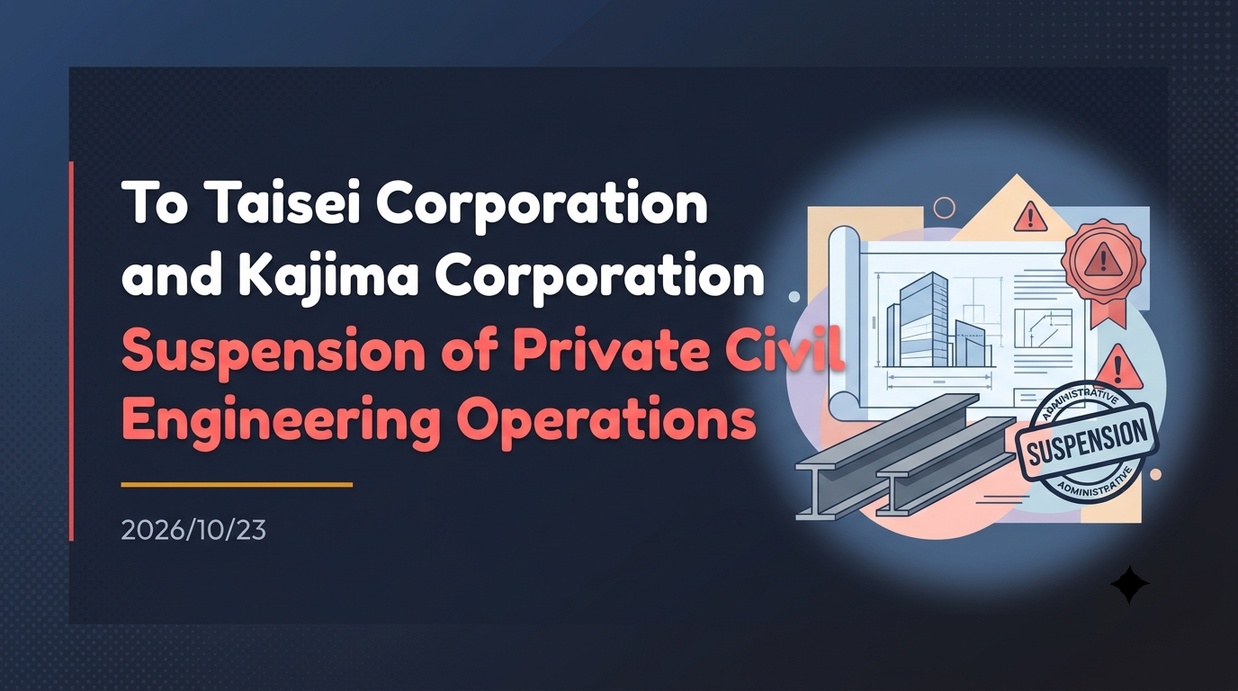
The Kanto Regional Development Bureau of the Ministry of Land, Infrastructure, Transport and Tourism has issued business suspension orders for private civil engineering projects to Taisei Corporation and Kajima Corporation under the Construction Business Act. The background to this is the finalization of guilty verdicts by the Supreme Court in the Antimonopoly Act violation case surrounding the Chuo Shinkansen construction project.
- Specific details of the business suspension order issued by the Ministry of Land, Infrastructure, Transport and Tourism
- Scope of Sales Restrictions in Private Civil Engineering Works and Practical Impacts
- A 10-year timeline from the start of the investigation to the final guilty verdict in the Supreme Court
- Arguments over Technical Adjustments in Court and the Reasons the Judiciary Dismissed Them
- Strengthening Compliance Frameworks and Complete Separation of Sales and Quotation
- Challenges in the Infrastructure Procurement System and a Future Vision for Preventing Recurrence
Specific details of the business suspension order issued by the Ministry of Land, Infrastructure, Transport and Tourism
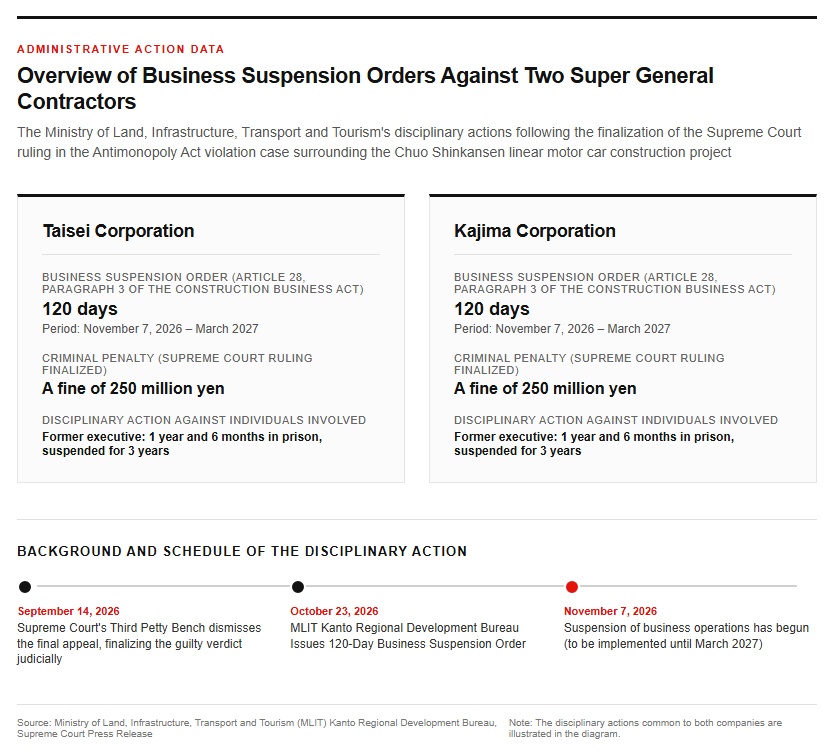
On October 23, 2026, the Kanto Regional Development Bureau of the Ministry of Land, Infrastructure, Transport and Tourism issued a 120-day business suspension order against two major general contractors, Taisei Corporation and Kajima Corporation, as an administrative disposition pursuant to Article 28, Paragraph 3 of the Construction Business Act. The suspension period will last for 120 days, from November 7, 2026, through March 2027. The direct catalyst for this disposition was the dismissal of their appeals by the Second Petty Bench of the Supreme Court on September 14, 2026, in the criminal trial regarding violations of the Antimonopoly Act (unreasonable restraint of trade) concerning the Chuo Shinkansen construction projects awarded to both companies, thereby legally finalizing their convictions as corporate entities. With the Supreme Court’s decision, fines of 250 million yen for each company were finalized, along with suspended prison sentences of one year and six months with a three-year probation period for two former executives involved. In response to this, the Ministry of Land, Infrastructure, Transport and Tourism, acting as the regulatory authority overseeing construction contractors engaging in inappropriate conduct, has taken strict legal measures.
Scope of Sales Restrictions in Private Civil Engineering Works and Practical Impacts
The scope of this business suspension order is limited to all sales activities related to private civil engineering construction work. Specifically, during the suspension period, the conclusion of new contracting agreements, as well as pre-contract activities such as participating in bids, submitting estimates, and various negotiation activities aimed at securing orders, are legally prohibited. On the other hand, based on the supervisory disposition standards of the Construction Business Act, the continuation of construction is permitted for existing construction contracts already concluded before November 7, 2026, the date the disciplinary action takes effect, meaning that construction sites will not come to an immediate halt. However, the halt on new sales will deal a serious blow to the mid-to-long-term order pipeline. Furthermore, quantitative and qualitative impacts on the company’s social credibility and market position are inevitable, including potential ripple effects such as suspension from bidding by public institutions beyond the private civil engineering sector, and a review of contractor selection by private clients from CSR and ESG perspectives.
Background and Judicial Rulings of the Linear Shinkansen Bid-Rigging Case
A 10-year timeline from the start of the investigation to the final guilty verdict in the Supreme Court
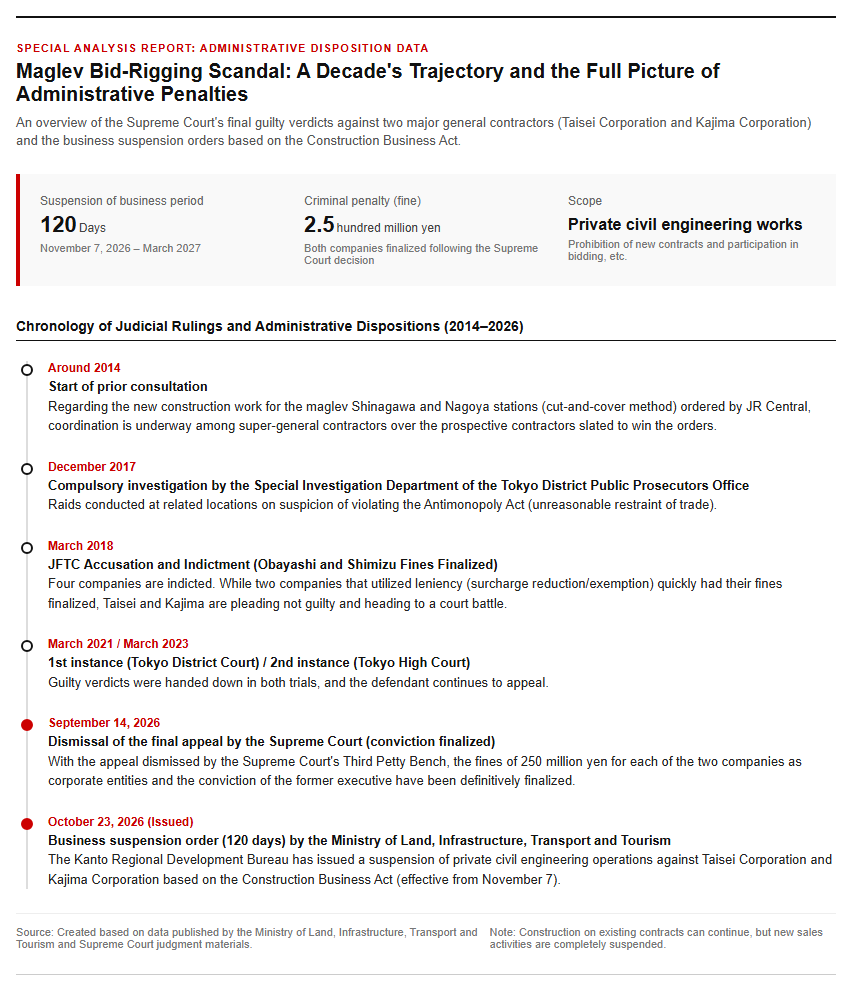
This case is a major bid-rigging incident involving alleged coordination among four major general contractors regarding the new construction contracts (underground cut-and-cover method) for the Shinagawa and Nagoya terminal stations of the Chuo Shinkansen commissioned by JR Tokai. Triggered by preliminary consultations that began around 2014, the Tokyo District Public Prosecutors Office conducted a forced investigation in December 2017. Following an accusation by the Japan Fair Trade Commission in March 2018, the four companies were indicted; however, Obayashi Corporation and Shimizu Corporation, which admitted to the violations early on, utilized the leniency program and had their fines finalized in 2018. In contrast, Taisei Corporation and Kajima Corporation consistently maintained their innocence and continued their legal battle. However, following the rulings of the first instance at the Tokyo District Court (March 2021) and the second instance at the Tokyo High Court (March 2023), the Supreme Court dismissed the defendants’ appeal in September 2026, finally finalizing the penalties for both companies more than 10 years after the incident occurred.
Arguments over Technical Adjustments in Court and the Reasons the Judiciary Dismissed Them
In the trial, Taisei Corporation and Kajima Corporation argued that the maglev new station construction work was an unprecedentedly challenging technical project and that, because the client JR Central had proceeded by consulting with companies possessing specific technologies, a substantive competitive environment did not exist in the first place. They further countered that sharing information among peers and expressing preferences for specific construction zones were merely considerations for establishing a smooth construction system, and did not constitute an unreasonable restraint of trade prohibited by the Antimonopoly Act. However, the judiciary completely dismissed these arguments. The court ruled that no matter how technically difficult a project may be, the act of allocating prospective contract recipients among competing companies to prevent price drops undermines the market’s free competition function and constitutes illegal bid rigging. This ruling became an important precedent that delivered a clear judicial decision against the conventional, industry-customary logic of prior coordination based on technical difficulty or the unique nature of the procurement process.
Impact on the Construction Industry and Future Outlook
Strengthening Compliance Frameworks and Complete Separation of Sales and Quotation
Following the finalization of Supreme Court guilty verdicts and the issuance of administrative penalties, governance reforms are accelerating across the entire construction industry. Particularly among primary general contractors, contact rules are being thoroughly overhauled because it has been made clear that even coordination activities conducted for the company’s benefit can directly result in criminal liability for individual handlers and executives. Specifically, essential practical requirements now include the introduction of a prior approval system for meetings with competitors, the preservation of digital logs for meeting records, and the establishment of information barriers (Chinese walls) between sales departments and estimation/bidding departments. Additionally, companies are required to expand whistleblowing systems for the early detection of misconduct and to revamp internal compliance training to break free from legacy practices. More than just establishing formal regulations, effectively embedding risk management and internal controls down to the operational front lines has become a critical, make-or-break issue for every company.
Challenges in the Infrastructure Procurement System and a Future Vision for Preventing Recurrence
This incident has also cast a spotlight on procurement systems and the role of project owners in massive infrastructure projects. In ultra-large-scale construction projects running into the trillions of yen, experts have also pointed to a structural backdrop: contractors bearing massive preliminary study costs while harboring deep-seated fears of running deficits on orders, leading them to tilt toward illicit bid coordination. While public works are advancing efforts to ensure a balance between quality and price based on the Act on Promotion of Quality Assurance in Public Works (Hinkakuho), achieving a balance between a fair competitive environment and appropriate cost and timeline settings is equally indispensable for private-sector mega-projects. Moving forward, the primary focus will not be limited to further strengthening the enforcement of the Japan Fair Trade Commission’s leniency program or expanding administrative monitoring systems; rather, the ultimate issue will be how both project owners and contractors can establish highly transparent, open contract procurement processes to ensure fair trade practices and restore trust throughout the entire industry.
Reference page
- [Ministry of Land, Infrastructure, Transport and Tourism] Criteria for Supervisory Dispositions Against Contractors’ Misconduct, etc.
[suspicious link removed]
【#TaiseiCorporation #KajimaCorporation #BusinessSuspensionOrder #ConstructionBusinessAct #AntimonopolyAct #MaglevBidRigging #MinistryOfLandInfrastructureTransportAndTourism #Compliance】

コメント