
The Bank of Japan has begun considering whether to judge that the underlying inflation rate has reached its 2% target at the Monetary Policy Meeting in October 2026. The backdrop includes the persistence of high consumer price indices and the entrenching of wage increases, marking a symbolic and historic turning point away from deflationary measures nearly 14 years after the target was first introduced in January 2013.
- Policy shift at the October monetary policy meeting and achievement of a 14-year-old goal
- The Basis for Achievement Seen in Underlying Inflation Indicators and Wage Trends
- Adapting Corporate Management and Financing to a World with Interest Rates
- Diverging Fortunes Across Generations: The Impact on Household Budgets and Interest Received and Paid
- Prediction of the Next Rate Hike Timing and US Policy Requests
- Challenges in Anchoring 2% Inflation and the Outlook for the Exit Strategy
Policy shift at the October monetary policy meeting and achievement of a 14-year-old goal
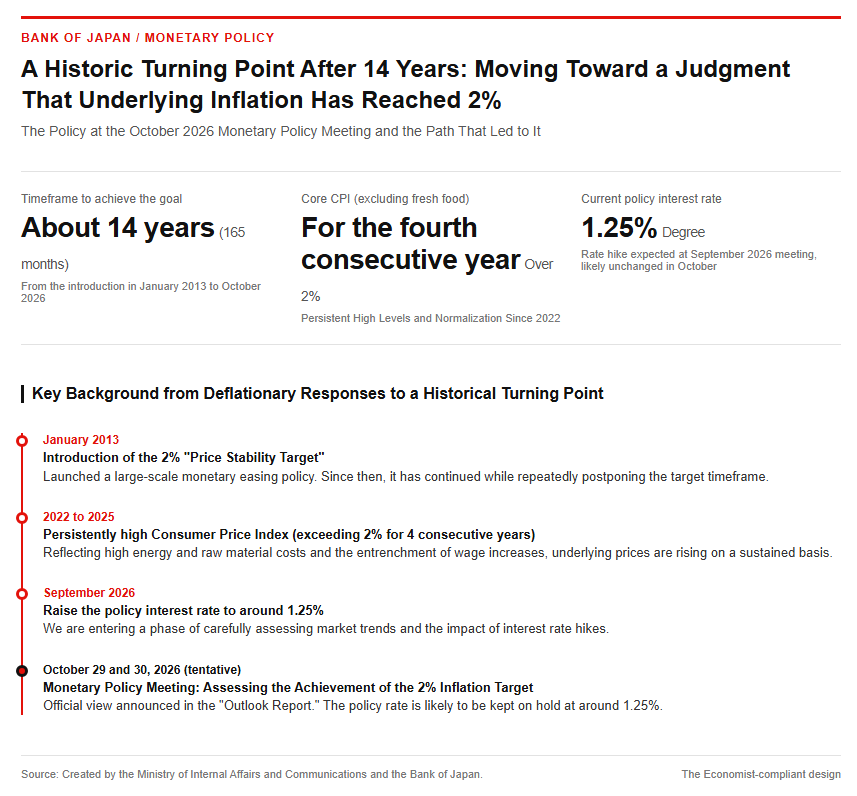
At the Monetary Policy Meeting to be held on October 29 and 30, 2026, the Bank of Japan (BOJ) has decided to determine whether it has reached its long-held inflation target of 2%. Since introducing the 2% “price stability target” in January 2013, the BOJ has repeatedly postponed the achievement timing despite continuing large-scale monetary easing measures, but if realized, this would mark the fulfillment of a long-cherished goal nearly 14 years in the making. According to an announcement by the Ministry of Internal Affairs and Communications, the national Consumer Price Index (core CPI) excluding fresh food has recorded an annual increase of over 2% for four consecutive years since 2022. While the BOJ has hitherto carefully assessed underlying price trends excluding the temporary impact of rising energy and raw material costs, it is making this judgment now that the entrenchment of price increases has been confirmed. A formal view regarding the achievement of the 2% target is expected to be presented in the “Outlook for Economic Activity and Prices” (Outlook Report) to be released immediately after the October meeting. As for the policy interest rate, it is highly likely to be left unchanged at around 1.25%, the level to which it was raised at the previous meeting in September 2026. This is because a period of observation is deemed necessary to monitor the impact of the rate hike and market trends. Please refer to the figure below.
The Basis for Achievement Seen in Underlying Inflation Indicators and Wage Trends
Behind the Bank of Japan’s decision to conclude that underlying inflation has reached 2% is the accumulation of data indicating structural changes in the macroeconomy. The Monthly Labour Survey continues to show robust wage growth of around 3% year-on-year, which is a major factor supporting the rise in prices. Additionally, the BOJ’s Tankan survey released on October 1, 2026, confirmed that corporate medium- and long-term inflation expectations remain at elevated levels. Among policy board members, Hajime Takata and Naoki Tamura had already asserted that the 2% target had been reached, while Governor Kazuo Ueda had also expressed the view that inflation was “largely hitting” 2%. Opinions voiced at the September meeting also successively pointed to the view that underlying inflation would reach 2% before long. Through the September rate hike, the BOJ brought the policy interest rate (1.25%) into the neutral interest rate range (1.1% to 2.5%) for the first time, but financial conditions remain accommodative. The underlying basis for the judgment that the target has been achieved is the transition from a purely cost-push inflation to a virtuous cycle in which both wages and prices rise together.
The Structural Impact of Rising Interest Rates on Markets, Corporations, and Households
Adapting Corporate Management and Financing to a World with Interest Rates
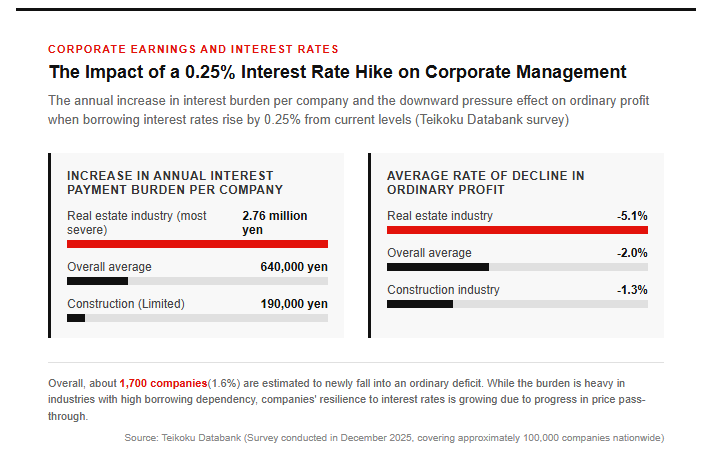
With the hike in policy interest rates, short-term prime rates and lending rates are rising, marking a full-scale transition to a “world with interest rates” in corporate management. According to a nationwide survey of approximately 100,000 companies published by Teikoku Databank in December 2025, if borrowing rates were to rise by 0.25% from current levels, the annual interest payment burden per company would increase by an average of 640,000 yen. This is estimated to push down corporate ordinary profits by an average of 2.0%, causing approximately 1,700 companies (1.6%) nationwide to newly fall into ordinary deficits. By industry, the “real estate” sector, which has a high dependence on borrowing, will be most severely impacted, with the burden increasing by 2.76 million yen per company annually and ordinary profits expected to decline by an average of 5.1%. On the other hand, in the “construction” sector, which has relatively abundant equity capital and cash on hand, the impact is considered limited, with an increased burden of 190,000 yen per year and a 1.3% decrease in profits. However, as corporate earning capacity itself has improved due to the progress of passing on costs, companies’ resilience to rising interest rates has steadily increased compared to past surveys. Please refer to the figure below.
Diverging Fortunes Across Generations: The Impact on Household Budgets and Interest Received and Paid
Rising interest rates are also having a major impact on household finances, with a clear divide emerging between generations. According to estimates by the Mizuho Research Institute, the overall impact of interest rate hikes on households will be a net positive effect of approximately 400 billion yen due to an increase in deposit interest. However, when analyzed by age group, structural disparities exist. Among younger generations with large mortgage balances, the burden of interest payments will increase as variable mortgage rates rise to around 1.45%. Specifically, this will result in an increased burden of 22,000 yen per year for households aged 29 and under, and 23,000 yen per year for households in their 30s. In contrast, older generations who hold more financial assets and time deposits will see an increase in interest received. With 10-year time deposit rates rising to 2.13%, households in their 60s will see an income-expenditure improvement of 20,000 yen per year, and households aged 70 and over will see an improvement of 21,000 yen per year. In this way, rate hikes exert contradictory effects: they squeeze the finances of the younger working generation while enhancing the asset effect for older generations.
The Next Phase of Monetary Policy and Medium- to Long-Term Outlook
Prediction of the Next Rate Hike Timing and US Policy Requests
Market attention has shifted, following the decision at the October meeting, to the timing of the next additional rate hike spanning from late 2026 to 2027. According to a Bloomberg survey of analysts, 0% of economists expect an additional rate hike at the policy meeting on October 30, 2026. Meanwhile, 83% of economists anticipate that the policy rate will be raised to 1.50% at the December 18, 2026 meeting. Furthermore, two-thirds of economists expect the BOJ to continue implementing gradual rate hikes on a quarterly basis, once every three months. International pressure is also behind this trend. U.S. Treasury Secretary Bessent’s stance in urging Japan to halt reflationary policies and pursue monetary tightening has led the Sanae Takaichi administration and the Ministry of Finance to shift toward a stance that accepts the BOJ’s rate-hike policy. The terminal rate is projected to be around 1.75% to 2.0%.
Challenges in Anchoring 2% Inflation and the Outlook for the Exit Strategy
For the Bank of Japan (BOJ), the most crucial challenge after underlying inflation reaches 2% is to stably anchor the inflation rate at around 2%. As Governor Kazuo Ueda noted, “the policy phase is changing,” shifting away from the previous phase aimed at overcoming deflation. This requires sophisticated steering to land at an appropriate neutral interest rate while managing the upside risks of inflation. Potential future risk factors include a sudden surge in crude oil prices driven by turmoil in the Middle East, and upward pressure on import prices caused by the depreciation of the yen, which is hovering around the 158 yen per US dollar level. If these external shocks generate secondary inflationary pressures, the BOJ may be forced into preemptive rate hikes. Furthermore, completing the exit strategy while maintaining trust in the soundness of the BOJ’s own balance sheet—which holds a massive amount of government bonds—and fiscal sustainability will be an essential condition for the sustainable growth of the Japanese economy.
Reference Page
- 【Survey on the Impact of the Bank of Japan’s Additional Rate Hike on Companies (December 2025) | Teikoku Databank, Ltd.】https://www.tdb.co.jp/report/industry/20251219-increase25y/
[#BankOfJapan #MonetaryPolicy #PriceTarget #AdditionalRateHike #JapaneseEconomy]


コメント