A technical demonstration spanning Japan and South Korea has been completed for “KYA,” an authentication infrastructure that cryptographically verifies the identity and authority of AI agents. In the background is the rapid proliferation of “Agentic Finance”—where AI autonomously executes various services and financial settlements on behalf of users—and the accompanying need for new security controls.
- Key Points of the Cross-Border Proof of Concept Conducted by Major Japanese and South Korean Financial and IT Firms
- The Authentication and Delegation Mechanisms Brought by KYA (Know Your Agent) Technology
- Cryptographic Proofs Using Decentralized Identifiers (DIDs) and Verifiable Credentials (VCs)
- The Societal Context Behind the Need to Shift from Conventional KYC to KYA
- Japan-Korea Payment Architecture Integrating KYA Trust Gateway and KB Pay
- Future Outlook and Financial Governance Design for Global Standardization
Key Points of the Cross-Border Proof of Concept Conducted by Major Japanese and South Korean Financial and IT Firms
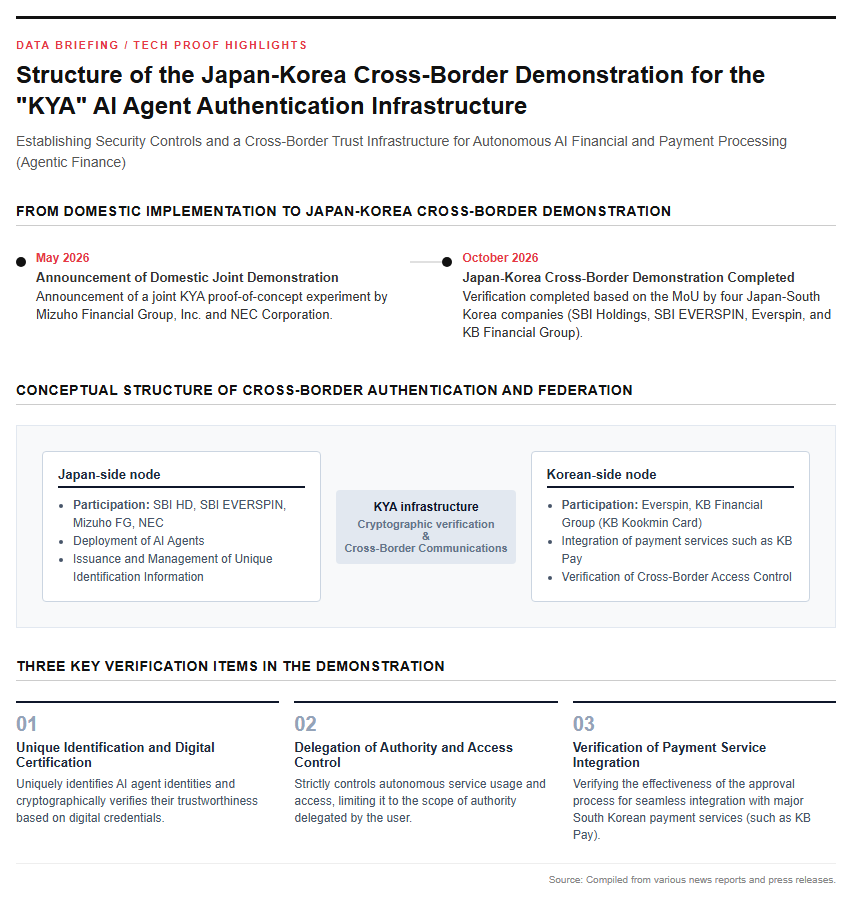
In October 2026, a Japan-Korea cross-border technical demonstration utilizing “KYA” (Know Your Agent), an authentication infrastructure for mutually verifying the identity and authority of AI agents, was completed. This initiative was driven by a Memorandum of Understanding (MoU) among four companies: SBI Holdings, Inc. and SBI EVERSPIN Co., Ltd. from the Japanese side, and Everspin Co., Ltd. and KB Kookmin Card Co., Ltd. (under the KB Financial Group) from the Korean side. Additionally, prior to this in May 2026, Mizuho Financial Group, Inc. and NEC Corporation announced a joint KYA proof-of-concept experiment, showing that the implementation of KYA in the financial sector is advancing rapidly.
In this demonstration, an environment was established enabling a Japanese AI agent to cross borders and access financial and payment services in South Korea. Specifically, the following verifications were conducted.
- Verification of AI Agent Trustworthiness Based on Unique Identification Information and Digital Credentials
- Access control and service usage control within the scope of permissions delegated by the user
- Verification of the approval process for integration with major South Korean payment services such as KB Pay
The significance of proving the effectiveness of a cross-border trust infrastructure for the “autonomous actions of AI agents,” which cannot be handled by conventional human-oriented authentication, is extremely high. As shown in the conceptual diagram below, an environment has been established in which financial nodes across multiple countries can communicate with each other.
The Authentication and Delegation Mechanisms Brought by KYA (Know Your Agent) Technology
KYA is a cutting-edge technology that extends the traditional concept of “KYC” (Know Your Customer) to AI agents, accurately understanding and verifying the identity, permissions, and behavior of the AI agents themselves acting on behalf of users. With the advancement of generative AI and LLMs, use cases are surging where AI agents automatically execute API calls, reservations, money transfers, and contract procedures on behalf of users.
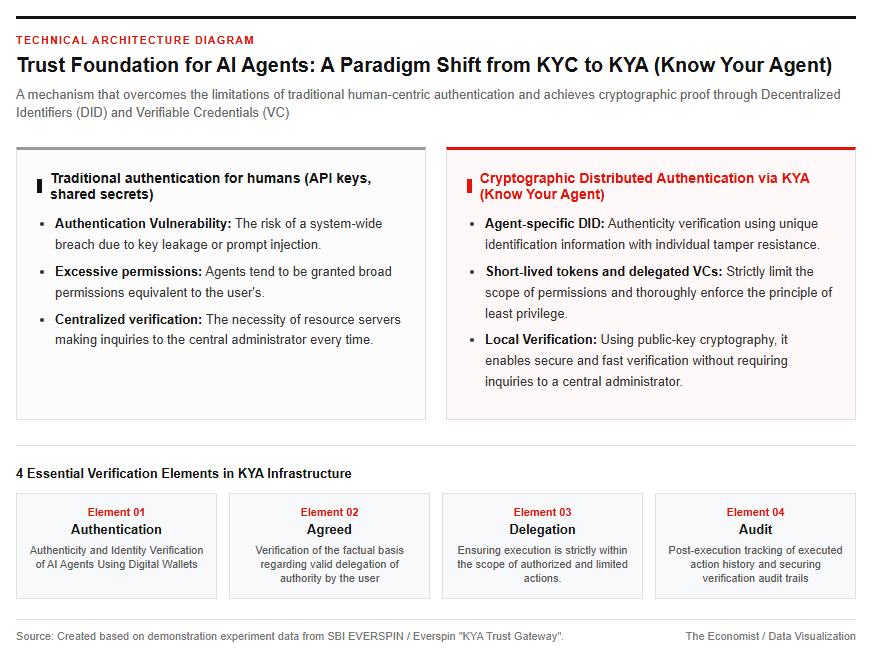
The verification elements considered essential for the KYA infrastructure can be summarized into the following four items.
- Authentication: Verification of AI Agent Authenticity and Identity Verification Using Digital Wallets
- Consent: Verification that users have legitimately delegated authority to AI agents
- Delegation: Ensuring that actions can be executed only within the scope of the delegated authority.
- Audit: Ensuring an audit trail that enables post-hoc tracking and verification of the complete history of executed actions
In this demonstration, “KYA Trust Gateway,” jointly developed by SBI EVERSPIN and Everspin, was used. When a user gave a natural language instruction to an AI, such as “Please book and pay for a hotel in Korea,” it was demonstrated that the agent holds a cryptographically signed mandate for the intent and cart, allowing it to execute payment APIs only within the scope of its authorized permissions.
Cryptographic Proofs Using Decentralized Identifiers (DIDs) and Verifiable Credentials (VCs)
At the core of KYA are Decentralized Identifiers (DID) and Verifiable Credentials (VC), the standardization of which is currently progressing at the W3C. Traditional authentication methods using API keys or shared secrets have vulnerabilities where system-wide damage can occur due to key leakage or the excessive granting of privileges.
In the demonstration experiment, a secure decentralized authentication flow was realized through the following technical architecture.
- Issuance of Agent-Specific DIDs: Assigning tamper-resistant identifiers unique to each AI agent
- VC Conversion of Authorization Policies: Issuing user delegation scopes and access restrictions as cryptographically signed VCs
- Verification using Public Key Cryptography: The Resource Server Completes Authorization Verification Locally Without Querying the Central Administrator
In demonstrations utilizing Mizuho’s common AI development platform, “Wiz Base,” and NEC’s DID/VC technology, a series of flows was incorporated to cryptographically prove that a customer’s AI agent is the “legitimate proxy of a specific user.” By granting short-lived tokens to the AI agent and strictly minimizing the access scope, a structure was established to contain the scope of damage to a minimum even if the AI agent falls victim to attacks such as prompt injection. Please refer to the diagram below for the architecture.
Security Controls and Technical Background in the Era of Agentic Finance
The Societal Context Behind the Need to Shift from Conventional KYC to KYA
As AI technology evolves from instruction-responsive Copilots to autonomously executing Agents, a new market called “Agentic Finance” is emerging in the financial sector. As of 2026, the security standard for Agentic Applications published by OWASP (Open Web Application Security Project), “OWASP Top 10 for Agentic Applications 2026,” highlights risks such as identity and privilege abuse (ASI03) and rogue agents (ASI10).
The differences between conventional security measures and the measures proposed by KYA are as follows.
- Conventional Generative AI Countermeasures: Primarily focused on censorship and guardrails for model input/output content.
- Agent Governance by KYA: Governing the Authorization of “Actions” Such as Tool Execution, External API Calls, and Financial Transactions
The discussion paper “AIDP v1.1” published by the Financial Services Agency (FSA) in March 2026, as well as the 14th edition of the FISC Security Guidelines, also call for the principle of least privilege for AI agents, separation of responsibilities (the three lines of defense model), and the retention of tamper-proof audit logs. Financial institutions and business operators have reached a stage where they cannot launch production operations without building a governance infrastructure capable of tracking under whose authority and what financial actions an AI agent has executed, rather than simply introducing AI models.
Japan-Korea Payment Architecture Integrating KYA Trust Gateway and KB Pay
The “KYA Trust Gateway,” which played a crucial role in this technical demonstration, is a security gateway that mediates trust and authorization for AI agents operating across different enterprises and security domains. When an AI agent in Japan integrates with the mobile payment infrastructure “KB Pay” operated by South Korea’s KB Kookmin Card, mutual authentication and access policy checks are performed in real time via this gateway.
The key technical steps in the Japan-Korea cross-border payment demonstration are as follows.
- Initial Integration and Pre-verification: Verifying the Validity of Digital Certificates Issued by Japan at the Korean Node
- Execution of payments within authorized limits: Automatically approves KB Pay payments only when pre-set limits and eligible store conditions are met.
- Human-in-the-Loop for Limit Exceedances: Requests immediate user approval using CIBA (Client Initiated Backchannel Authentication) or similar methods during high-value transactions or access to unapproved categories.
Furthermore, in subsequent phases of the project, the feasibility of directly linking digital assets such as stablecoins held by Japanese travelers with merchant payments in South Korea is also being explored. Compared to existing international remittance and payment networks, tremendous benefits such as fee reduction and instant settlement processing are expected.
Future Outlook and Financial Governance Design for Global Standardization
The success of the KYA technology demonstration in Japan and South Korea is not merely a bilateral demonstration, but an important first step toward the standardization of AI agent finance in Asia and globally. Building on these results, the four participating companies will proceed with commercialization verification of financial and non-financial services utilizing AI agents, while aiming to establish an open, common trust infrastructure that is not dependent on any specific platform.
The key areas of focus for future developments can be summarized into the following three points.
- Alignment with Global Standards: Ensuring interoperability with agent identity standards (such as OIDC-A and Web Bot Auth) being advanced by organizations like the OpenID Foundation and the IETF.
- Regulatory dialogue with authorities: Engaged with regulatory bodies such as Japan’s Financial Services Agency (FSA) and South Korea’s Financial Services Commission (FSC), contributing to the formulation of guidelines on digital asset settlement and AI agent execution.
- Building a multifaceted ecosystem: Horizontally expanding the KYA trust infrastructure beyond financial services into non-financial areas such as e-commerce, transportation, and healthcare.
With initiatives such as the Financial Services Agency’s planned support for AI agent utilization in March 2027, the shift toward an agent-centric society is accelerating in both the public and private sectors. As robust authentication and authorization management infrastructure like KYA becomes widely adopted as social infrastructure, consumers will be able to safely enjoy the convenience of autonomous AI agents without experiencing security concerns.
Reference Page
- [Mizuho Financial Group News Release] https://prtimes.jp/main/html/rd/p/000000012.000177612.html
- [SBI Holdings Press Release] https://www.sbigroup.co.jp/
- [NEC News Release] https://jpn.nec.com/press/202605/20260528_02.html
【#AIAgent #KYA #AuthenticationInfrastructure #DID #AgenticFinance #FinancialSecurity #JapanKoreaCollaboration #DecentralizedID】
コメント