Mitsubishi UFJ eスマート証券 (Mitsubishi UFJ eスマート証券 -> Mitsubishi UFJ eSmart Securities) has adopted “Oracle Exadata Cloud@Customer” as the core database infrastructure for its stock ordering system “RAIDEN” and other systems. The background to this includes ensuring the high processing performance and availability required to support an online securities business with a scale of approximately 2.1 million accounts, as well as the pursuit of operational efficiency.
- Background of Oracle’s Adoption in the RAIDEN Stock Ordering System
- Overview of the Introduced System and Hybrid Configuration for Cloud Operations
- Prior Performance and Group Synergies at MUFG Bank
- Establishing Observability and System Visualization Initiatives
- Security Standards and Governance Required for Financial Institutions
- Measures Against System Failure Risks as Seen in the Financial Services Agency’s Analysis Report
- Future Outlook and Key Points to Watch Toward the Completion of the Migration by March 2027
Background of Oracle’s Adoption in the RAIDEN Stock Ordering System
Founded in 1999, Mitsubishi UFJ e-Smart Securities became a wholly owned subsidiary of MUFG Bank, Ltd. in 2025, changing its name from the former au Kabucom Securities to its current name. Currently, it plays a central role in the online securities strategy of Mitsubishi UFJ Financial Group (MUFG), and as of the end of July 2026, it is one of Japan’s leading online brokerage firms with approximately 2.1 million accounts. The equity ordering system “RAIDEN” operated by the company has been running since its launch in 2014 as its most critical infrastructure, handling order routing for domestic stock spot and margin trading as well as futures and options trading, order and execution processing, and the management of cash and securities balances in accounts. In this system overhaul, amid the aging of the database infrastructure—including the existing “Oracle AI Database”—key challenges included reducing the maintenance and operational burden of an infrastructure fragmented across multiple on-premises products, as well as simplifying increasingly complex backup operations. The background behind the selection of a next-generation database infrastructure lies in the need to achieve a high-level balance between responsiveness to trading spikes driven by market volatility, and the data governance and high availability essential for a financial institution.
Overview of the Introduced System and Hybrid Configuration for Cloud Operations
For the newly adopted next-generation database infrastructure, “Oracle Exadata Database Service” on “Oracle Exadata Cloud@Customer” will be deployed for the production and pre-production environments. Furthermore, a hybrid configuration has been adopted that combines “Oracle Base Database Service” on “Oracle Cloud Infrastructure (OCI)” for the BCP environment designed with disaster recovery in mind. The overall configuration of the system is as follows.
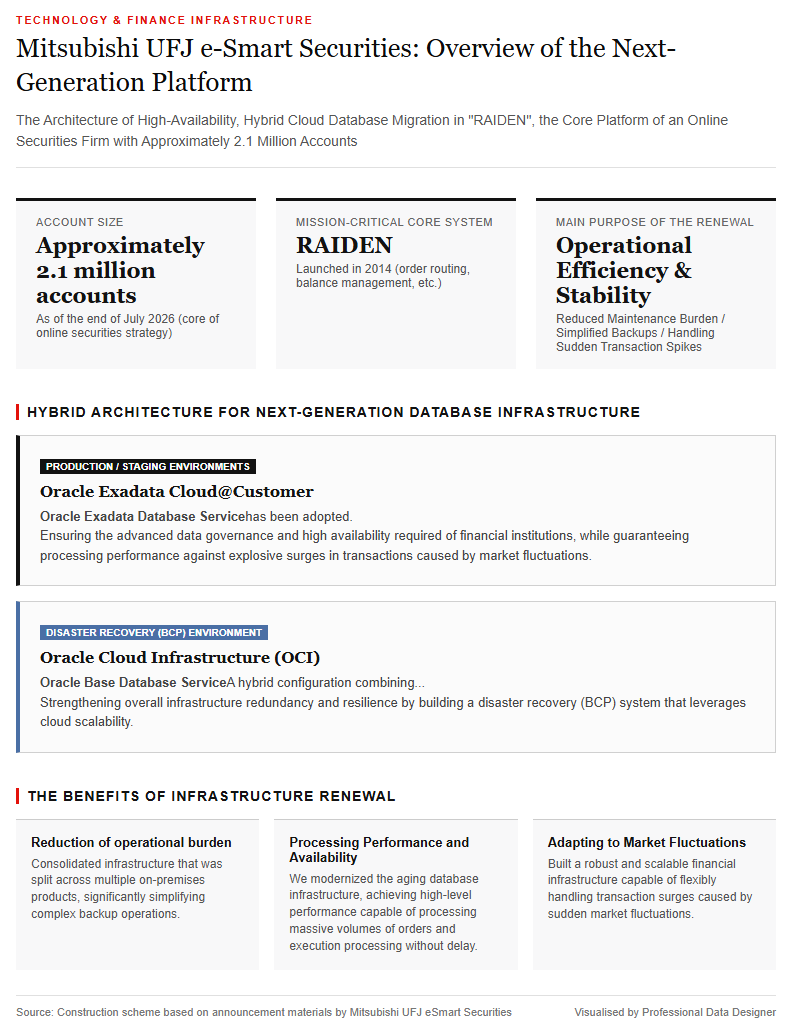
This configuration makes it possible to strictly retain highly confidential customer data within the company’s own data center while fully leveraging cloud-specific automation features such as patching and lifecycle management. The project is being advanced in strong collaboration with ASIST Co., Ltd., and following the delivery of equipment in May 2026, the plan is to complete the migration to the new platform by March 2027 through phased construction and testing. During the preliminary evaluation phase, consultants from Oracle Customer Success Services assisted with verification work (PoC) and architectural design. Furthermore, by thoroughly verifying impacts prior to production rollout using “Oracle Real Application Testing,” the project will achieve a stable transition and operational standardization.
Strengthening Group Infrastructure and Technical Approaches
Prior Performance and Group Synergies at MUFG Bank
Behind Mitsubishi UFJ eスマート証券’s decision to adopt this system lies a strong influence from precedents and technological synergies within the MUFG group. Mitsubishi UFJ Bank, Ltd., the core of the group, renewed the system infrastructure for “Mitsubishi UFJ Direct,” its personal internet banking service used by over 10 million people, using “Oracle Exadata Database Machine” and other technologies, with an announcement made in April 2025. In this project, for which Mitsubishi UFJ Information Technology was responsible for development, alongside responding to the end of support for legacy hardware, they succeeded in improving processing performance by approximately five times compared to conventional levels in anticipation of future transaction volume growth. The reasons for selecting Oracle products were high economic efficiency in 10-year cost estimations, the flexible scalability of CPU resources without the need to add physical equipment, and the reliability of “Oracle Maximum Availability Architecture (MAA)” which achieves high availability. The fact that the construction and operational track record in mission-critical, large-scale infrastructure at the bank was shared within the group served as a major factor in supporting the adoption of the Oracle infrastructure for the system renewal that underpins the online securities strategy.
Establishing Observability and System Visualization Initiatives
At Mitsubishi UFJ eSmart Securities, in parallel with strengthening its database infrastructure, the company has been advancing operational structure reforms aimed at preventing system failures and quickly identifying their root causes. The company has been fully deploying the observability platform “New Relic” since February 2024. Behind this initiative is a system failure in the smartphone application that occurred in 2023. At that time, when the failure occurred around 9:00 a.m. when access was concentrated, the conventional siloed, log-dependent monitoring took a long time to identify the cause of the failure within a system structure where various APIs are intricately intertwined. Based on this lesson, the company expanded its observation targets from the smartphone app to the investment information tool “kabu Station” and the corporate “kabu.com API”. The system’s operational status is visualized as shown in the following figure.
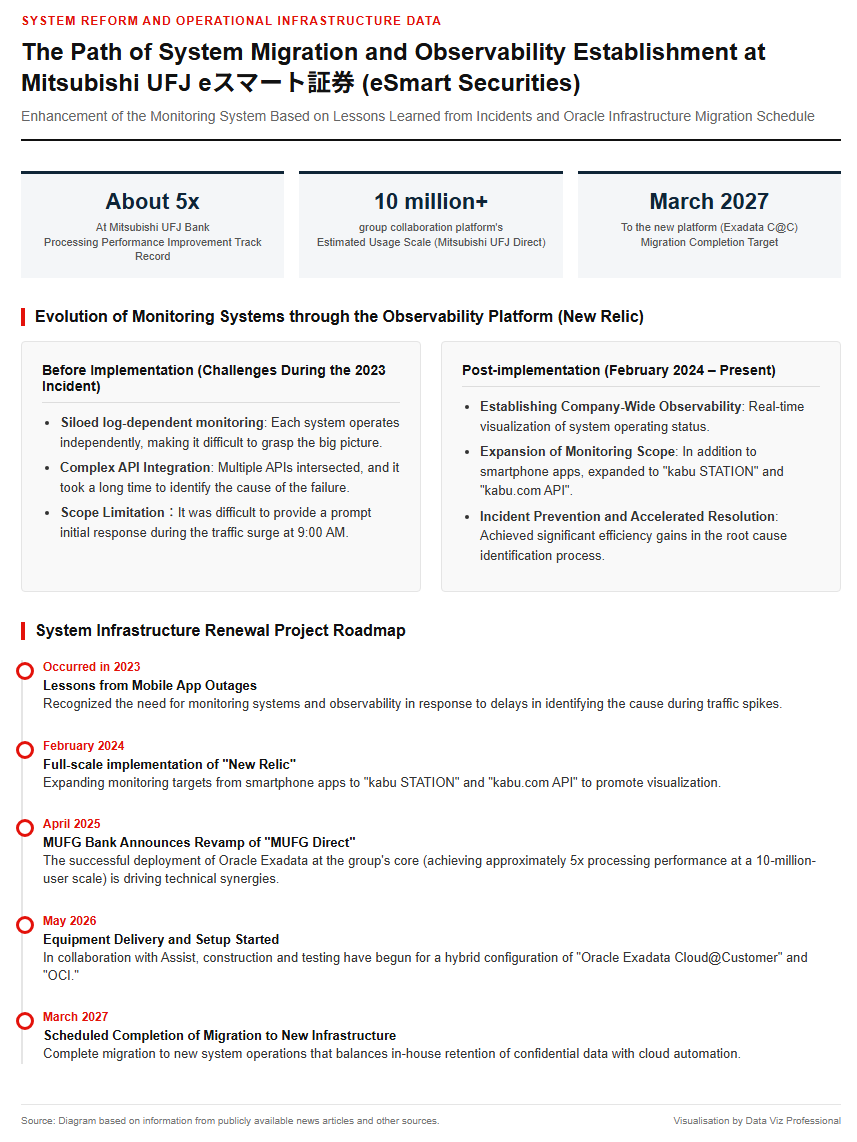
By establishing a system where all engineers can grasp status in real time on a common platform, system dependency on specific individuals has been eliminated, successfully transitioning from conventional mere resource monitoring to an observability setup that prioritizes user experience (UX).
Security Standards and Governance Required for Financial Institutions
As the adoption of cloud technologies and external services progresses, financial institutions are under strict pressure to implement advanced security measures and maintain governance. In particular, compliance with the “Security Guidelines on Computer Systems for Financial Institutions” issued by the Center for Financial Industry Information Systems (FISC) is an essential requirement in system development. In response to this, Mitsubishi Research Institute, Inc. (MRI) has published the “Security Reference for Cloud Services for Financial Institutions.” This reference thoroughly verifies and organizes the compliance status of Oracle Corporation’s “Oracle Cloud Infrastructure (OCI)” across all items of the FISC security guidelines, including control standards, practice standards, facility standards, and audit standards. This allows financial institutions to confirm in advance through objective data that the necessary security levels and internal controls are guaranteed when adopting OCI. By combining it with “Exadata Cloud@Customer,” which keeps data within the organization’s own data center, a secure environment is established that incorporates the latest cloud features while meeting the highest standards of governance requirements.
Financial IT Resilience and Key Focus Areas Moving Forward
Measures Against System Failure Risks as Seen in the Financial Services Agency’s Analysis Report
As reliance on digital technology grows across the entire financial industry, improving IT resilience (fault tolerance and recovery capability) has become a top management priority. According to the “Analysis Report on IT Resilience in the Financial Sector” (July 2026) compiled by the Financial Services Agency (FSA), approximately 70% of the roughly 1,600 system failures reported by financial institutions in fiscal 2025 were attributed to “software failures” and “management and human factors.” Particularly during system integrations and large-scale system overhauls, there are frequent cases where bugs are overlooked due to misalignments in understanding among stakeholders caused by complex specifications, or a lack of comprehensive impact-free verification testing, which subsequently cascades into major failures after release. Operating on the premise that failures can occur even despite preventive measures, the FSA strongly urges the strengthening of pre-implementation testing frameworks and escalation systems. In the core system renewal of Mitsubishi UFJ e-Smart Securities as well, thoroughly conducting pre-validation using “Oracle Real Application Testing” prior to production deployment and enforcing proper change management will be key to preventing issues before they happen.
Future Outlook and Key Points to Watch Toward the Completion of the Migration by March 2027
The modernization of the core securities system at Mitsubishi UFJ e-Smart Securities will be implemented in phases, following the delivery of “Oracle Exadata Cloud@Customer” in May 2026, targeting completion of the cutover in March 2027. Once the new infrastructure is operational, the automation of lifecycle management—including patch application—and the standardization of operations will progress, significantly reducing the workload on the IT department and creating an environment where staff can focus on higher-value-added service improvements and the development of new features. Furthermore, by establishing a framework that can flexibly and instantly scale processing capacity even amidst market volatility and sudden spikes in trading volume, it will be possible to consistently provide a stable trading environment for users representing approximately 2.1 million accounts. At a time when the financial industry is required to balance the adoption of cloud technology with high robustness, the results of this project, which underpins the MUFG Group’s online securities strategy, are attracting widespread attention for their future trajectory as an advanced model of financial digital transformation (DX).
Reference page
- [Oracle Japan News Release] Mitsubishi UFJ eスマート Securities Adopts Oracle Exadata Cloud@Customer for Core Securities System Modernization
Mitsubishi UFJ eSmart Securities Modernizes Core Brokerage Systems with Oracle Database Services - 【Oracle Japan News Release】MUFG Bank Partners with Oracle to Build Next-Generation Infrastructure for MUFG Direct
Mitsubishi UFJ Bank Collaborates with Oracle to Build Next-Generation Platform - [Financial Services Agency] Analysis Report on IT Resilience in the Financial Sector (July 2026)
[suspicious link removed]
【#MitsubishiUFJeSmartSecurities #Oracle #Exadata #FinancialIT #DigitalTransformation #SystemModernization #MUFG】
コメント