On October 21, 2026, at GTC Berlin in Berlin, Germany, NVIDIA announced a major expansion of its general-purpose robotics development platform, “NVIDIA Isaac,” along with a new reference humanoid, “Agile ONE SN.” Aiming to drive the societal deployment of physical AI capable of making advanced decisions and performing tasks in real-world physical spaces, the entire workflow from simulation to physical deployment has been revamped.
- A New Phase of Robotics Shown at GTC Berlin
- Robot Learning Platform Isaac Lab 3.0 and Control System Isaac OS
- System Architecture Centered on Jetson Thor and GR00T
- Integration of 20-DOF Hand and Halos Safety Platform
- Human 1M Dataset and Synthetic Data Generation Workflow
- Hiring and Outlook at Major European Robotics Companies
A New Phase of Robotics Shown at GTC Berlin
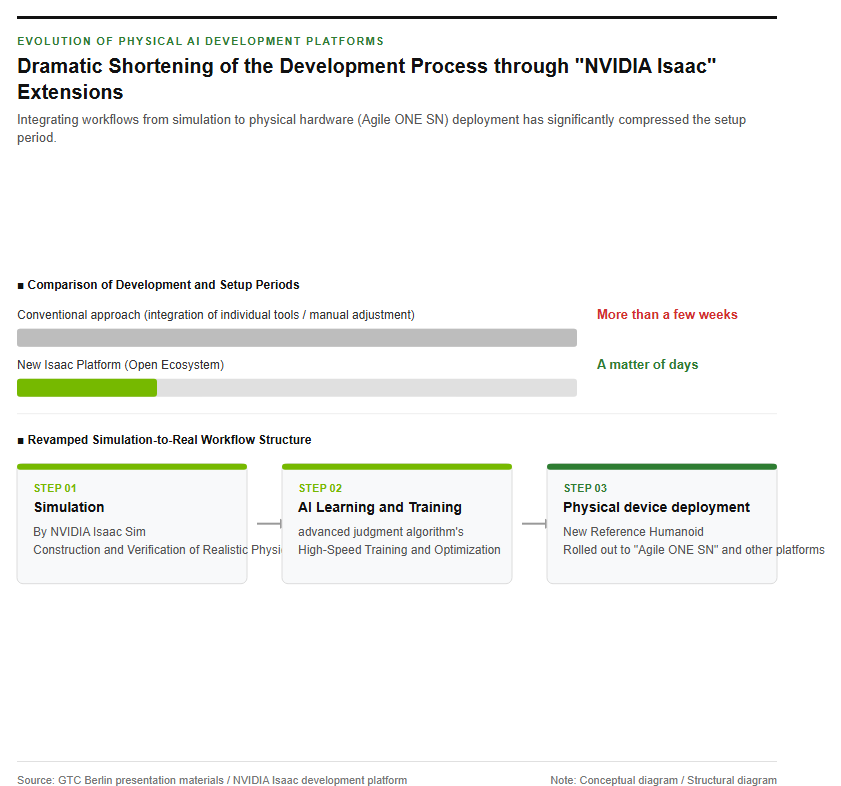
The expansion of the NVIDIA Isaac development platform, announced on October 21, 2026, marked a significant milestone in elevating artificial intelligence from the digital space into physical AI operating in the real world. Founder and CEO Jensen Huang has noted that a “ChatGPT moment” for general-purpose robotics is rapidly approaching. Until now, robot developers required weeks or more of trial and error to integrate disparate toolsets such as simulation, AI training, and deployment on actual hardware. With this foundational expansion, the goal is to encompass these development processes into a single open ecosystem, reducing setup times to a matter of days. Infrastructure development is now underway in earnest to accelerate the adoption of humanoid robots in the world’s largest industrial sectors, including automotive manufacturing, logistics, and medical fields. As the overall picture below demonstrates, a development environment where hardware and software are advancedly integrated has been realized.
Robot Learning Platform Isaac Lab 3.0 and Control System Isaac OS
The technical core of this announcement is the general availability of the open-source learning framework Isaac Lab 3.0 and the introduction of Isaac OS, a new runtime environment. Isaac Lab 3.0 supports multi-GPU workflows and leverages high-performance physics engines such as Newton and NVIDIA PhysX to train and refine robot policies from desktop to data center scales. Meanwhile, Isaac OS is built on NVIDIA Holoscan, connecting AI models, sensor inputs, control systems, and robot hardware. A major feature is its ability to ensure the deterministic real-time performance that has traditionally been a challenge during the transition from simulation to real-world robots. Furthermore, reference workflows to support reinforcement learning and the learning of dexterous object manipulation skills have also been released.
The Complete Overview of the New Reference Humanoid Agile ONE SN
System Architecture Centered on Jetson Thor and GR00T
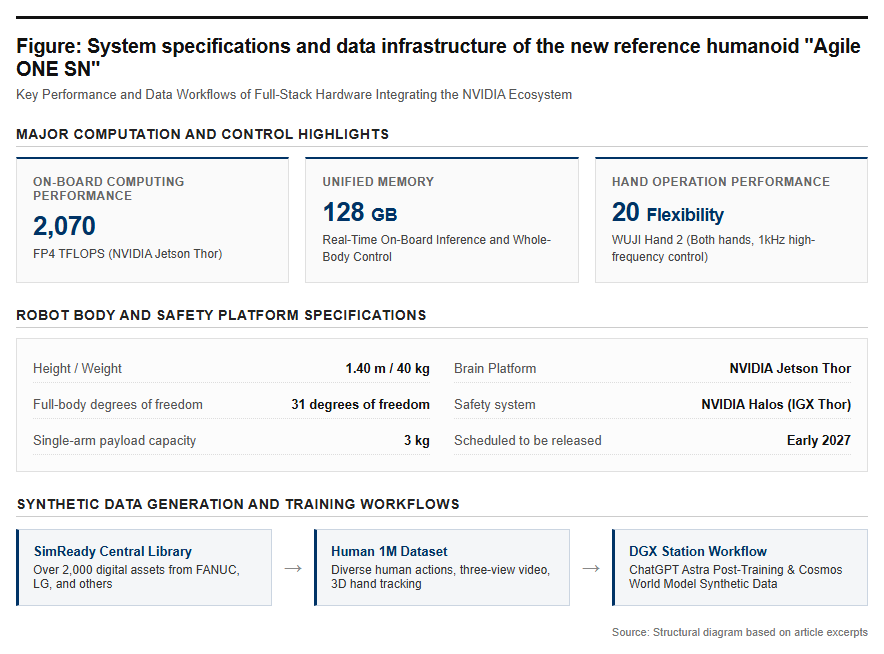
Developed in integration with the NVIDIA ecosystem, the Agile ONE SN is a full-stack humanoid reference platform developed by Agile Robots. Standing 1.40 meters tall and weighing 40 kilograms, the robot features 31 degrees of freedom throughout its entire body. With a payload capacity of 3 kilograms per arm, it can smoothly perform tasks in environments designed for humans, such as factories and laboratories. For its brain, it is equipped onboard with the NVIDIA Jetson Thor, a state-of-the-art edge AI platform. Jetson Thor delivers 2,070 FP4 TFLOPS of compute performance and 128GB of unified memory, enabling real-time onboard inference and whole-body control without relying on the cloud. Because the NVIDIA Isaac GR00T foundation model is pre-configured out of the box, researchers can utilize cutting-edge foundation models immediately upon deployment.
Integration of 20-DOF Hand and Halos Safety Platform
Symbolizing the operability of the Agile ONE SN are the five-fingered hands called WUJI Hand 2 mounted on both arms. Each hand features 20 degrees of freedom and supports high-frequency 1kHz force control and tactile sensing. This enables highly dexterous tasks such as precision parts assembly and the grasping of fragile objects. In addition, as multimodal sensing, it comes standard with cameras on the head and wrists, LiDAR, and an inertial measurement unit (IMU), enhancing its spatial awareness of the surroundings. On the safety front, integration with NVIDIA Halos, an integrated safety system based on NVIDIA IGX Thor, is planned. It is designed to maintain advanced safety protocols even in harsh industrial environments and human-coexistence areas, attracting high interest from research institutions such as Stanford University and ETH Zurich ahead of its scheduled launch in early 2027.
Expanding Data Infrastructure and Its Ripple Effects on European Industry
Human 1M Dataset and Synthetic Data Generation Workflow
Large-scale and high-quality datasets are essential for improving the accuracy of AI models that operate in the real world. NVIDIA has released the SimReady Central Library, a collection of simulation-ready assets, on Hugging Face, making over 2,000 digital assets provided by FANUC, Universal Robots, LG Electronics, and others available for use. Additionally, the Human 1M Dataset, which includes diverse human actions, synchronized three-view video, and 3D hand tracking, has been released simultaneously. Furthermore, three open-source workflows running on NVIDIA DGX Station are provided, accelerating post-training utilizing ChatGPT Astra and synthetic data generation via the Cosmos world model. The training process utilizing synthetic data generation and world models is as shown in the image below.
Hiring and Outlook at Major European Robotics Companies
Following this foundation reinforcement, momentum toward implementation is rapidly expanding across global industries, particularly in Europe. ABB Robotics has integrated the NVIDIA Omniverse libraries into its RobotStudio HyperReality, enabling pre-installation simulation and virtual commissioning. The KUKA Group is also utilizing them for real-time factory rendering, while Sereact is applying Isaac GR00T to train moving-object handling models on Universal Robots’ industrial arms. Furthermore, deployment into the logistics and service sectors is progressing, such as Bellboy’s operation of “Billie” delivery robots in hotels including Marriott and Hilton, and the building of autonomous transport solutions at Toyota Material Handling Europe. The societal implementation of physical AI has moved beyond the mere research stage and entered an accelerated phase of practical application.
Reference Page
- [NVIDIA Press Release] https://nvidianews.nvidia.com/news/nvidia-advances-isaac-platform-for-general-purpose-robotics-with-new-reference-humanoid-frameworks-simulation-pipelines-and-data
- [NVIDIA Japan Blog] https://blogs.nvidia.co.jp/blog/nvidia-advances-isaac-platform-for-general-purpose-robotics-with-new-reference-humanoid-frameworks-simulation-pipelines-and-data/
- [NVIDIA Developer Isaac Platform] https://developer.nvidia.com/isaac
- Hugging Face SimReady Central
【#NVIDIA #Isaac #PhysicalAI #Humanoid #JetsonThor #Robotics #GTCBerlin】


コメント