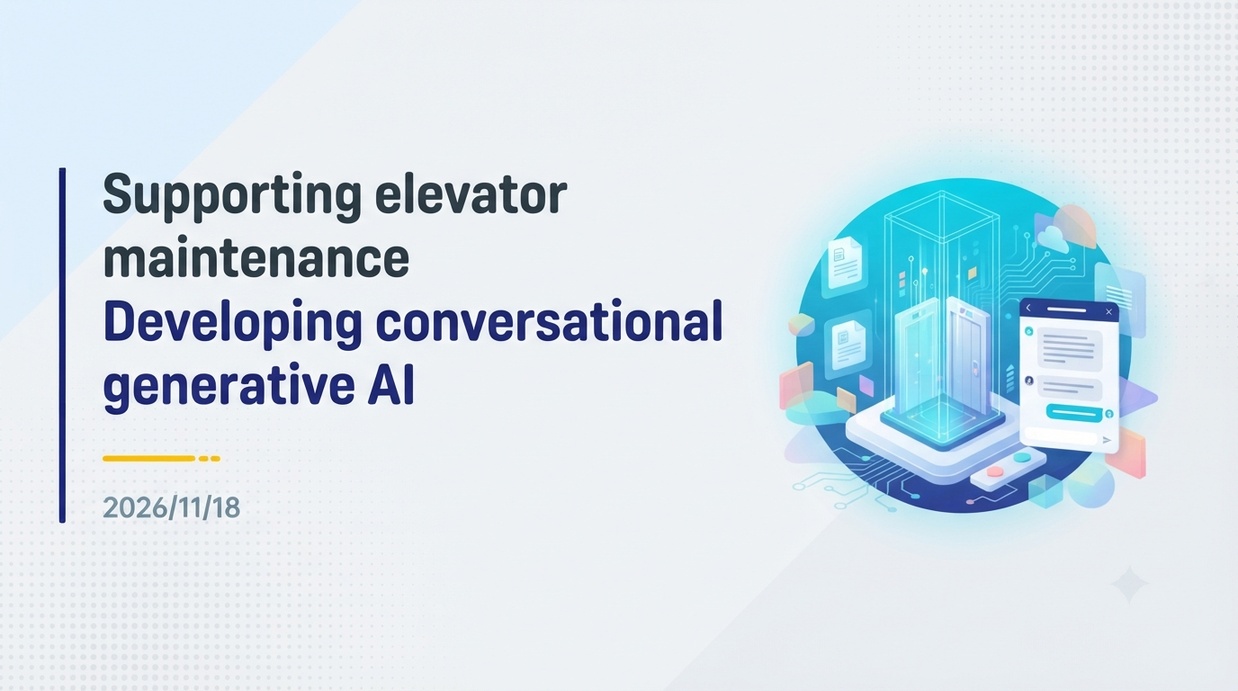
On November 18, 2026, Mitsubishi Electric Building Solutions announced the development of the “Field Engineer Support App,” an interactive generative AI designed to assist elevator maintenance technicians with their work and training. This development comes against the backdrop of a labor shortage in the building maintenance industry driven by a decreasing number of skilled technicians and the “2024 Problem,” creating an urgent need to pass down tacit knowledge and improve operational efficiency in the field.
- An AI App That Instantly Summarizes and Searches 150,000 Pages of Technical Documents
- A Frontline-Led DX Strategy Integrating Explicit and Tacit Knowledge
- 4-Step Dialogue Flow from Question to Answer and Source Verification
- A system that balances reducing on-site work hours with accident prevention
- The Limits of Maintenance Systems Threatened by the Aging of Skilled Technicians and the “2024 Problem”
- Evolution from CBM Threshold Monitoring to AI Predictive Detection and Interactive Support
- Phased AI advancement from Phase 1 to Phase 3
- Expanding the Scope to All Maintenance Operations and Responsible Management in the Smart Building Era
An AI App That Instantly Summarizes and Searches 150,000 Pages of Technical Documents
On November 18, 2026, Mitsubishi Electric Building Solutions Corporation announced the development of the “Field Engineer Support App” designed for technicians engaged in the maintenance and inspection of elevators, escalators, and other vertical transportation systems. Built upon ITOCHU Techno-Solutions’ document management system, the new system integrates Retrieval-Augmented Generation (RAG) technology with generative AI. The AI instantly searches and summarizes a massive volume of approximately 150,000 pages of technical documents and manuals related to elevators, providing appropriate answers in a conversational format to inquiries made by technicians from their PCs, smartphones, or tablets.
The app is scheduled to be rolled out sequentially in actual elevator maintenance and inspection operations starting in December 2026. Because on-site technicians can search and check work procedures, numerical standards, and safety precautions on the spot, it will significantly reduce the time previously spent searching through vast technical materials. The system is designed to clearly display links to the source documents on which the answers are based, strongly supporting reliable operational decision-making in building infrastructure maintenance and management, where high safety and precision are strictly required.
A Frontline-Led DX Strategy Integrating Explicit and Tacit Knowledge
In the building equipment maintenance industry, while digital transformation is progressing through the introduction of remote monitoring and IoT technologies, the know-how and judgment of experienced technicians in on-site equipment maintenance and troubleshooting play an extremely crucial role. How to pass on not only the codified “explicit knowledge” found in manuals, but also the “tacit knowledge” cultivated by veteran engineers through years of experience to younger generations has been a major challenge for the industry as a whole. Mitsubishi Electric Building Solutions’ initiative is an attempt to convert advanced judgment criteria and work tips—which have traditionally tended to be person-dependent—into data, elevating them into company-wide shareable knowledge through generative AI. By having the AI provide advice based on expert wisdom in response to questions technicians face on-site, the company is establishing an environment where everyone from junior to veteran staff can consistently maintain a high standard of work quality. By combining automation through digital technology and the strengths of human on-site work as dual pillars, the company aims to achieve faster maintenance response and improved quality, thereby building a sustainable maintenance system.
System Architecture for Streamlining On-Site Operations and Ensuring Safety
4-Step Dialogue Flow from Question to Answer and Source Verification
The utilization flow of this application consists of four steps tailored to actual on-site work practices. In the first step, after arriving at the site or before starting work, technicians input the work details and confirmation items from their devices. The AI suggests necessary tools and parts, and notifies them of safety precautions based on past accident cases. In the second step, when it becomes necessary to query various adjustment reference values or procedures during work, technicians ask the AI questions in an interactive format. The AI instantly searches for relevant technical documents and outputs a summarized answer, allowing technicians to smoothly transition to the next process without interrupting their workflow. As a third step, links to the source technical documents are always attached to the presented answers. As shown in the flowchart below, the system is designed to prevent misidentification and ensure reliable judgment by having technicians visually check the reference materials on the spot.
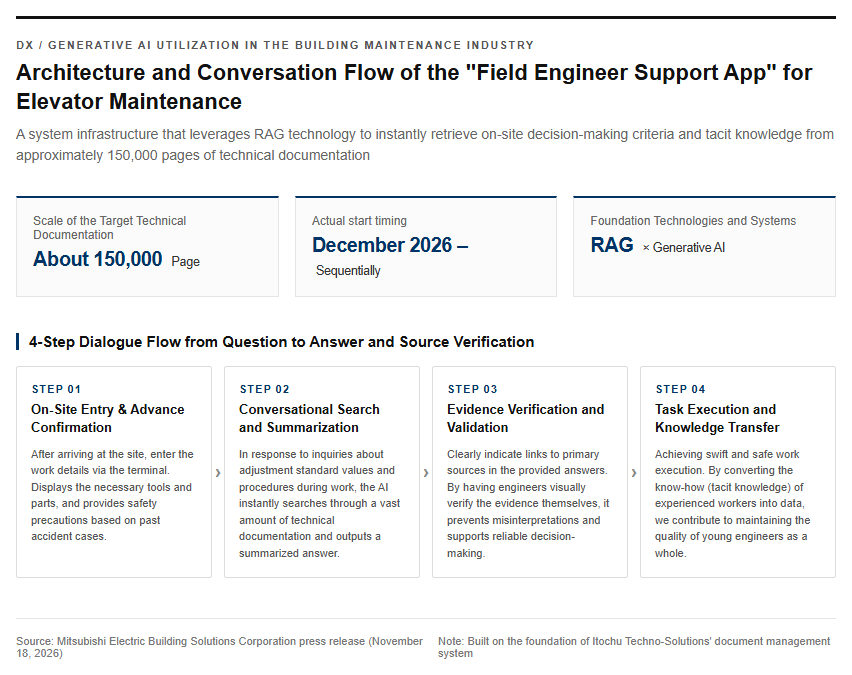
In the fourth step, feedback from the field is accumulated and analyzed to continuously improve the accuracy of the AI’s responses, while frequently inquired items are incorporated into the internal training curriculum.
A system that balances reducing on-site work hours with accident prevention
In elevator maintenance and inspection, there are numerous tasks that, if mishandled even slightly, can lead to serious personal injury or equipment failure, such as adjustment work requiring millimeter-level precision and checking electrical circuits carrying high voltage. In conventional work environments, when questions arose, workers had to search through thick paper manuals or PDF files page by page, raising concerns about compressed working hours and the risk of overlooked checks. The introduction of a field engineer support app enables access to essential information—such as complex standard values, wiring diagrams, and replacement procedures—in a matter of seconds, drastically reducing preparation and verification time. Furthermore, by proactively presenting risk alerts based on past accident data and previous failures, the app is expected to help prevent occupational accidents caused by operator oversight or lack of awareness. Even inexperienced junior engineers can perform tasks with the same level of safety awareness and precision as veterans, thanks to accurate AI guidance and clear reference materials, substantially improving overall on-site work safety and productivity.
Challenges Facing the Industry and Technological Developments in Remote Monitoring and Generative AI
The Limits of Maintenance Systems Threatened by the Aging of Skilled Technicians and the “2024 Problem”
In the building maintenance and elevator inspection sectors, a severe labor shortage continues, driven by the aging of skilled certified inspectors and the difficulty of recruiting younger generations. Furthermore, with the application of the so-called “2024 Problem”—brought about by the introduction of caps on overtime work under the Work Style Reform Act—the conventional labor-intensive routine inspection model, which relies on emergency callouts on nights and weekends and time-consuming travel, is reaching its limits. Although the number of installed elevators is increasing year by year alongside the growth in the number of buildings in Japan, the supply of field engineers in charge of maintenance is failing to keep pace. In 2016, the Ministry of Land, Infrastructure, Transport and Tourism (MLIT) also reviewed the operation of the periodic inspection reporting system, indicating a policy to allow a reduction in the frequency of manned inspections under conditions such as the introduction of remote monitoring devices. Fundamentally shifting the maintenance model from the traditional style of “human personnel visiting the site every month for inspections” to continuous monitoring using IoT communications and sensors, as well as the utilization of digital tools, has become an urgent challenge to maintain the operation of elevators as social infrastructure.
Evolution from CBM Threshold Monitoring to AI Predictive Detection and Interactive Support
Traditional remote monitoring systems have predominantly relied on “threshold monitoring,” which triggers alerts when equipment temperature or vibration exceeds specific values. However, in many cases, by the time the threshold is crossed, components have already degraded or been significantly damaged, making it difficult to completely prevent sudden equipment shutdowns or emergency dispatches. The latest maintenance technology has evolved into “AI predictive detection,” which analyzes multiple sensor data streams and minute current fluctuations using machine learning to capture future signs of anomalies even while they are still within the normal range. As shown in the conceptual diagram below, the industry is transitioning from reactive maintenance—repairing after an anomaly occurs—to predictive maintenance that prevents failures before they happen.
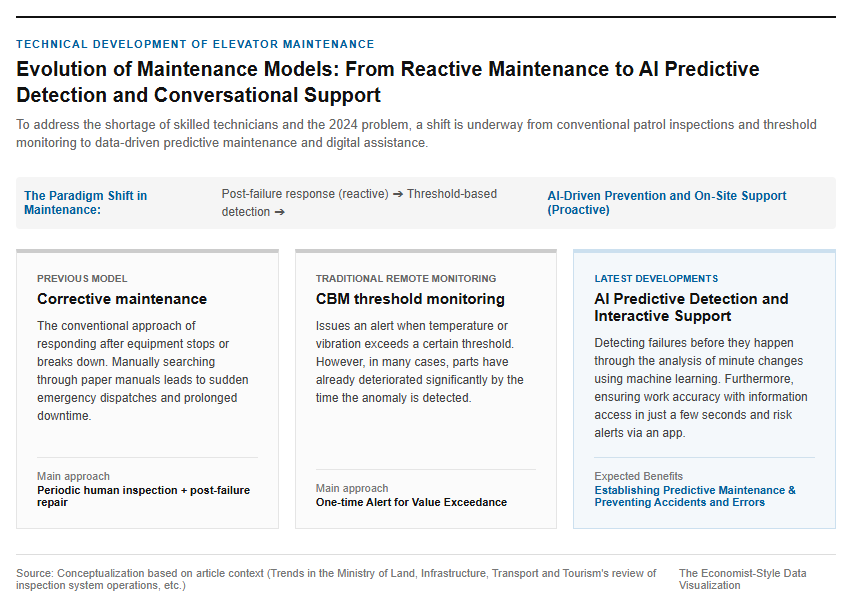
The newly developed interactive generative AI app links with this predictive detection data and real-time monitoring data to suggest to technicians in an interactive format “which parts should be adjusted or replaced and when.” By digitalizing and presenting the anomalies and decision-making know-how that veteran technicians used to perceive through their five senses, the system minimizes downtime caused by emergency stops and establishes a framework that guarantees the safe operation of buildings at a high level.
Future Development Roadmap and Future Outlook for the Building Management Industry
Phased AI advancement from Phase 1 to Phase 3
The development of the “field engineer support app” by Mitsubishi Electric Building Solutions is planned to be carried out in three phased stages. In Phase 1, scheduled to begin in December 2026, basic features centered on searching approximately 150,000 pages of technical documentation and confirming procedures will be implemented. In Phase 2, slated for the first half of fiscal 2027, alongside AI-powered technical document summarization, a system will be built to digitize specific decision-making points and work techniques held by veteran engineers so they can be searched and utilized. Furthermore, in Phase 3 during the second half of fiscal 2027, the app is scheduled to evolve into an advanced “AI agent” that comprehensively analyzes past troubleshooting cases and expert know-how. At this stage, the AI will proactively suggest the next tasks to be performed, provide risk detection and context-aware decision support, and implement an interactive OJT (on-the-job training) feature to dramatically accelerate the training period and skills transfer for younger engineers.
Expanding the Scope to All Maintenance Operations and Responsible Management in the Smart Building Era
The application scope of the support app is expected to expand progressively, moving from initial elevator maintenance to air-conditioning equipment and general building management systems. As overall building management shifts toward data-driven operations, the importance of legal liability and compliance management in maintenance tasks involving AI and automated systems is also growing. Deliberations within study groups at the Digital Agency and the Ministry of Internal Affairs and Communications are similarly advancing the development of frameworks for accident liability and agile governance in the AI era, requiring companies to retain system operation logs and ensure explainability. The design philosophy of this app, which clearly presents the reference materials for AI-generated answers, can be considered an extremely rational approach from the standpoint of preventing erroneous judgments caused by AI hallucinations and preparing for legal risks and product liability. Establishing a system in which humans and AI appropriately divide their roles—with engineers retaining ultimate decision-making responsibility while receiving advanced support—will likely serve as the standard model for sustainable and safe building infrastructure operations in the coming smart building era.
Reference page
- [Mitsubishi Electric Building Solutions News Release] https://www.mebs.co.jp/press/261118.html
- [PR TIMES Press Release] [suspicious link removed]
- [Digital Agency: Demonstration of Regular Equipment Status Inspection] https://www.digital.go.jp/policies/digital-extraordinary-administrative-research-committee/technology-verification/type4
[#ElevatorMaintenance #GenerativeAI #FieldEngineer #MitsubishiElectricBuildingSolutions #DX #PredictiveMaintenance]
コメント