
European cloud giant OVHcloud has announced its first-ever open-source Large Language Model (LLM), “Olala mini 7A1B.” It is attracting worldwide attention as a move aimed at countering the US-dominated AI market, establishing data sovereignty in Europe, and achieving low-cost local inference.
- Overview of the Announcement and Basic Specifications of the Small, High-Performance Model Olala mini 7A1B
- The Technical Breakthrough of 8GB Memory-Driven Operation Enabled by Hybrid Attention and MoE
- Synergy of Utilizing €7 Million in Public Computing Resources and Acquiring Dragon LLM
- Operational Track Record on the Qwant Search Engine and Reduction of Inference Costs to One-Third
- Strengthening Governance through Countermeasures against the US CLOUD Act and Inclusion of EU AI Act-Compliant Documentation
- Roadmap to v1.1 and v2.0 and the Future of the European AI Market
Overview of the Announcement and Basic Specifications of the Small, High-Performance Model Olala mini 7A1B
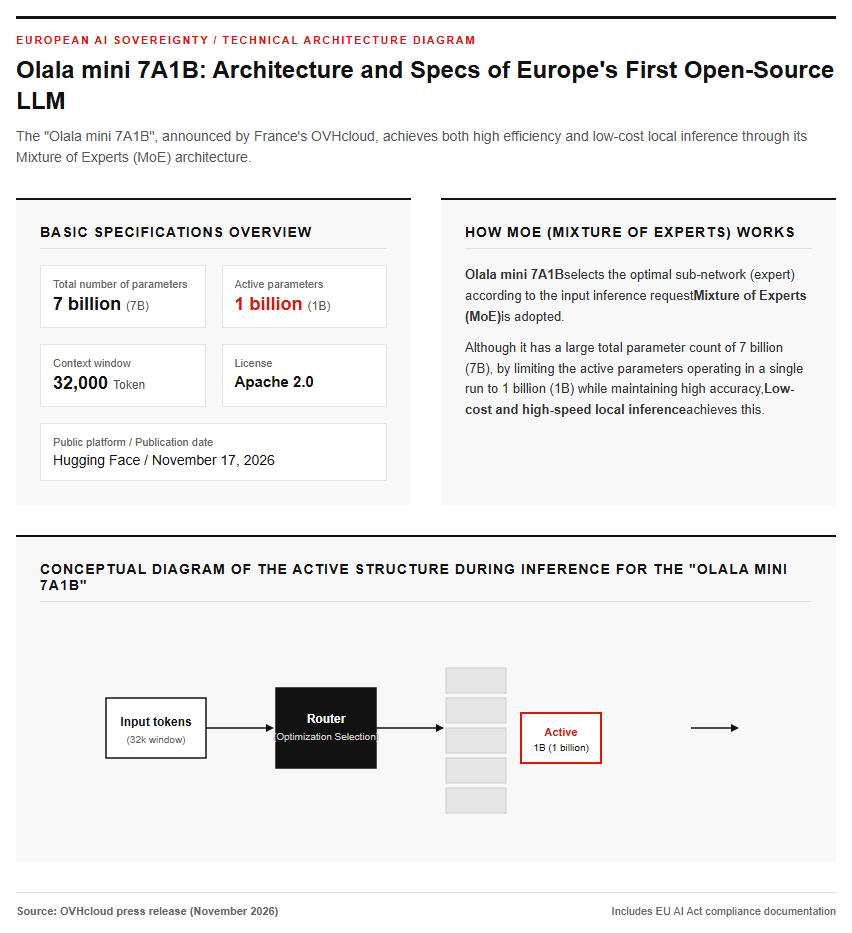
On November 17, 2026, French cloud provider OVHcloud (headquartered in Roubaix) announced its first LLM family, “Olala,” and its inaugural model, “Olala mini 7A1B.” Despite having a total parameter count of 7 billion (7B), this model adopts a compact Mixture of Experts (MoE) architecture that limits the active parameters operating per inference request to 1 billion (1B). Licensed under Apache 2.0, it is made freely available as open source on Hugging Face, along with model weights, a pre-trained base model, a technical report, and EU AI Act compliance documentation. The context window supports 32,000 tokens by default. The most significant takeaway is that it demonstrates the capability of European companies to build and operate models from scratch on their own, without relying on proprietary models provided by U.S. tech giants. The following diagram illustrates the basic structure of Olala mini 7A1B.
The Technical Breakthrough of 8GB Memory-Driven Operation Enabled by Hybrid Attention and MoE
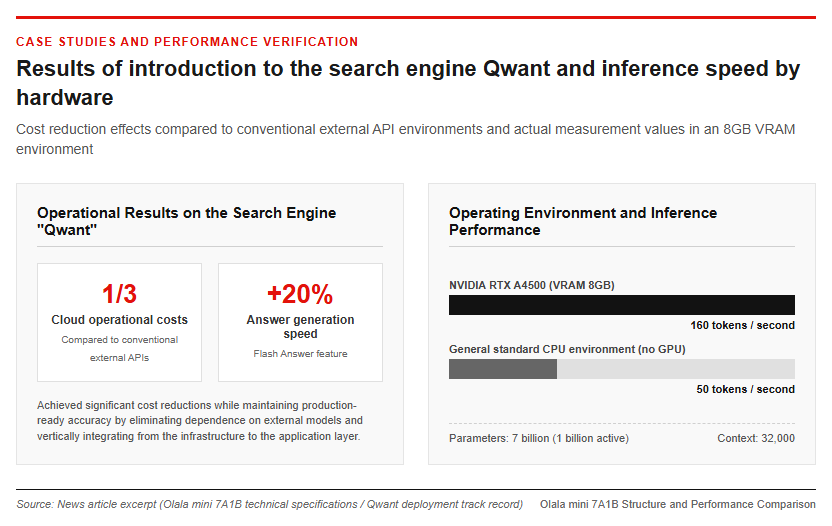
The greatest innovation in the technical architecture of the Olala mini 7A1B lies in its adoption of an MoE structure with 256 experts placed in each layer of the network and a proprietary hybrid attention mechanism. The attention layers incorporate Differential-TPA, a Transformer derivative technology, and Mamba-3, a type of state space model (SSM), while BF16 is used as the numerical format. Through this design, significant reductions in model size and increases in processing speed have been achieved compared to conventional models of the same scale. Specifically, it is capable of operating in a GPU environment equipped with a mere 8GB of VRAM, and records an output speed of 160 tokens per second on the NVIDIA RTX A4500 workstation GPU. Furthermore, even in a typical standard CPU environment without a GPU, it can maintain an inference speed of 50 tokens per second, making it possible to securely run local operations on in-house servers or edge devices without making special infrastructure investments.
Training on European Supercomputers and Practical Outcomes for Industry and Society
Synergy of Utilizing €7 Million in Public Computing Resources and Acquiring Dragon LLM
Pre-training of Olala mini 7A1B was conducted under the European Union’s (EU) public funding framework on three of Europe’s most advanced supercomputers: “Jupiter” (Germany), “MeluXina” (Luxembourg), and “Jean Zay” (France). These supercomputers are equipped with high-performance GPUs such as the NVIDIA GH200, A100, and H100, and the provided computing time is equivalent to approximately 7 million euros. Against the backdrop of the success of this public initiative, a specialized research organization, “OVHai LLM Agentic Lab,” was established within OVHcloud. The lab has been joined by the engineering team from Dragon LLM (formerly Lingua Custodia), a French AI startup acquired by OVHcloud in March 2026. By integrating Dragon LLM’s fine-tuning technology—which has a proven track record in machine translation and domain-specific LLM development for the financial sector—a vertically integrated system has been established, spanning from infrastructure construction to the application layer of model development and operation.
Operational Track Record on the Qwant Search Engine and Reduction of Inference Costs to One-Third
The practical results of this model have already been demonstrated in actual European service environments. Qwant, a privacy-focused search engine originating in France, adopted Olala mini 7A1B as the backend for its “Flash Answer” feature, which instantly generates responses. As a result of the implementation, response generation speed improved by 20% compared to environments using conventional external APIs or large-scale models, while cloud operating costs were reduced to one-third. By achieving both accuracy and speed capable of withstanding practical use despite its lightweight design of 7 billion parameters (1 billion active), it presents an extremely realistic cost-reduction option for companies suffering from skyrocketing expenses due to API pay-as-you-go pricing, as well as financial and medical institutions that cannot transmit internal data externally. Please refer to the comparison chart below.
Future Prospects for EU AI Act Compliance and European AI Sovereignty
Strengthening Governance through Countermeasures against the US CLOUD Act and Inclusion of EU AI Act-Compliant Documentation
Behind OVHcloud’s AI strategy lie the pressing challenges of a stringent regulatory environment and the protection of data sovereignty in Europe. The US CLOUD Act grants US authorities access rights even to data stored in overseas data centers by major US cloud providers, which has been pointed out as creating a legal contradiction with the GDPR (General Data Protection Regulation). In contrast, OVHcloud, with its entirely European capital, provides a sovereign cloud that guarantees the legal sovereignty of data. Furthermore, anticipating the comprehensive regulations of the “EU AI Act,” which entered into force in August 2024 and will be fully applicable from August 2026, Olala mini comes bundled from the start with compliance documentation proving risk assessment and traceability. Companies can safely deploy AI agents while avoiding the risk of legal violations and massive fines reaching up to 35 million euros (or 7% of global turnover).
Roadmap to v1.1 and v2.0 and the Future of the European AI Market
As part of its future roadmap, OVHcloud has explicitly stated its commitment to continuous feature expansion and the development of large-scale models. Scheduled for release by the end of 2026, Version 1.1 will significantly expand the context window to 128,000 tokens and enhance mathematical reasoning capabilities. Furthermore, the next-generation Version 2.0 plans to scale up to a parameter size exceeding 100 billion (100B). With v2.0, the company plans to focus heavily on three areas: “OVHai Workspace,” a business AI agent operated with encryption on local devices; cloud DevOps automation tools; and specialized cybersecurity models covering both defensive and offensive capabilities. Backed by a dramatic plunge in model training costs over the past three years—dropping to roughly one-twentieth (from about 1 billion euros to under 200 million euros)—OVHcloud is poised to strongly drive the creation of a sovereign and sustainable AI ecosystem as Europe’s second advanced LLM developer, following Mistral AI.
Reference Page
- 【OVHcloud Official Press Release: OVH announces Olala mini 7A1B】https://corporate.ovhcloud.com/en/newsroom/news/ovh-olala-mini/
【#OVHcloud #OlalaMini #OpenSourceLLM #AISovereignty #EUAIAct #MoE #LocalAI #SovereignCloud】

コメント