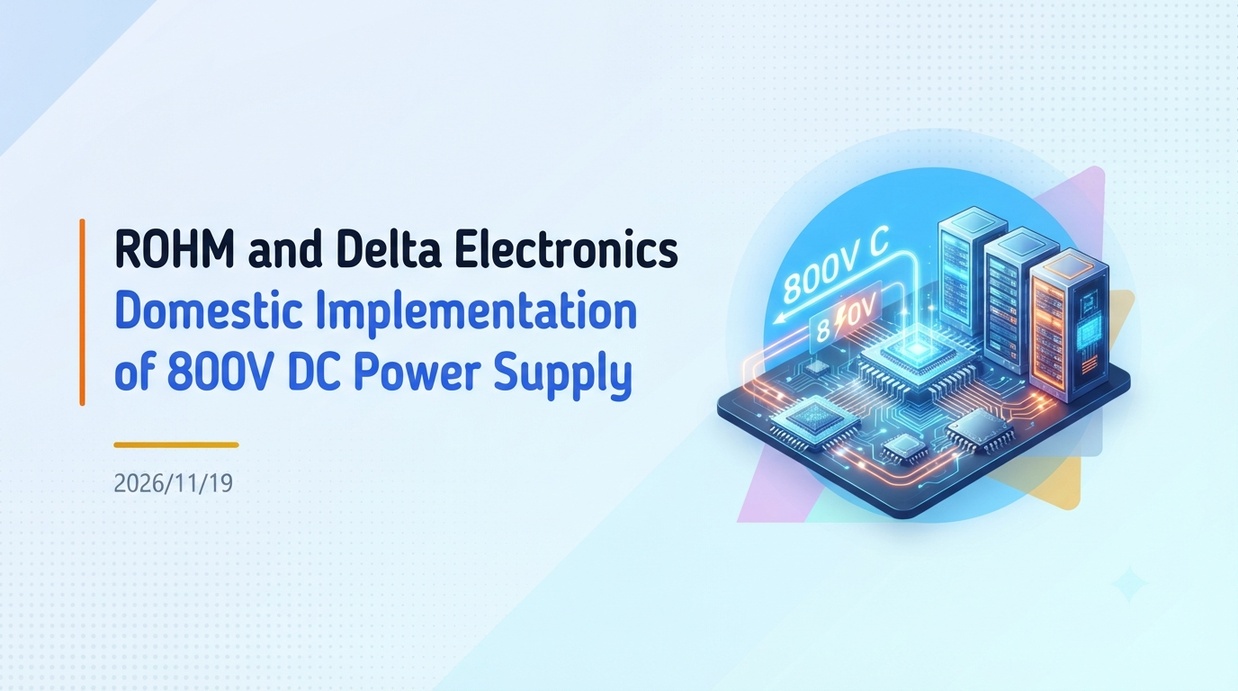
Major semiconductor manufacturer ROHM and major power system provider Delta Electronics have signed a basic agreement toward the societal implementation of an 800V direct current (800VDC) power supply solution for AI data centers in Japan. Behind this move is the explosive surge in power demand accompanying the widespread adoption of generative AI, alongside the physical limitations confronting conventional power supply architectures.
- Key Points of the Basic Agreement Toward the Practical Implementation of 800VDC
- Power Challenges of the “1MW Rack Era” in AI Data Centers
- Coexistence of SiC, GaN, and Si and Power Architecture Optimization
- Domestic Legal Regulation “The 750V Barrier” and the Roadmap for Demonstration Experiments
- Addressing Shorter Development Cycles and Decarbonizing Manufacturing Sites
- Future Developments and Key Points to Watch in Next-Generation AI Infrastructure
Key Points of the Basic Agreement Toward the Practical Implementation of 800VDC
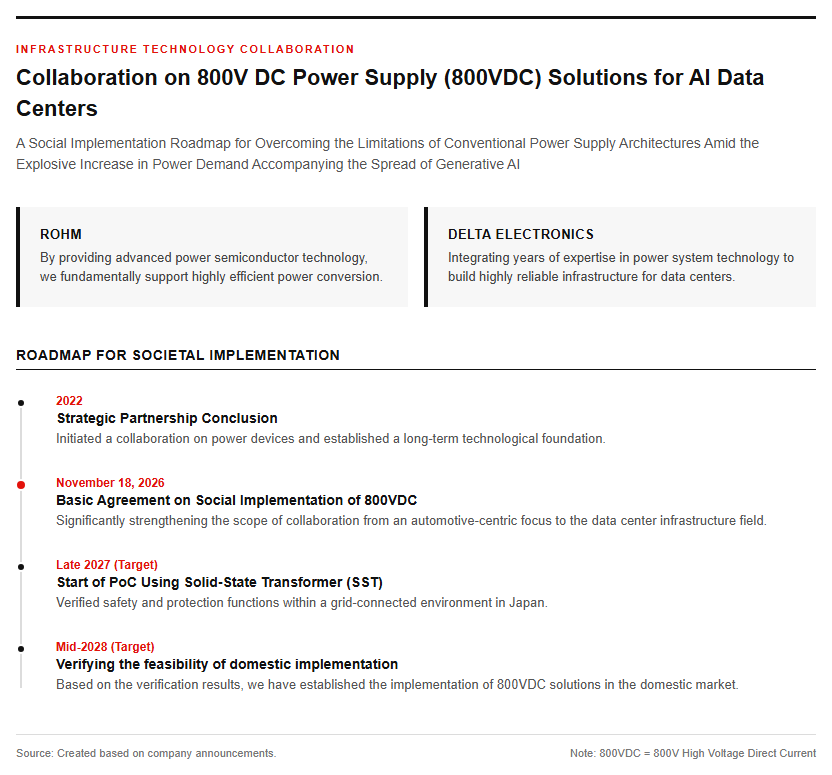
On November 18, 2026, Delta Electronics and ROHM announced that they have signed a basic agreement regarding the practical implementation of an 800V high-voltage direct current (800VDC) power supply solution aimed at resolving power challenges in AI data centers. By combining the power system technologies and power semiconductor technologies that both companies have cultivated over the years, they will jointly promote the widespread adoption and market formation of 800VDC in the Japanese market. Specifically, aiming for the latter half of 2027, they will initiate a PoC (proof of concept) using solid-state transformers (SST) in Japan to verify safety and protection functions in an environment connected to the power grid. Building on this, they have set a goal to confirm the feasibility of domestic deployment within 2028. This collaboration is built upon the strategic partnership regarding power devices concluded by the two companies in 2022, drastically expanding the scope of their cooperation from a conventional focus on automotive applications to the data center infrastructure sector amid the rapid growth of generative AI. Please refer to the overview diagram below.
Power Challenges of the “1MW Rack Era” in AI Data Centers
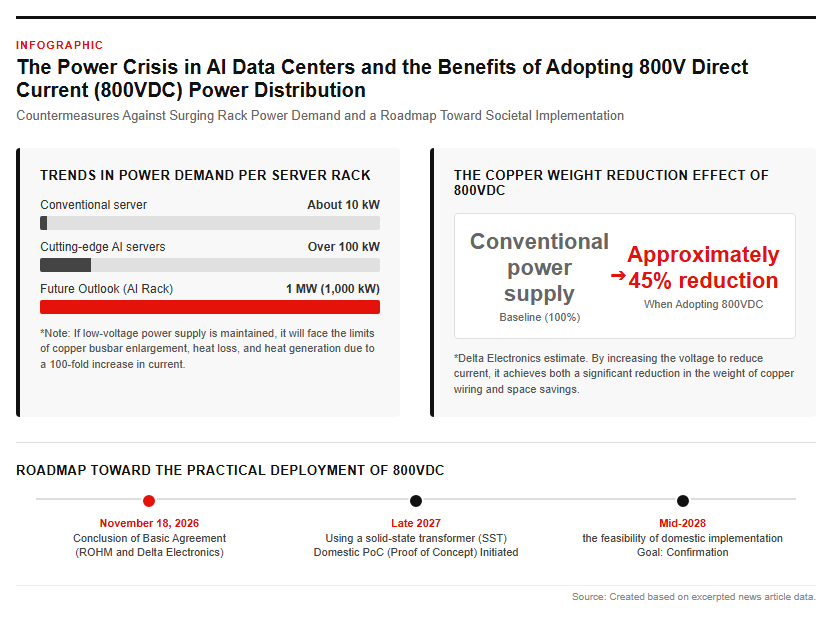
While the explosive adoption of generative AI has driven improvements in the computing performance of AI accelerators and GPUs, power consumption per server rack is soaring. While conventional server racks required around 10 kW of power, cutting-edge AI servers exceed 100 kW, and power demand is projected to reach 1 MW (1,000 kW) per rack in the future. Maintaining conventional low-voltage power supplies, such as 50V, would necessitate passing a massive amount of current to deliver power that has ballooned by a factor of 100. This creates severe physical bottlenecks, including oversized copper busbars, maximized heat loss and heat generation due to wiring resistance, and constraints on installation space. To address these challenges, the 800VDC architecture—which reduces current by supplying power at a high voltage of 800V close to the racks—is gaining traction as a solution. According to estimates by Delta Electronics, implementing 800VDC can reduce the weight of copper materials used for power wiring by approximately 45%.
Technical Approaches and Regulatory Hurdles
Coexistence of SiC, GaN, and Si and Power Architecture Optimization
To realize 800VDC power supply systems, the role of power semiconductors that convert and control high voltages with high efficiency is extremely crucial. ROHM comprehensively offers a variety of power devices—including silicon carbide (SiC), gallium nitride (GaN), and silicon (Si)—alongside gate drivers and control ICs. The company advocates a “coexistence” approach for power semiconductors tailored to each stage of power conversion. Its policy is to optimally place high-voltage SiC in SSTs and DC/DC conversion units that handle high voltages, GaN or Si MOSFETs inside racks requiring high-speed switching, and DrMOS or control ICs near AI accelerators. Meanwhile, Delta Electronics is developing the “From Grid to Chip” initiative, which handles everything consistently from the power grid to the chip. In the future, the company is also considering building a tri-brid power supply that reduces power grid loads by combining Battery Energy Storage Systems (BESS), Solid Oxide Fuel Cells (SOFC), and grid power. Please refer to the configuration image below.
Domestic Legal Regulation “The 750V Barrier” and the Roadmap for Demonstration Experiments
The biggest institutional barrier to advancing the societal implementation of 800VDC in Japan is domestic regulations. Under Japan’s Technical Standards for Electrical Facilities (Article 2 of the Ministerial Ordinance), the upper limit for low-voltage DC is set at 750V (600V for AC), and 800VDC is legally classified as “high voltage.” In major overseas countries such as the United States, Europe, South Korea, and China, up to 1500V DC is treated as low voltage. Consequently, introducing global-standard 800V equipment into Japan as-is would result in strict restrictions regarding wiring work, clearance distances, and maintenance operations. For this reason, the two companies will jointly conduct educational and awareness-raising activities—not only developing semiconductors and devices, but also communicating the necessity, safety, and implementation benefits of 800VDC to relevant ministries, agencies, and the market. They plan to conduct repeated verification through a domestic PoC using SST starting in the latter half of 2027, confirm implementation feasibility within 2028, and aim for full-scale domestic adoption over a timeframe of approximately five years.
Revamping the Development Structure and the Future of Sustainable Infrastructure
Addressing Shorter Development Cycles and Decarbonizing Manufacturing Sites
Rapid changes in the generative AI market are bringing dramatic shifts to the product development processes for power supply systems as well. While conventional power supply system development typically allowed for a development cycle of around two years, applications for AI servers increasingly demand support for next-generation products in an extremely short timeframe of roughly six months. Since conventional contract-based development cannot keep up with this pace, the two companies will share market, customer, and technology roadmap information from the early stages to establish a framework for proactively developing reference designs and products. ROHM aims to achieve 100 billion yen or more in AI server-related sales by fiscal 2030, positioning this collaboration as a pillar of its growth. Furthermore, the agreement includes leveraging Delta Electronics’ ESG consulting and energy-saving technologies to optimize energy use and promote decarbonization at ROHM’s semiconductor manufacturing facilities.
Future Developments and Key Points to Watch in Next-Generation AI Infrastructure
The collaboration between the two companies goes beyond high-power solutions for AI data centers, aiming for technology ripple effects across a broad range of industrial fields in the future. In addition to integrally advancing high-efficiency power supply and energy optimization at manufacturing sites, they also envision future technology deployment into fields such as edge data centers supporting physical AI, robotics, and autonomous driving. By fusing ROHM’s strong development capabilities in power and analog semiconductors with Delta Electronics’ superior power system building expertise from an early stage, they aim to meet the development speed demanded by the market. Trends toward the relaxation of domestic regulations and the development of operational guidelines, along with the results of domestic verification experiments scheduled for 2027, will be critical focal points that determine the competitiveness of Japan’s next-generation digital infrastructure.
Reference page
- [ROHM Co., Ltd. News Release: Delta Electronics and ROHM Strengthen Collaboration to Solve Power Challenges in AI Data Centers] https://www.rohm.co.jp/news-detail?news-title=2026-11-18_news_delta&defaultGroupId=false
- [Delta Electronics Japan Official Website] https://www.delta-japan.jp/
【#ROHM #DeltaElectronics #AIDataCenter #800VDC #PowerSemiconductors #SiC #GaN #Decarbonization】

コメント