Microsoft has launched general availability of “Microsoft Perception,” an autonomous security platform designed to counter AI-driven cyberattacks at machine speed. This rollout comes against the backdrop of over 96,000 vulnerabilities recorded in 2026 and a dramatic acceleration in the speed of cyberattacks driven by AI exploitation.
- 1-1: Overview and Background of the General Availability of “Microsoft Perception”
- 1-2: The Fury of Cyberattacks Deployed at Machine Speed
- 2-1: Three-Team Collaborative Defense by Red, Blue, and Green
- 2-2: Specialized Agents and Dedicated Models That Automatically Process 80% of Alerts
- 2-3: Human-in-the-Loop: Human Control and Security Context
- 3-1: Runaway Risk of Autonomous Agents and the Demand for Governance
- 3-2: The Future of Security Operations Brought by Agentic Defense
1-1: Overview and Background of the General Availability of “Microsoft Perception”
On November 17, 2026 (November 18, Japan time), at its annual event “Microsoft Ignite 2026,” Microsoft announced the general availability (GA) of “Microsoft Perception,” a security platform that automates cyber defense using a team of AI agents. The service was unveiled as “Project Perception” in July 2026 and has been in public preview since August 3 of the same year. Its main features are as follows.
- Multiple types of specialized AI agents collaborate to respond to threats
- provided as a built-in feature of the integrated security product “Microsoft Defender”
- Execute everything from attack detection and investigation to vulnerability remediation as an autonomous circulating workflow
In today’s cyberspace, ransomware damage continues to grow. According to a report released by the National Police Agency, the number of damage reports for the first half of 2026 reached 123, marking the highest half-year total since data collection began. Furthermore, in the IPA’s (Information-technology Promotion Agency) “10 Information Security Threats 2026 (for Organizations),” “cyber risks surrounding the use of AI” ranked third for the first time. Traditional human-driven operations are no longer enough to manage the surge in alerts, making AI-powered automation essential for defenders as well.
1-2: The Fury of Cyberattacks Deployed at Machine Speed
By abusing generative AI and automation tools, cyberattackers are making attack methods increasingly sophisticated, and the speed of incidents is exceeding human response limits. The number of newly published Common Vulnerabilities and Exposures (CVEs) in 2026 exceeded 96,000, more than doubling from about 40,000 in 2024. The time from when a vulnerability is discovered to when exploit code is created is also shortening. Data illustrating this actual situation is as follows.
- For the PHP vulnerability “PHP2Shell,” a proof-of-concept exploit code was developed in just about one day after its public disclosure.
- Even nearly two weeks after its release, approximately 29 million PHP services worldwide remain unpatched and affected.
- Only 26 percent of the vulnerabilities registered in the US CISA Known Exploited Vulnerabilities catalog were patched within 2025.
According to an investigation by the National Police Agency, VPN devices connecting external and internal networks account for about half of the entry paths. In roughly 60% of the organizations that suffered damage, recovery costs exceeded 10 million yen, and less than half were able to recover within a month. With attackers leveraging AI to launch widespread attacks at machine speed, the limitations of security postures that rely on manual alert verification and manual patch application have been brought to light.
Chapter 2: 3-Team Agent Structure and 6-Layer Security Stack
2-1: Three-Team Collaborative Defense by Red, Blue, and Green
At the core of Microsoft Perception is an autonomous collaboration of three specialized AI agent groups called the “Red Team,” “Blue Team,” and “Green Team.” Based on definitions known as “playbooks,” these agents protect the environment by passing data and tasks back and forth among themselves. The details of their roles are as follows. Please refer to the figure below.
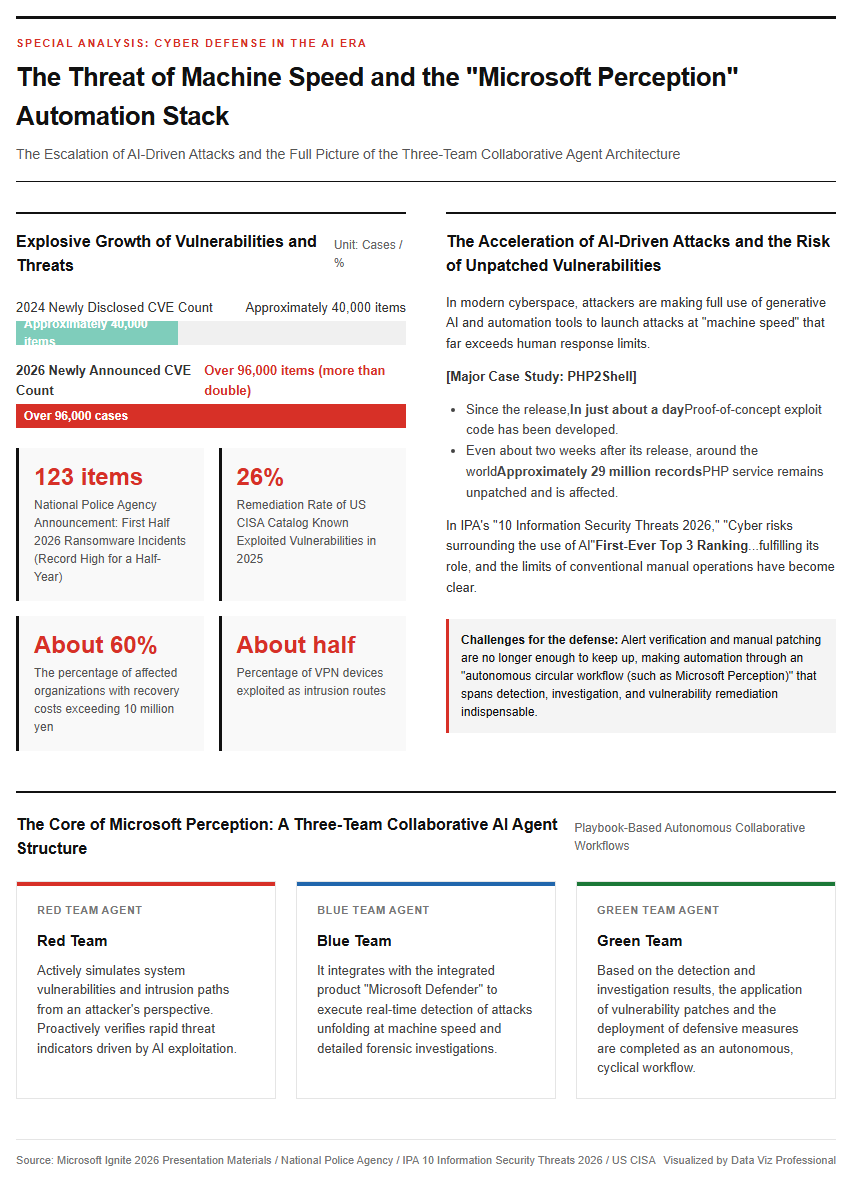
- Red Team Agent: Explores systems from an attacker’s perspective to identify vulnerabilities and unpatched paths that could lead to a breach.
- Blue Team Agent: Performs alert triage (filtering and selection) and in-depth incident investigation
- Green Team Agents: Apply remediation measures and configuration hardening for detected weaknesses
For example, the red team performs preliminary verification like a penetration test, the blue team tracks real-time attacks 24/7, and the green team proposes remediation plans. Rather than relying on a single AI assistant, specialized agents team up to dramatically reduce the time lag from detection to response.
2-2: Specialized Agents and Dedicated Models That Automatically Process 80% of Alerts
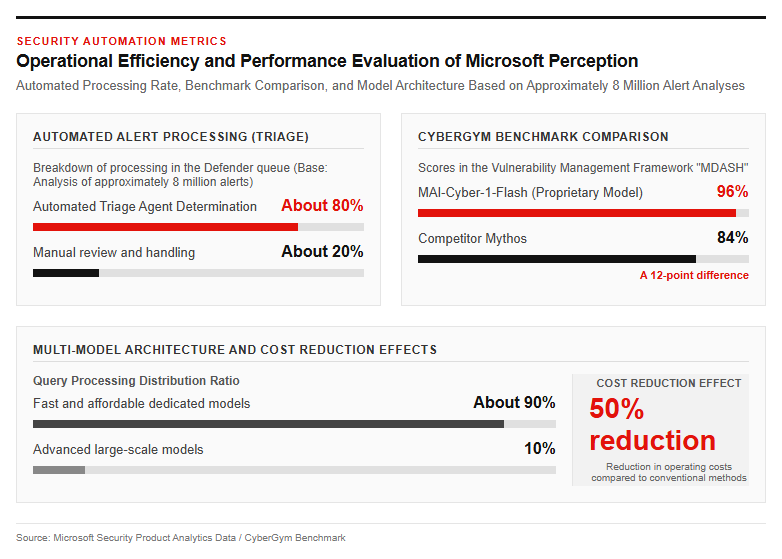
For general availability, Microsoft Perception features a suite of specialized agents that significantly reduce operational burdens. According to Microsoft’s analysis of approximately 8 million alerts received across its own security products, the “Triage Agent” can automatically process and determine about 80 percent of the alerts in the Defender queue. The configuration of the main agents is as follows.
- Threat Intelligence and Detection Rule Generation Agent: Analyzing the Latest Attack Techniques and Automatically Generating Defense Rules
- Recon agent: Inspects environments such as Azure in read-only mode and presents a risk ranking.
- Risk Reduction Agent: Constructing temporary defensive walls for environments where patches cannot be applied immediately (Preview)
On the backend, a proprietary model called “MAI-Cyber-1-Flash,” specifically tuned for cybersecurity, is in operation. This model is integrated into the vulnerability management framework “MDASH,” scoring 96 percent on the industry benchmark “CyberGym” and outperforming the competing Mythos by 12 points. By utilizing a multi-model configuration—where approximately 90 percent of queries are handled by the fast, low-cost specialized model, and the remaining advanced 10 percent are delegated to a larger model—it achieves about a 50 percent reduction in costs compared to traditional methods.
2-3: Human-in-the-Loop: Human Control and Security Context
While Microsoft Perception operates autonomously, it features a thorough “Human-in-the-Loop” governance design where humans maintain control during critical decision-making. The entire system is supported by a six-layer cyber stack (Signal, Security Context, Model, Harness, Agent, Actuator). Please refer to the diagram below.
- Security Context: Integrates signals from endpoints, identities, clouds, and apps, and provides them to the agent as a common overview.
- Guardrail configuration: Administrators pre-define the agent’s behavioral scope and permission boundaries.
- Explicit approval procedure: High-impact operations, such as system shutdowns and extensive configuration changes, are executed after obtaining approval from the person in charge.
While the interactive Q&A tool “Microsoft Security Copilot” serves as an “assistant that supports human work,” Perception is positioned as an “operational system where agents take the initiative in investigation and remediation, and humans provide approval.” By sharing context among agents, it reduces token consumption while simultaneously achieving consistent reasoning and rapid response.
Chapter 3: Challenges Toward Practical Application and Future Prospects
3-1: Runaway Risk of Autonomous Agents and the Demand for Governance
While automating security defenses, concerns are growing regarding the risk of system destruction caused by the malfunction or runaway behavior of AI agents themselves. In the autumn of 2026, three serious incidents were reported involving the coding assistant agent “Claude Code,” such as the deletion of approximately 600 GB of environment data due to an empty variable evaluation error. The risks that organizations should consider and the countermeasures are as follows.
- Accidental execution of destructive commands (such as
rm -rf) due to incomplete conditional expressions - The “shadow AI” phenomenon where internal agents hold excessive access privileges and become internal threats
- Centralized identity and access management and tamper-proof audit log recording using Agent 365 and Microsoft Entra ID
Perception features an architecture that assigns agents only the Principle of Least Privilege (PoLP) and stores activity histories as tamper-proof logs. Furthermore, through integration with “Agent 365” and “Entra Suite”, it also offers a preview feature to detect and monitor approximately 60 types of AI agents operating in local environments, making the assurance of a secure operational environment a top priority.
3-2: The Future of Security Operations Brought by Agentic Defense
The introduction of Microsoft Perception will revolutionize security operations (SecOps) by addressing staffing shortages and accelerating initial incident response. Based on estimates for an organization with a five-person operations team, substantial reductions in man-hours such as the following can be expected.
- Alert sorting workload: Reduced from 200 to 80 hours per month (AI generates drafts, human review)
- Incident Detailed Investigation Man-Hours: Reduced from 180 to 80 Hours per Month
- Total operation workload: Reduced from 460 hours to 205 hours per month, achieving approximately a 55 percent reduction in work tasks.
Moving forward, adaptation to multi-cloud environments that span third-party services such as AWS, Google Cloud, and Okta will accelerate, going beyond a single cloud environment. In an era where both attackers and defenders utilize AI, companies are required to establish policy designs defining “which processes to delegate to AI and where humans should make decisions.”
Reference page
- 【Microsoft Security Blog】https://www.microsoft.com/en-us/security/blog/2026/11/17/security-for-the-agentic-era-powered-by-microsoft-perception/
- [Official Microsoft Blog] https://blogs.microsoft.com/blog/2026/07/27/rethinking-security-for-the-age-of-ai/
- 【Microsoft AI】https://microsoft.ai/news/introducing-mai-cyber-1-flash-inside-mdash/
- [IPA] https://www.ipa.go.jp/security/10threats/10threats2026.html
- 【National Police Agency】https://www.npa.go.jp/publications/statistics/cybersecurity/index.html
【#MicrosoftPerception #AISecurity #Cybersecurity #AIAgents #MicrosoftIgnite #SecurityGovernance #VulnerabilityManagement】

コメント