Related ministries and agencies, including the Financial Services Agency and the Ministry of Finance, have requested financial institutions across the country to facilitate smooth cash flow for small and medium-sized enterprises (SMEs) and small businesses, as well as to provide hands-on management support, ahead of the year-end and fiscal year-end periods when funding demand typically rises. As the business environment becomes increasingly challenging due to rising prices and labor shortages, alongside the impacts of the Middle East situation and the 2026 Kumamoto Earthquake, there is a strong demand for support to prevent business bankruptcies and drive growth.
- [Background of the Government Request] A challenging business environment compounded by soaring prices, labor shortages, and disasters
- [Specific Request Details] Modification of existing debt terms and prompt, flexible financing
- [Support for Kumamoto Earthquake Victims and Specific Businesses] Specific Measures for Rebuilding Lives and Livelihoods
- [Preparing for Consumption Tax Cuts and the Abolition of Promissory Notes] Cash Flow Defense Measures to Adapt to Structural Changes
- [Regional Future Financial Action Plan and Turnaround M&A]: Shift to “Growth-Oriented Turnaround”
- [Actions Small and Medium-Sized Enterprise Owners Should Take] Early Financial Assessment and Expert Collaboration
[Background of the Government Request] A challenging business environment compounded by soaring prices, labor shortages, and disasters
On November 19, 2026, the Financial Services Agency (FSA) and other related ministries and agencies simultaneously issued a request document to financial institutions and related organizations nationwide, urging thorough cash-flow support and financial facilitation for small and medium-sized enterprises (SMEs) and small-scale business operators. This request was jointly issued by five cabinet ministers: Minister of State and Acting Prime Minister Minoru Kihara, Minister of Finance and Minister in charge of Financial Services Satsuki Katayama, as well as the Minister of Health, Labour and Welfare, the Minister of Agriculture, Forestry and Fisheries, and the Minister of Economy, Trade and Industry.
The background to the government’s decision to make such a large-scale request lies in the rapidly deteriorating business environment surrounding SMEs. In addition to ongoing structural challenges such as prolonged high prices and labor shortages, the impact of escalating tensions in the Middle East and a succession of natural disasters, including the 2026 Kumamoto earthquake, have dealt severe blows.
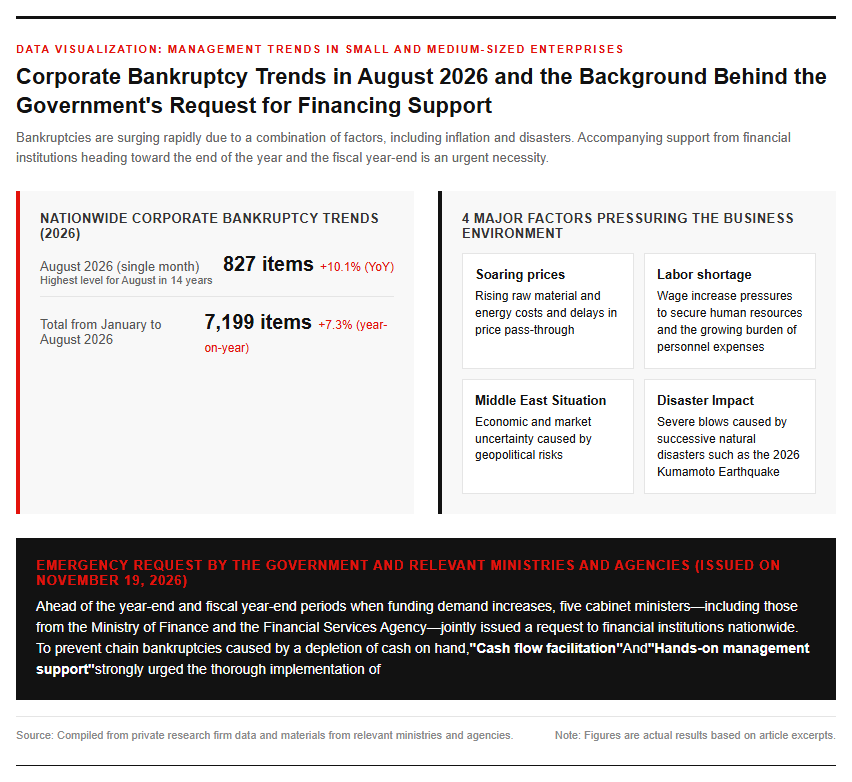
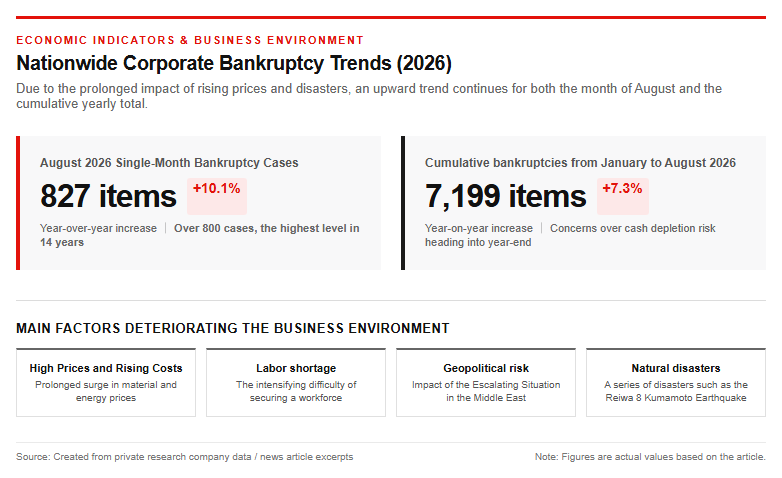
In fact, according to data from a private research company, the number of corporate bankruptcies nationwide in August 2026 reached 827, a 10.1% increase compared to the same month last year. This is the highest level for the month of August in 14 years, exceeding 800 cases, and the cumulative number of bankruptcies since January 2026 has also increased by 7.3% year-on-year to 7,199 cases. From the end of the year through the end of the fiscal year, when funding demand peaks for the year, it is an urgent task to prevent chain bankruptcies and the abandonment of business operations due to the depletion of cash on hand.
The following figure is an image showing recent trends in corporate bankruptcies and changes in the business environment.
[Specific Request Details] Modification of existing debt terms and prompt, flexible financing
The requests announced this time call upon financial institutions to fulfill their financial intermediary functions more actively than ever to ensure that no significant disruptions occur in year-end and fiscal year-end cash flows. Specifically, strict instructions were given to continue providing prompt and flexible responses tailored to the circumstances of businesses applying for grace periods, condition changes (rescheduling), or refinancing regarding existing debts accumulated during the recovery process from the COVID-19 pandemic. Regarding lending decisions, financial institutions are strictly prohibited from mechanically and rigidly rejecting applications solely based on current financial statements showing deficits, negative net worth, or past borrowing history. They are mandated to comprehensively evaluate the business characteristics of enterprises, their potential for future improvement, and the prospects for applying various government and municipal support measures, thereby offering thorough consultation services that lead to business improvement. Furthermore, institutions are requested to provide attentive, hands-on support without discrimination to all businesses—not only existing primary clients, but also those with whom new relationships began through COVID-19 zero-interest, unsecured loans, regardless of whether the financing is proprietary or credit-guaranteed. In terms of fundraising, the use of various systems is recommended, including the “Cooperative Support Type Special Guarantee,” the “Business Capability Strengthening Guarantee,” and a new “Monitoring Guarantee” that reduces guarantee fees on the condition of regular monitoring by financial institutions.
[Deepening Key Measures] Support measures covering everything from disaster recovery to institutional changes
[Support for Kumamoto Earthquake Victims and Specific Businesses] Specific Measures for Rebuilding Lives and Livelihoods
The request document also places strong emphasis on detailed relief measures for businesses and individuals affected by natural disasters in various regions. In particular, based on the “Package for Supporting Disaster Victims’ Daily Lives and Livelihoods,” business reconstruction and the restoration of living foundations in the disaster-affected areas of the Reiwa 8 Kumamoto Earthquake are positioned as the top priority. For individuals and sole proprietors, guidance is provided to apply the “Guidelines for Debt Adjustment for Disaster Victims” and swiftly advance procedures for the exemption or reduction of debts such as mortgages. For business operators, a system is being established to prevent any interruption in necessary working capital by making full use of “Safety Net Guarantee No. 4,” the Japan Finance Corporation’s “Disaster Recovery Loans,” and the “Agriculture, Forestry and Fisheries Safety Net Funds.” Furthermore, the Kumamoto Industrial Reconstruction Consultation Center—established as a consultation desk for affected businesses—and SME Revitalization Councils will cooperate to resolve double-loan issues and support the formulation of business rehabilitation plans. In addition, the policy is to strongly support the reconstruction of the entire region from a financial perspective by utilizing the “Reiwa 8 Kumamoto Earthquake Reconstruction Support Fund (tentative name),” which is being jointly established by the Regional Economy Vitalization Corporation of Japan (REVIC) and the Organization for Small & Medium Enterprises and Regional Innovation, Japan (SME Support Japan) along with regional financial institutions. The figure below illustrates the multi-layered support framework for affected businesses.
[Preparing for Consumption Tax Cuts and the Abolition of Promissory Notes] Cash Flow Defense Measures to Adapt to Structural Changes
This request goes beyond short-term cash flow management, also encompassing proactive preparations for major upcoming institutional changes and environmental shifts. Regarding the planned temporary reduction of the consumption tax rate on food and beverages scheduled for FY2027 and FY2028, there are concerns about a decrease in sales tax revenue and a temporary worsening of cash flow for farmers, fishermen, food processors, and restaurant operators. Therefore, the request calls for flexible financing responses in advance. Furthermore, anticipating the revised laws and regulations taking effect on April 1, 2027, which will mandate “payments within 60 days” for manufacturing consignments and prohibit payment by promissory notes, it is explicitly stated that thorough support must be provided to ease the burden on businesses’ cash flow resulting from shortened payment terms. In addition, since paper promissory notes and checks will be completely abolished at clearinghouses on March 31, 2027, support for a smooth transition to electronic payment methods such as Densai (electronically recorded monetary claims) will be thoroughly enforced at the operational level. Regarding management guarantees, given that the ratio of unguaranteed loans in new lending by private financial institutions has risen to 55.7% (as of FY2025 results), reviews—including of existing guarantee contracts—and considerations for revising the “Guidelines on Management Guarantees” will be initiated.
[Future Outlook and Key Points to Watch] Growth-Oriented Turnaround and the Sustainability of Regional Finance
[Regional Future Financial Action Plan and Turnaround M&A]: Shift to “Growth-Oriented Turnaround”
As a long-term goal of financial administration, a strong push is underway to shift from conventional “life-prolonging support” through mere repayment deferrals to “growth-oriented turnaround,” which aims for drastic balance sheet improvement and enhanced earning capacity of businesses. Previous fact-finding surveys highlighted the challenge that fundamental revitalization is not progressing, with approximately 87% of businesses that received condition changes requesting continuous debt rescheduling, and companies for which 10 years or more have passed since their initial condition change accounting for 31%. In response, the Financial Services Agency and the Small and Medium Enterprise Agency are proceeding with the formulation of “Regional Future Finance Action Plans” that visualize the current state of regional and hands-on support for each prefecture, building a framework for regional financial institutions and support organizations to collaborate in a timely manner. In addition, for businesses that find it difficult to recover on their own due to excessive debt, the promotion of “turnaround M&A”—in which business operations or shares are transferred to a sponsor—is being encouraged to protect employee jobs, technology, and know-how. By utilizing the “Guidelines for the Smooth Execution of Turnaround M&A (tentative name)” and the “Business Succession and M&A Subsidies” currently being formulated by the Small and Medium Enterprise Agency, efforts are being made to guide businesses from early sign management to drastic revitalization with an eye toward an exit.
[Actions Small and Medium-Sized Enterprise Owners Should Take] Early Financial Assessment and Expert Collaboration
While support frameworks by governments and financial institutions are being expanded, SME owners themselves are also strongly urged to practice proactive financial management and take early action. Rather than rushing to financial institutions only after cash flow has reached an impasse, it is essential to accurately understand the company’s cash flow during normal times. Specific actions that management should take include, first, creating a “cash flow table” covering cash in, cash out, and loan repayments for the next three to six months, thereby visualizing the projected trend in cash and deposit balances. Second, they must improve gross profit margins, implement price pass-throughs, and review unprofitable businesses to transform into a financial structure that generates cash through core operations. Third, they should organize financial statements, trial balances, and repayment schedules, and consult with their partner financial institutions early if a cash shortage is a concern. If formulating a plan independently is difficult, it is important to actively utilize specialized institutions such as Certified Management Innovation Agencies, SME Revitalization Councils, or Yorozu Support Bases to create a persuasive business improvement plan and deepen relationships of trust with financial institutions.
Reference page
- [Financial Services Agency] Regarding the Promotion of Business Support and Facilitation of Finance https://www.fsa.go.jp/news/r8/ginkou/20261119-2/20261119-2.html
- [Financial Services Agency] Regarding Initiatives for Facilitating Finance and Thorough Business Support https://www.fsa.go.jp/news/r8/ginkou/20261119/yousei.html
【#FinancialServicesAgency #SMEsupport #SmoothFinancing #RegionalFinance #BusinessSupport #BusinessImprovement #FundRaising】

コメント