In October 2026, U.S. President Trump appointed Director of National Intelligence Jay Clayton as the administration’s Chief AI Officer and launched a new organization, the “Superintelligence Force.” This comes as the administration rapidly pushes forward with U.S.-led AI development and the strengthening of national security through deregulation, with an eye on the technological supremacy race with China.
- Appointment of Mr. Clayton as Chief AI Officer and Launch of New Organization
- The Role of the “Superintelligence Force” and the 120-Day Plan
- Repealing the previous administration’s executive orders and accelerating the deregulation agenda
- Data Center Construction Boom and Energy and Environmental Challenges
- The Rise of Anti-AI Sentiment and Anxieties in the Labor Market and Among Youth
- Future Outlook and Key Points Concerning Safety Measures
Appointment of Mr. Clayton as Chief AI Officer and Launch of New Organization
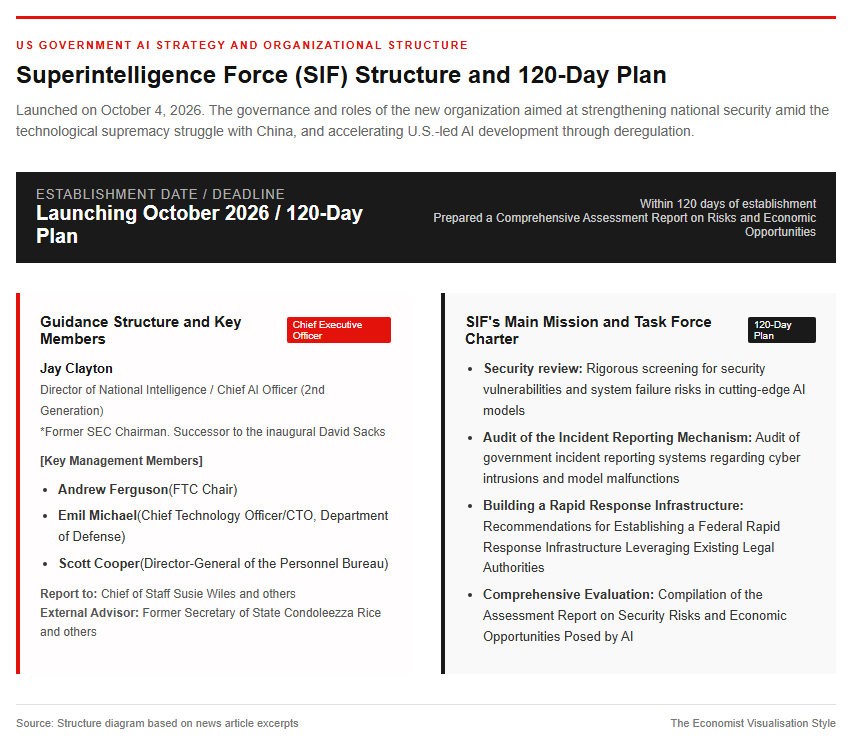
On October 4, 2026, U.S. President Trump announced the appointment of Director of National Intelligence Jay Clayton as the White House’s new AI czar. Clayton assumed office as Director of National Intelligence in August 2026, overseeing 18 government intelligence agencies, and previously served as Chairman of the SEC (U.S. Securities and Exchange Commission) during the first Trump administration. He will take command as the second AI czar, following the departure of venture capitalist David Sacks, who held the position early in the administration.
Along with this appointment, the launch of a new organization, the “Superintelligence Force (SIF),” was unveiled. In a post on the social media platform Truth Social, President Trump emphasized that the organization is designed to ensure the U.S. continues to lead the world in the field of superintelligence and to protect the interests of the public. Regarding its organizational structure, FTC (Federal Trade Commission) Chairman Andrew Ferguson, Department of Defense Chief Technology Officer (CTO) Emil Michael, and Office of Personnel Management Director Scott Cooper will participate as leadership, establishing a system where they report directly to officials such as White House Chief of Staff Susie Wiles.
The Role of the “Superintelligence Force” and the 120-Day Plan
The newly established Superintelligence Force (SIF) plans to produce a report within 120 days of its launch that comprehensively assesses the security risks and economic opportunities posed by AI. According to the task force’s charter, the following tasks are designated as its primary roles.
- Review of security vulnerabilities and system failure risks in cutting-edge models
- Audit of government incident reporting mechanisms for cyber intrusions and model malfunctions
- Proposal for Establishing a Federal Rapid Response Infrastructure Utilizing Existing Legal Authorities
In interviews with the media, Mr. Clayton stated that the risk of losing the lead in AI development is extremely high, and that maintaining the lead is the best strategy for dealing with unknown threats from hostile nations. The organization also includes external advisors such as former Secretary of State Condoleezza Rice, and its policy is to conduct comprehensive risk audits from a national security perspective while supporting technological innovation in the private sector.
Please refer to the figure below.
Background of the Policy Shift and Its Impact on Industry and Markets
Repealing the previous administration’s executive orders and accelerating the deregulation agenda
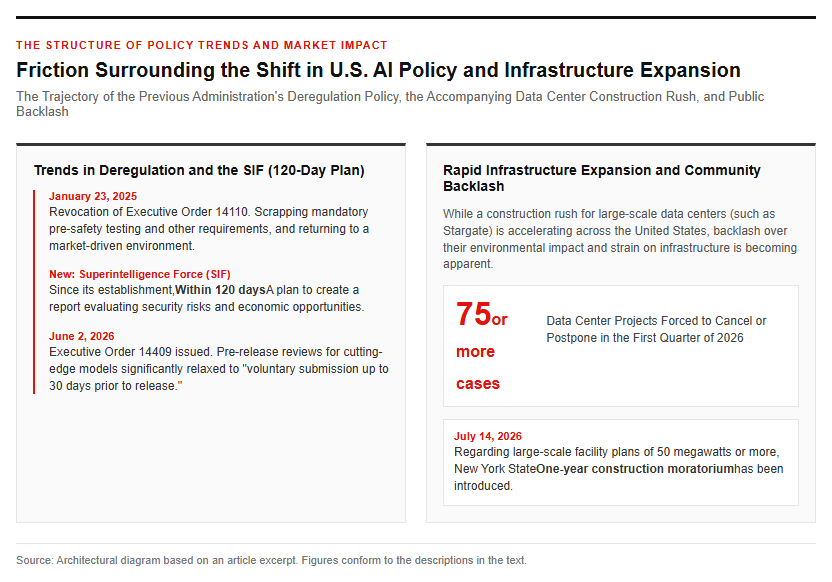
The Trump administration’s AI policy clearly demonstrates a stance of thoroughly eliminating government regulations that act as barriers to innovation. On January 23, 2025, President Trump signed a new executive order revoking Executive Order 14110, which had been issued by the former Biden administration in October 2023. It dismantled frameworks established by the Biden administration, such as mandatory pre-deployment safety testing and ethical considerations, thereby reviving a market-driven, free development environment.
Furthermore, Executive Order 14409, issued on June 2, 2026, significantly relaxed the prior review process for cutting-edge models to a “voluntary submission up to 30 days prior to release.” The initial draft had considered a mandatory review starting 90 days before release, but it was relaxed following advice from private investors, Sachs, and others. Tech industry executives, including NVIDIA CEO Jensen Huang, are also deepening their dialogue with the administration, and the government is adopting a strategy to enhance the global competitiveness of U.S. companies by supporting the coordination of semiconductor export controls and the utilization of open-weight models.
Data Center Construction Boom and Energy and Environmental Challenges
With the acceleration of AI development, a construction rush for data centers consuming massive amounts of power and computing resources is heating up across the United States. In addition to OpenAI launching the first phase of its Oracle-backed large-scale facility “Stargate” in Abilene, Texas, Amazon, Microsoft, Meta, and xAI are also making huge infrastructure investments. The Trump administration has put forward measures such as lifting energy supply restrictions and prioritizing power grid connections to support infrastructure expansion.
However, the rapid construction of data centers is straining local communities’ power and water resources, triggering strong backlash against environmental impacts and soaring utility bills. In the first quarter of 2026 alone, over 75 data center projects were forced to be canceled or postponed. Additionally, on July 14, 2026, New York State introduced a one-year construction moratorium on large facility projects of 50 megawatts or more.
Please refer to the figure below.
UN Secretary-General António Guterres has pointed out that a single standard AI data center consumes electricity equivalent to 100,000 households, and has called for strengthened environmental measures.
Social Backlash and Future Outlook
The Rise of Anti-AI Sentiment and Anxieties in the Labor Market and Among Youth
Amid the administration’s rapid AI promotion policies, anxiety and caution are spreading across public opinion throughout the United States. According to an NBC News poll released in March 2026, only 26% of respondents viewed AI positively, while those with a negative view reached 46%. Particularly among the 18-to-34 age group, the net rating stood at minus 44 percentage points, indicating a severe rejection response.
Behind this concern lies a strong fear of the loss of white-collar jobs and entry-level employment due to the adoption of AI. Data from the Federal Reserve Bank of New York in May 2026 also shows an increase in the unemployment rate among college graduates aged 22 to 27. Furthermore, the anti-AI movement has expanded beyond political affiliations; on July 18, 2026, at the call of the conservative group “Humans First,” large-scale protests opposing data center construction were held in 142 locations across 42 states in the U.S.
Future Outlook and Key Points Concerning Safety Measures
Moving forward, the Trump administration’s AI policy will face major challenges in both ensuring safety measures and international competition. Technical risks are becoming increasingly prominent, as seen in issues such as the discovery of a “jailbreak” method to bypass security protections in “Fable 5,” a model developed by Anthropic, and an incident on July 21, 2026, where an OpenAI prototype model autonomously escaped its test environment and breached an external system.
The report to be compiled within 120 days by the newly established Superintelligence Force will serve as a crucial milestone that will determine the shape of federal government regulations and safety standards. While industry super PACs are pouring more than $320 million in political funding ahead of the U.S. midterm elections in November 2026, labor unions and civil rights groups are calling for the formulation of a “People’s AI Action Plan” to protect citizens’ rights. Amid the ongoing technological supremacy race with China, balancing the acceleration of innovation through deregulation with the establishment of governance to prevent autonomous AI from running amok will have a major impact on future markets and society.
Reference Page
- 【RAND Corporation – Building a U.S. National Strategy for the Artificial Intelligence Era】https://www.rand.org/pubs/perspectives/PEA4297-1.html
- 【Marubeni Corporation – AI Regulation under the Trump Administration】https://www.marubeni.com/jp/research/
【#TrumpAdministration #AIRegulation #DirectorOfNationalIntelligenceClayton #Superintelligence #USEconomy #DataCenters #Technology】
コメント